

smartphones, which have become a part of the infrastructure of everyday life, into
consideration.
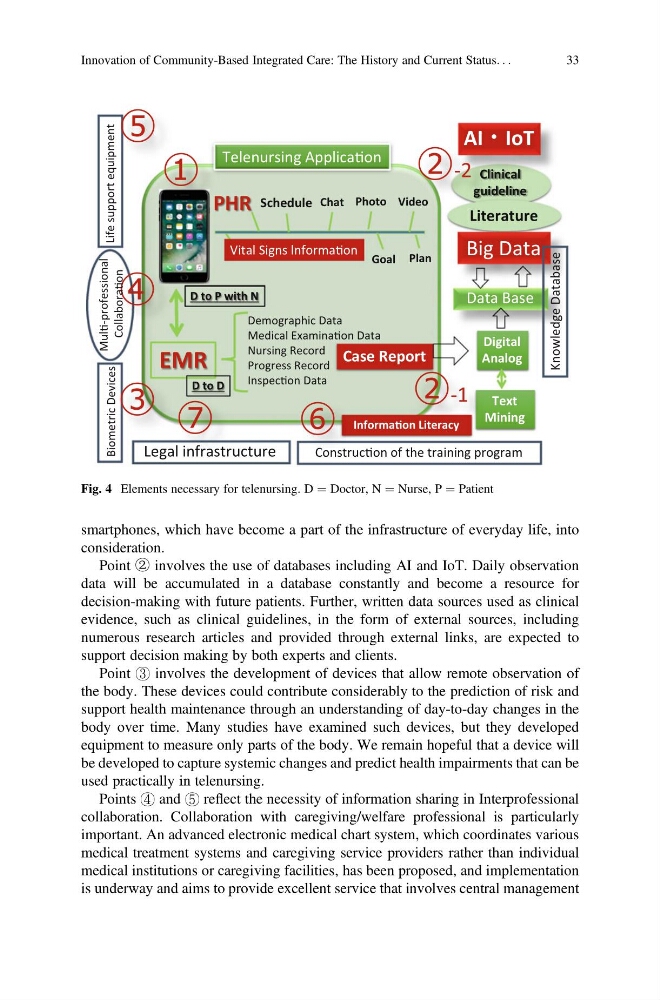
Point ② involves the use of databases including AI and IoT. Daily observation
data will be accumulated in a database constantly and become a resource for
decision-making with future patients. Further, written data sources used as clinical
evidence, such as clinical guidelines, in the form of external sources, including
numerous research articles and provided through external links, are expected to
support decision making by both experts and clients.
Point ③ involves the development of devices that allow remote observation of
the body. These devices could contribute considerably to the prediction of risk and
support health maintenance through an understanding of day-to-day changes in the
body over time. Many studies have examined such devices, but they developed
equipment to measure only parts of the body. We remain hopeful that a device will
be developed to capture systemic changes and predict health impairments that can be
used practically in telenursing.
Points ④ and ⑤ reflect the necessity of information sharing in Interprofessional
collaboration. Collaboration with caregiving/welfare professional is particularly
important. An advanced electronic medical chart system, which coordinates various
medical treatment systems and caregiving service providers rather than individual
medical institutions or caregiving facilities, has been proposed, and implementation
is underway and aims to provide excellent service that involves central management
Literature
EMR
Digital
Analog
Data Base
Goal Plan
Photo
PHR
Case Report
Text
Mining
Big Data
Schedule
InformaƟon Literacy
Clinical
guideline
ConstrucƟon of the training program
⋇
⋈-1
⋋
⋌
⋈-2
⋍
⋉
⋊
Demographic Data
Medical ExaminaƟon Data
Nursing Record
Progress Record
InspecƟon Data
Vital Signs lnformaƟon
Telenursing ApplicaƟon
AIIoT
Legal infrastructure
Video
Chat
Life support equipment
Biometric Devices
MulƟ-professional
CollaboraƟon
Knowledge Database
D to P with N
D to D
Fig. 4 Elements necessary for telenursing. D ¼ Doctor, N ¼ Nurse, P ¼ Patient
Innovation of Community-Based Integrated Care: The History and Current Status. . .
33
consideration.
Point ② involves the use of databases including AI and IoT. Daily observation
data will be accumulated in a database constantly and become a resource for
decision-making with future patients. Further, written data sources used as clinical
evidence, such as clinical guidelines, in the form of external sources, including
numerous research articles and provided through external links, are expected to
support decision making by both experts and clients.
Point ③ involves the development of devices that allow remote observation of
the body. These devices could contribute considerably to the prediction of risk and
support health maintenance through an understanding of day-to-day changes in the
body over time. Many studies have examined such devices, but they developed
equipment to measure only parts of the body. We remain hopeful that a device will
be developed to capture systemic changes and predict health impairments that can be
used practically in telenursing.
Points ④ and ⑤ reflect the necessity of information sharing in Interprofessional
collaboration. Collaboration with caregiving/welfare professional is particularly
important. An advanced electronic medical chart system, which coordinates various
medical treatment systems and caregiving service providers rather than individual
medical institutions or caregiving facilities, has been proposed, and implementation
is underway and aims to provide excellent service that involves central management
Literature
EMR
Digital
Analog
Data Base
Goal Plan
Photo
PHR
Case Report
Text
Mining
Big Data
Schedule
InformaƟon Literacy
Clinical
guideline
ConstrucƟon of the training program
⋇
⋈-1
⋋
⋌
⋈-2
⋍
⋉
⋊
Demographic Data
Medical ExaminaƟon Data
Nursing Record
Progress Record
InspecƟon Data
Vital Signs lnformaƟon
Telenursing ApplicaƟon
AIIoT
Legal infrastructure
Video
Chat
Life support equipment
Biometric Devices
MulƟ-professional
CollaboraƟon
Knowledge Database
D to P with N
D to D
Fig. 4 Elements necessary for telenursing. D ¼ Doctor, N ¼ Nurse, P ¼ Patient
Innovation of Community-Based Integrated Care: The History and Current Status. . .
33