

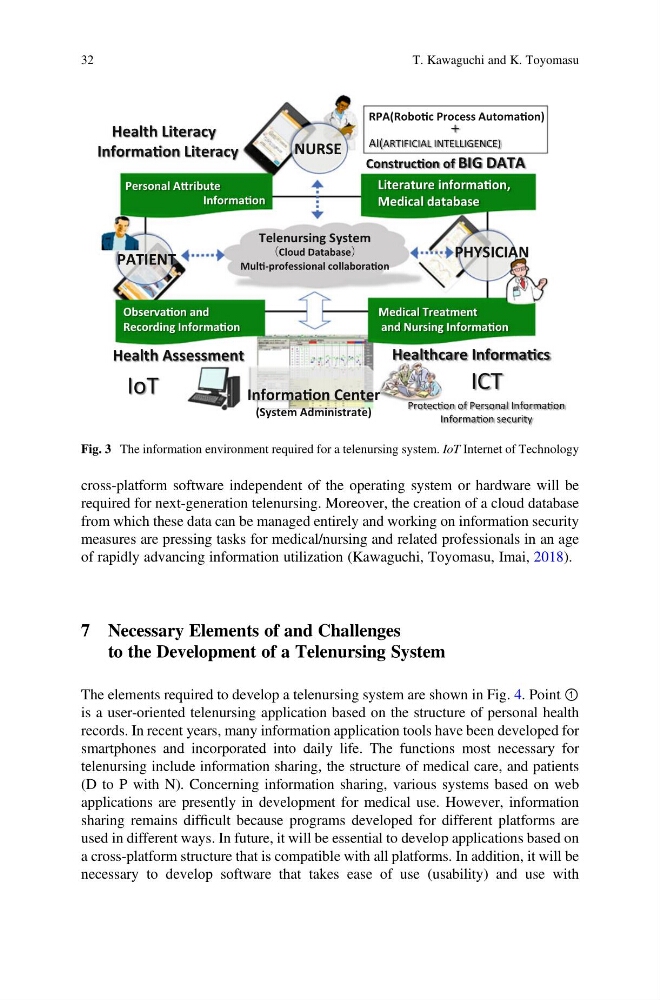
cross-platform software independent of the operating system or hardware will be
required for next-generation telenursing. Moreover, the creation of a cloud database
from which these data can be managed entirely and working on information security
measures are pressing tasks for medical/nursing and related professionals in an age
of rapidly advancing information utilization (Kawaguchi, Toyomasu, Imai, 2018).
7 Necessary Elements of and Challenges
to the Development of a Telenursing System
The elements required to develop a telenursing system are shown in Fig. 4. Point ①
is a user-oriented telenursing application based on the structure of personal health
records. In recent years, many information application tools have been developed for
smartphones and incorporated into daily life. The functions most necessary for
telenursing include information sharing, the structure of medical care, and patients
(D to P with N). Concerning information sharing, various systems based on web
applications are presently in development for medical use. However, information
sharing remains difficult because programs developed for different platforms are
used in different ways. In future, it will be essential to develop applications based on
a cross-platform structure that is compatible with all platforms. In addition, it will be
necessary to develop software that takes ease of use (usability) and use with
NURSE
PATIENT
PHYSICIAN
InformaƟon Center
(System Administrate)
Medical Treatment
and Nursing InformaƟon
Literature informaƟon,
Medical database
Telenursing System
Cloud Database
MulƟ-professional collaboraƟon
ٔ
AI(ARTIFICIAL INTELLIGENCE)
IoT
ICT
ProtecƟon of Personal InformaƟon
InformaƟon security
Health Assessment
Healthcare InformaƟcs
Health Literacy
ConstrucƟon of BIG DATA
Personal AƩribute
InformaƟon
ObservaƟon and
Recording InformaƟon
RPA(RoboƟc Process AutomaƟon)
InformaƟon Literacy
Fig. 3 The information environment required for a telenursing system. IoT Internet of Technology
32
T. Kawaguchi and K. Toyomasu
required for next-generation telenursing. Moreover, the creation of a cloud database
from which these data can be managed entirely and working on information security
measures are pressing tasks for medical/nursing and related professionals in an age
of rapidly advancing information utilization (Kawaguchi, Toyomasu, Imai, 2018).
7 Necessary Elements of and Challenges
to the Development of a Telenursing System
The elements required to develop a telenursing system are shown in Fig. 4. Point ①
is a user-oriented telenursing application based on the structure of personal health
records. In recent years, many information application tools have been developed for
smartphones and incorporated into daily life. The functions most necessary for
telenursing include information sharing, the structure of medical care, and patients
(D to P with N). Concerning information sharing, various systems based on web
applications are presently in development for medical use. However, information
sharing remains difficult because programs developed for different platforms are
used in different ways. In future, it will be essential to develop applications based on
a cross-platform structure that is compatible with all platforms. In addition, it will be
necessary to develop software that takes ease of use (usability) and use with
NURSE
PATIENT
PHYSICIAN
InformaƟon Center
(System Administrate)
Medical Treatment
and Nursing InformaƟon
Literature informaƟon,
Medical database
Telenursing System
Cloud Database
MulƟ-professional collaboraƟon
ٔ
AI(ARTIFICIAL INTELLIGENCE)
IoT
ICT
ProtecƟon of Personal InformaƟon
InformaƟon security
Health Assessment
Healthcare InformaƟcs
Health Literacy
ConstrucƟon of BIG DATA
Personal AƩribute
InformaƟon
ObservaƟon and
Recording InformaƟon
RPA(RoboƟc Process AutomaƟon)
InformaƟon Literacy
Fig. 3 The information environment required for a telenursing system. IoT Internet of Technology
32
T. Kawaguchi and K. Toyomasu