

In other words, it is almost the day when AI takes on a new combination on behalf
of humans. However, the essence of this innovation in the traditional “medical
informatics” has not been discussed extensively. This book focuses on innovationoriented health information, as manifested in the subtitle, translating information
into innovation. However, it differs greatly from the conventional book in that this
book approaches health informatics from the perspective of translational systems
science.
The features of translational systems science are the following eight points.
Innovation-oriented health informatics and the related many practice cases are best
seen through the lens of translational systems science.
3.1 Three Types of Knowledge—Episteme, Techne,
and Phronesis—Coevolve in a Cyclic Translationality
in Micro-, Meso-, and Macro-Spheres
Translational systems science focuses on cross-border flows of knowledge. Knowledge is information that has been interpreted and made meaningful. The exchange of
information is fundamental. Innovation-oriented medical informatics also focuses on
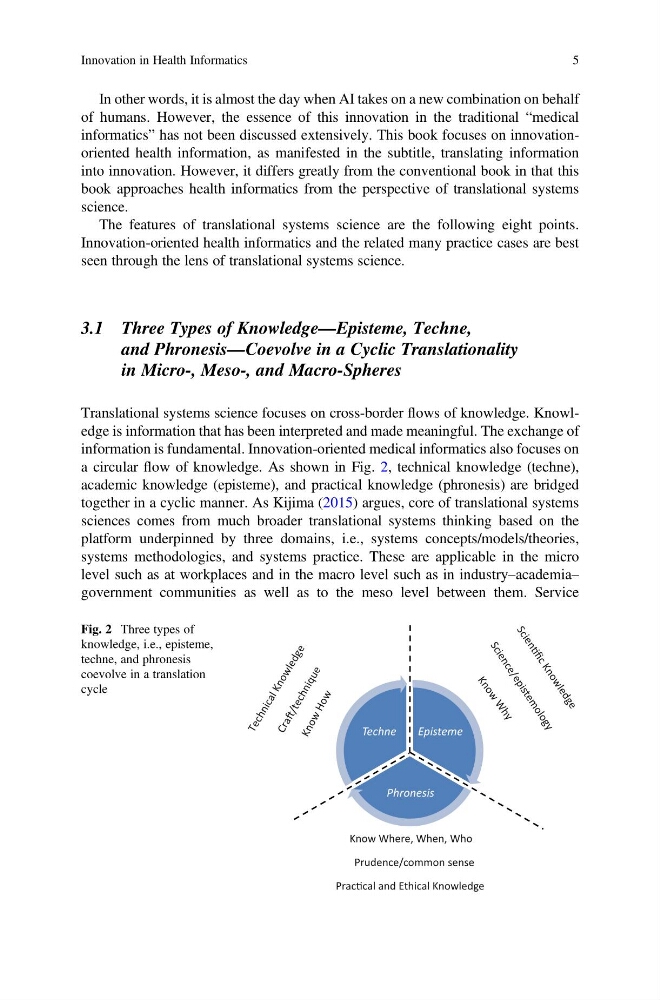
a circular flow of knowledge. As shown in Fig. 2, technical knowledge (techne),
academic knowledge (episteme), and practical knowledge (phronesis) are bridged
together in a cyclic manner. As Kijima (2015) argues, core of translational systems
sciences comes from much broader translational systems thinking based on the
platform underpinned by three domains, i.e., systems concepts/models/theories,
systems methodologies, and systems practice. These are applicable in the micro
level such as at workplaces and in the macro level such as in industry–academia–
government communities as well as to the meso level between them. Service
PracƟcal and Ethical Knowledge
Know Where, When, Who
Episteme
Phronesis
Techne
Prudence/common sense
S
c
ie
n
Ɵ
fi
c
K
n
o
w
le
d
g
e
T e c h n ic a l K n o w le d g e
K n o w H o w
K
n
o
w
W
h
y
C r a Ō / t e c h n iq u e
S
c
ie
n
c
e
/
e
p
is
t
e
m
o
lo
g
y
Fig. 2 Three types of
knowledge, i.e., episteme,
techne, and phronesis
coevolve in a translation
cycle
Innovation in Health Informatics
5
of humans. However, the essence of this innovation in the traditional “medical
informatics” has not been discussed extensively. This book focuses on innovationoriented health information, as manifested in the subtitle, translating information
into innovation. However, it differs greatly from the conventional book in that this
book approaches health informatics from the perspective of translational systems
science.
The features of translational systems science are the following eight points.
Innovation-oriented health informatics and the related many practice cases are best
seen through the lens of translational systems science.
3.1 Three Types of Knowledge—Episteme, Techne,
and Phronesis—Coevolve in a Cyclic Translationality
in Micro-, Meso-, and Macro-Spheres
Translational systems science focuses on cross-border flows of knowledge. Knowledge is information that has been interpreted and made meaningful. The exchange of
information is fundamental. Innovation-oriented medical informatics also focuses on
a circular flow of knowledge. As shown in Fig. 2, technical knowledge (techne),
academic knowledge (episteme), and practical knowledge (phronesis) are bridged
together in a cyclic manner. As Kijima (2015) argues, core of translational systems
sciences comes from much broader translational systems thinking based on the
platform underpinned by three domains, i.e., systems concepts/models/theories,
systems methodologies, and systems practice. These are applicable in the micro
level such as at workplaces and in the macro level such as in industry–academia–
government communities as well as to the meso level between them. Service
PracƟcal and Ethical Knowledge
Know Where, When, Who
Episteme
Phronesis
Techne
Prudence/common sense
S
c
ie
n
Ɵ
fi
c
K
n
o
w
le
d
g
e
T e c h n ic a l K n o w le d g e
K n o w H o w
K
n
o
w
W
h
y
C r a Ō / t e c h n iq u e
S
c
ie
n
c
e
/
e
p
is
t
e
m
o
lo
g
y
Fig. 2 Three types of
knowledge, i.e., episteme,
techne, and phronesis
coevolve in a translation
cycle
Innovation in Health Informatics
5