

3 “The Long-Term Care Insurance System”
and “Community-Based Integrated Care System”
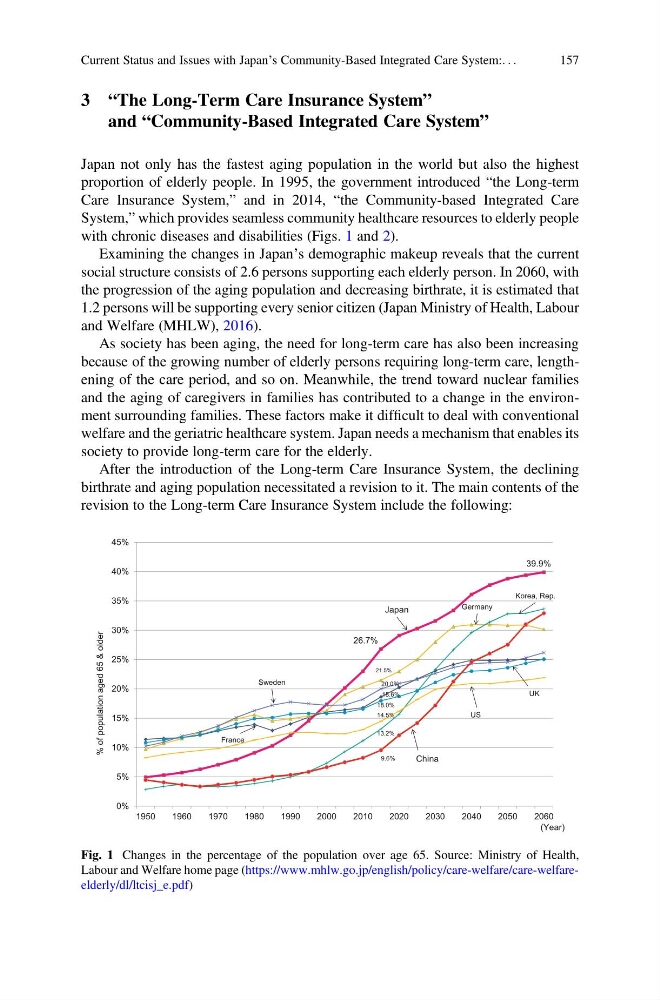
Japan not only has the fastest aging population in the world but also the highest
proportion of elderly people. In 1995, the government introduced “the Long-term
Care Insurance System,” and in 2014, “the Community-based Integrated Care
System,” which provides seamless community healthcare resources to elderly people
with chronic diseases and disabilities (Figs. 1 and 2).
Examining the changes in Japan’s demographic makeup reveals that the current
social structure consists of 2.6 persons supporting each elderly person. In 2060, with
the progression of the aging population and decreasing birthrate, it is estimated that
1.2 persons will be supporting every senior citizen (Japan Ministry of Health, Labour
and Welfare (MHLW), 2016).
As society has been aging, the need for long-term care has also been increasing
because of the growing number of elderly persons requiring long-term care, lengthening of the care period, and so on. Meanwhile, the trend toward nuclear families
and the aging of caregivers in families has contributed to a change in the environment surrounding families. These factors make it difficult to deal with conventional
welfare and the geriatric healthcare system. Japan needs a mechanism that enables its
society to provide long-term care for the elderly.
After the introduction of the Long-term Care Insurance System, the declining
birthrate and aging population necessitated a revision to it. The main contents of the
revision to the Long-term Care Insurance System include the following:
26.7%
39.9%
18.6%
21.5%
18.0%
20.0%
13.2%
14.5%
9.6%
0%
5%
10%
15%
20%
25%
30%
35%
40%
45%
1950
1960
1970
1980
1990
2000
2010
2020
2030
2040
2050
2060
(Year)
Japan
Germany
Korea, Rep.
France
Sweden
UK
US
China
% of population aged 65 & older
Fig. 1 Changes in the percentage of the population over age 65. Source: Ministry of Health,
Labour and Welfare home page (https://www.mhlw.go.jp/english/policy/care-welfare/care-welfareelderly/dl/ltcisj_e.pdf)
Current Status and Issues with Japan’s Community-Based Integrated Care System:. . .
157
and “Community-Based Integrated Care System”
Japan not only has the fastest aging population in the world but also the highest
proportion of elderly people. In 1995, the government introduced “the Long-term
Care Insurance System,” and in 2014, “the Community-based Integrated Care
System,” which provides seamless community healthcare resources to elderly people
with chronic diseases and disabilities (Figs. 1 and 2).
Examining the changes in Japan’s demographic makeup reveals that the current
social structure consists of 2.6 persons supporting each elderly person. In 2060, with
the progression of the aging population and decreasing birthrate, it is estimated that
1.2 persons will be supporting every senior citizen (Japan Ministry of Health, Labour
and Welfare (MHLW), 2016).
As society has been aging, the need for long-term care has also been increasing
because of the growing number of elderly persons requiring long-term care, lengthening of the care period, and so on. Meanwhile, the trend toward nuclear families
and the aging of caregivers in families has contributed to a change in the environment surrounding families. These factors make it difficult to deal with conventional
welfare and the geriatric healthcare system. Japan needs a mechanism that enables its
society to provide long-term care for the elderly.
After the introduction of the Long-term Care Insurance System, the declining
birthrate and aging population necessitated a revision to it. The main contents of the
revision to the Long-term Care Insurance System include the following:
26.7%
39.9%
18.6%
21.5%
18.0%
20.0%
13.2%
14.5%
9.6%
0%
5%
10%
15%
20%
25%
30%
35%
40%
45%
1950
1960
1970
1980
1990
2000
2010
2020
2030
2040
2050
2060
(Year)
Japan
Germany
Korea, Rep.
France
Sweden
UK
US
China
% of population aged 65 & older
Fig. 1 Changes in the percentage of the population over age 65. Source: Ministry of Health,
Labour and Welfare home page (https://www.mhlw.go.jp/english/policy/care-welfare/care-welfareelderly/dl/ltcisj_e.pdf)
Current Status and Issues with Japan’s Community-Based Integrated Care System:. . .
157