

clinical efficiency for doctors, transactional efficiency for firm managers, and clinical
outcomes for patients.
Technological innovations are shaped not only by firm’s history and R&D
intensity but also by changes in the public knowledge base triggered by social
changes (Williams & Edge, 1996). These changes, often driven by both technology
development and new clinical applications, adopted by the masses may be such that
the technological foundations of businesses shift dramatically. This may cause the
technological knowledge base to converge or diverge. In our medical imaging case,
the development of 16-row detector CTs did support the noninvasive CT cardiac
imaging procedure by medical lead users in late 2000 (Sablayrolles, 2002), helping
the global medical imaging industry to now advocate CT cardiac imaging as a
noninvasive routine exam for high-risk patients.
Expanding to a broader range of patients (e.g., low-risk patient, every person), we
rapidly face societal challenges such as aging population and more multiple chronic
disease burden. For more than two decades, now, electronic health records (EHRs)/
electronic medical records (EMRs) solutions aim to improve the relevance of the
diagnosis while increasing the efficiency of the therapy from multiple real-time data
sources coming from various actors/systems (devices, IT, clinical inputs. . .) in the
acute care setting.
(Co-definition)
Service
Co-development
Co-development and co-elevation
Co-experience and co-definition
(relation focused)
(entity focused)
Co-elevation
Co-experience
Shared Internal
model
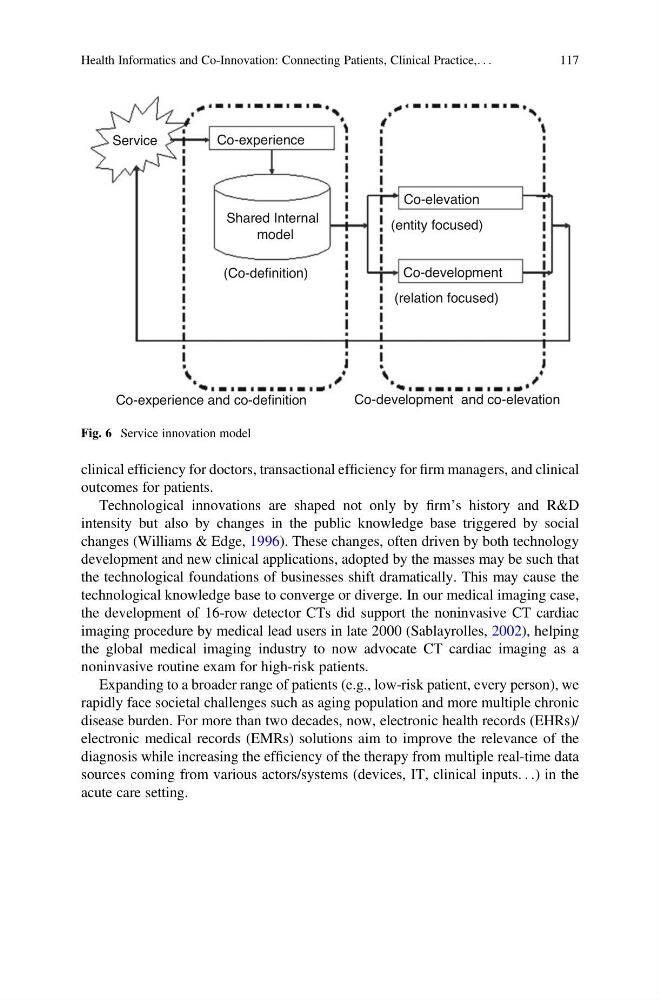
Fig. 6 Service innovation model
Health Informatics and Co-Innovation: Connecting Patients, Clinical Practice,. . .
117
outcomes for patients.
Technological innovations are shaped not only by firm’s history and R&D
intensity but also by changes in the public knowledge base triggered by social
changes (Williams & Edge, 1996). These changes, often driven by both technology
development and new clinical applications, adopted by the masses may be such that
the technological foundations of businesses shift dramatically. This may cause the
technological knowledge base to converge or diverge. In our medical imaging case,
the development of 16-row detector CTs did support the noninvasive CT cardiac
imaging procedure by medical lead users in late 2000 (Sablayrolles, 2002), helping
the global medical imaging industry to now advocate CT cardiac imaging as a
noninvasive routine exam for high-risk patients.
Expanding to a broader range of patients (e.g., low-risk patient, every person), we
rapidly face societal challenges such as aging population and more multiple chronic
disease burden. For more than two decades, now, electronic health records (EHRs)/
electronic medical records (EMRs) solutions aim to improve the relevance of the
diagnosis while increasing the efficiency of the therapy from multiple real-time data
sources coming from various actors/systems (devices, IT, clinical inputs. . .) in the
acute care setting.
(Co-definition)
Service
Co-development
Co-development and co-elevation
Co-experience and co-definition
(relation focused)
(entity focused)
Co-elevation
Co-experience
Shared Internal
model
Fig. 6 Service innovation model
Health Informatics and Co-Innovation: Connecting Patients, Clinical Practice,. . .
117