

74
3 Advanced Technologies (Biological and Thermochemical) …
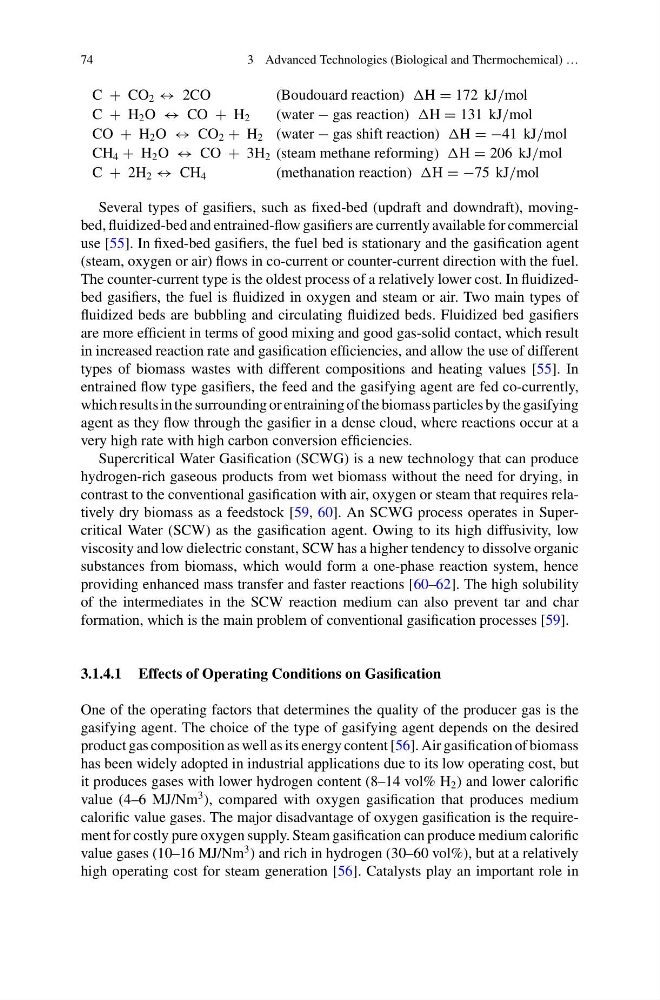
C + CO 2 ↔ 2CO
(Boudouard reaction) H = 172 kJ/mol
C + H 2 O ↔ CO + H 2
(water − gas reaction) H = 131 kJ/mol
CO + H 2 O ↔ CO 2 + H 2 (water − gas shift reaction) H = −41 kJ/mol
CH 4 + H 2 O ↔ CO + 3H 2 (steam methane reforming) H = 206 kJ/mol
C + 2H 2 ↔ CH 4
(methanation reaction) H = −75 kJ/mol
Several types of gasifiers, such as fixed-bed (updraft and downdraft), movingbed, fluidized-bed and entrained-flow gasifiers are currently available for commercial
use [55]. In fixed-bed gasifiers, the fuel bed is stationary and the gasification agent
(steam, oxygen or air) flows in co-current or counter-current direction with the fuel.
The counter-current type is the oldest process of a relatively lower cost. In fluidizedbed gasifiers, the fuel is fluidized in oxygen and steam or air. Two main types of
fluidized beds are bubbling and circulating fluidized beds. Fluidized bed gasifiers
are more efficient in terms of good mixing and good gas-solid contact, which result
in increased reaction rate and gasification efficiencies, and allow the use of different
types of biomass wastes with different compositions and heating values [55]. In
entrained flow type gasifiers, the feed and the gasifying agent are fed co-currently,
which results in the surrounding or entraining of the biomass particles by the gasifying
agent as they flow through the gasifier in a dense cloud, where reactions occur at a
very high rate with high carbon conversion efficiencies.
Supercritical Water Gasification (SCWG) is a new technology that can produce
hydrogen-rich gaseous products from wet biomass without the need for drying, in
contrast to the conventional gasification with air, oxygen or steam that requires relatively dry biomass as a feedstock [59, 60]. An SCWG process operates in Supercritical Water (SCW) as the gasification agent. Owing to its high diffusivity, low
viscosity and low dielectric constant, SCW has a higher tendency to dissolve organic
substances from biomass, which would form a one-phase reaction system, hence
providing enhanced mass transfer and faster reactions [60–62]. The high solubility
of the intermediates in the SCW reaction medium can also prevent tar and char
formation, which is the main problem of conventional gasification processes [59].
3.1.4.1 Effects of Operating Conditions on Gasification
One of the operating factors that determines the quality of the producer gas is the
gasifying agent. The choice of the type of gasifying agent depends on the desired
product gas composition as well as its energy content [56]. Air gasification of biomass
has been widely adopted in industrial applications due to its low operating cost, but
it produces gases with lower hydrogen content (8–14 vol% H 2 ) and lower calorific
value (4–6 MJ/Nm
3 ), compared with oxygen gasification that produces medium
calorific value gases. The major disadvantage of oxygen gasification is the requirement for costly pure oxygen supply. Steam gasification can produce medium calorific
value gases (10–16 MJ/Nm
3 ) and rich in hydrogen (30–60 vol%), but at a relatively
high operating cost for steam generation [56]. Catalysts play an important role in
3 Advanced Technologies (Biological and Thermochemical) …
C + CO 2 ↔ 2CO
(Boudouard reaction) H = 172 kJ/mol
C + H 2 O ↔ CO + H 2
(water − gas reaction) H = 131 kJ/mol
CO + H 2 O ↔ CO 2 + H 2 (water − gas shift reaction) H = −41 kJ/mol
CH 4 + H 2 O ↔ CO + 3H 2 (steam methane reforming) H = 206 kJ/mol
C + 2H 2 ↔ CH 4
(methanation reaction) H = −75 kJ/mol
Several types of gasifiers, such as fixed-bed (updraft and downdraft), movingbed, fluidized-bed and entrained-flow gasifiers are currently available for commercial
use [55]. In fixed-bed gasifiers, the fuel bed is stationary and the gasification agent
(steam, oxygen or air) flows in co-current or counter-current direction with the fuel.
The counter-current type is the oldest process of a relatively lower cost. In fluidizedbed gasifiers, the fuel is fluidized in oxygen and steam or air. Two main types of
fluidized beds are bubbling and circulating fluidized beds. Fluidized bed gasifiers
are more efficient in terms of good mixing and good gas-solid contact, which result
in increased reaction rate and gasification efficiencies, and allow the use of different
types of biomass wastes with different compositions and heating values [55]. In
entrained flow type gasifiers, the feed and the gasifying agent are fed co-currently,
which results in the surrounding or entraining of the biomass particles by the gasifying
agent as they flow through the gasifier in a dense cloud, where reactions occur at a
very high rate with high carbon conversion efficiencies.
Supercritical Water Gasification (SCWG) is a new technology that can produce
hydrogen-rich gaseous products from wet biomass without the need for drying, in
contrast to the conventional gasification with air, oxygen or steam that requires relatively dry biomass as a feedstock [59, 60]. An SCWG process operates in Supercritical Water (SCW) as the gasification agent. Owing to its high diffusivity, low
viscosity and low dielectric constant, SCW has a higher tendency to dissolve organic
substances from biomass, which would form a one-phase reaction system, hence
providing enhanced mass transfer and faster reactions [60–62]. The high solubility
of the intermediates in the SCW reaction medium can also prevent tar and char
formation, which is the main problem of conventional gasification processes [59].
3.1.4.1 Effects of Operating Conditions on Gasification
One of the operating factors that determines the quality of the producer gas is the
gasifying agent. The choice of the type of gasifying agent depends on the desired
product gas composition as well as its energy content [56]. Air gasification of biomass
has been widely adopted in industrial applications due to its low operating cost, but
it produces gases with lower hydrogen content (8–14 vol% H 2 ) and lower calorific
value (4–6 MJ/Nm
3 ), compared with oxygen gasification that produces medium
calorific value gases. The major disadvantage of oxygen gasification is the requirement for costly pure oxygen supply. Steam gasification can produce medium calorific
value gases (10–16 MJ/Nm
3 ) and rich in hydrogen (30–60 vol%), but at a relatively
high operating cost for steam generation [56]. Catalysts play an important role in