

38
2 Conventional Approaches for Waste Management …
and refinery waste, as well as MSW. This type of incinerators consists of two-stage
combustion chambers: the primary chamber or rotary kiln chamber and the secondary
chamber. Waste is batch fed or screw fed to the rotating kiln chamber where it is
partially combusted at 850 °C for approximately 30 min, followed by complete
combustion at the stationary secondary chamber at 1000–1200 °C with a retention
time of few seconds. Rotary kiln incinerators have relatively high operating and
maintenance costs. In addition, the destruction of the seals of the rotary unit at high
temperatures could cause leakage problems, leading to poor combustion and energy
recovery performance. The capacities of rotary kiln incinerators vary between 10–50
tonnes per day [19].
Solid recovered fuel systems: Solid recovered fuel (SRF) system is a technology
to produce fuel from pre-processing of various types of non-hazardous solid waste
such as MSW, industrial waste or commercial waste. SRF is also referred to as refusederived fuel (RDF) and can be utilized as a substitute for some conventional fossil
fuels such as coal. Pre-processing includes drying, removal of non-combustibles,
materials containing metals, organics and recyclables in order to improve the combustion characteristics of the SRF/RDF. The SRF particles are then pelletized for easier
transportation and storage. SRF has been used in Europe and the USA for electricity
generation or in heat-intensive industrial applications such as cement manufacturing,
but by far, there is no facility in Canada using SRF derived from MSW [19].
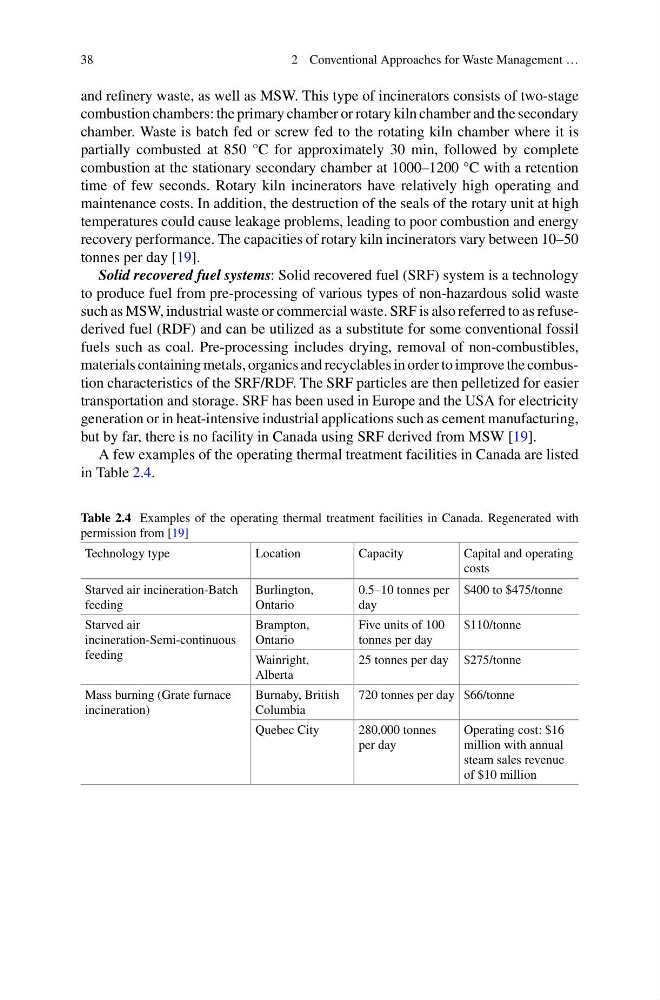
A few examples of the operating thermal treatment facilities in Canada are listed
in Table 2.4.
Table 2.4 Examples of the operating thermal treatment facilities in Canada. Regenerated with
permission from [19]
Technology type
Location
Capacity
Capital and operating
costs
Starved air incineration-Batch
feeding
Burlington,
Ontario
0.5–10 tonnes per
day
$400 to $475/tonne
Starved air
incineration-Semi-continuous
feeding
Brampton,
Ontario
Five units of 100
tonnes per day
$110/tonne
Wainright,
Alberta
25 tonnes per day $275/tonne
Mass burning (Grate furnace
incineration)
Burnaby, British
Columbia
720 tonnes per day $66/tonne
Quebec City
280,000 tonnes
per day
Operating cost: $16
million with annual
steam sales revenue
of $10 million
2 Conventional Approaches for Waste Management …
and refinery waste, as well as MSW. This type of incinerators consists of two-stage
combustion chambers: the primary chamber or rotary kiln chamber and the secondary
chamber. Waste is batch fed or screw fed to the rotating kiln chamber where it is
partially combusted at 850 °C for approximately 30 min, followed by complete
combustion at the stationary secondary chamber at 1000–1200 °C with a retention
time of few seconds. Rotary kiln incinerators have relatively high operating and
maintenance costs. In addition, the destruction of the seals of the rotary unit at high
temperatures could cause leakage problems, leading to poor combustion and energy
recovery performance. The capacities of rotary kiln incinerators vary between 10–50
tonnes per day [19].
Solid recovered fuel systems: Solid recovered fuel (SRF) system is a technology
to produce fuel from pre-processing of various types of non-hazardous solid waste
such as MSW, industrial waste or commercial waste. SRF is also referred to as refusederived fuel (RDF) and can be utilized as a substitute for some conventional fossil
fuels such as coal. Pre-processing includes drying, removal of non-combustibles,
materials containing metals, organics and recyclables in order to improve the combustion characteristics of the SRF/RDF. The SRF particles are then pelletized for easier
transportation and storage. SRF has been used in Europe and the USA for electricity
generation or in heat-intensive industrial applications such as cement manufacturing,
but by far, there is no facility in Canada using SRF derived from MSW [19].
A few examples of the operating thermal treatment facilities in Canada are listed
in Table 2.4.
Table 2.4 Examples of the operating thermal treatment facilities in Canada. Regenerated with
permission from [19]
Technology type
Location
Capacity
Capital and operating
costs
Starved air incineration-Batch
feeding
Burlington,
Ontario
0.5–10 tonnes per
day
$400 to $475/tonne
Starved air
incineration-Semi-continuous
feeding
Brampton,
Ontario
Five units of 100
tonnes per day
$110/tonne
Wainright,
Alberta
25 tonnes per day $275/tonne
Mass burning (Grate furnace
incineration)
Burnaby, British
Columbia
720 tonnes per day $66/tonne
Quebec City
280,000 tonnes
per day
Operating cost: $16
million with annual
steam sales revenue
of $10 million