

1.3 Waste Management Strategies
11
(a) Upstream waste prevention at the manufacturing level. Strategies for waste
prevention include source reduction by increasing source efficiency and minimizing
raw material input, improving eco-friendly designs for products and packaging, reorganizing production processes by using the waste of one industry as a valued input
to another (industrial ecology approach), transferring additional waste management
responsibilities to producers and consumers, and developing and implementing the
ISO 14,001 strategy [7, 28].
(b) Consumer or commercial/institutional-level waste prevention. It includes
educating and informing consumers about reuse and waste reduction, taking initiatives to limit purchases of disposable products and encourage consumers to buy materials made from recovered or reused items, implementing bulk-purchasing policies
and paper usage reduction policies for institutional and commercial sectors [7, 28].
Strategy 2: Waste diversion (recycling and composting)
Waste diversion refers to recycling and composting without energy recovery. From
2000 to 2010 in Canada, the total amount of waste diverted to recycling and
composted increased by 33% from 6.1 million tonnes to 8.1 million tonnes [7]. Strategies for waste diversion include increasing the opportunity for reuse and recycling,
increasing the effectiveness of the existing recycling programs, targeting specific
materials and waste streams for reusing, recycling and diversion and targeting specific
sectors to improve diversion rates [28]. For instance, there are different recycling and
composting programs Canada-wide for various waste streams: Packaging and Printed
Paper (PPP), beverage containers, paper, plastic bags, electronic products, household hazardous and special wastes (consumer batteries, aerosols, solvents, mercurycontaining lamps, paint, pharmaceuticals and sharps), automotive products (used
oils, containers and filters, glycerol, end-of-life tires and lead-acid batteries).
Composting is another option for diversion and refers to the biodegradation of
organic waste such as food waste, manure, leave, crop residue, etc., into a valuable
organic fertilizer. The composting rate of the organics (food and yard waste) in
Canada increased markedly by 125% from 0.98 million tonnes in 2000 to 2.2 million
tonnes in 2010 partially due to limited landfill space [7].
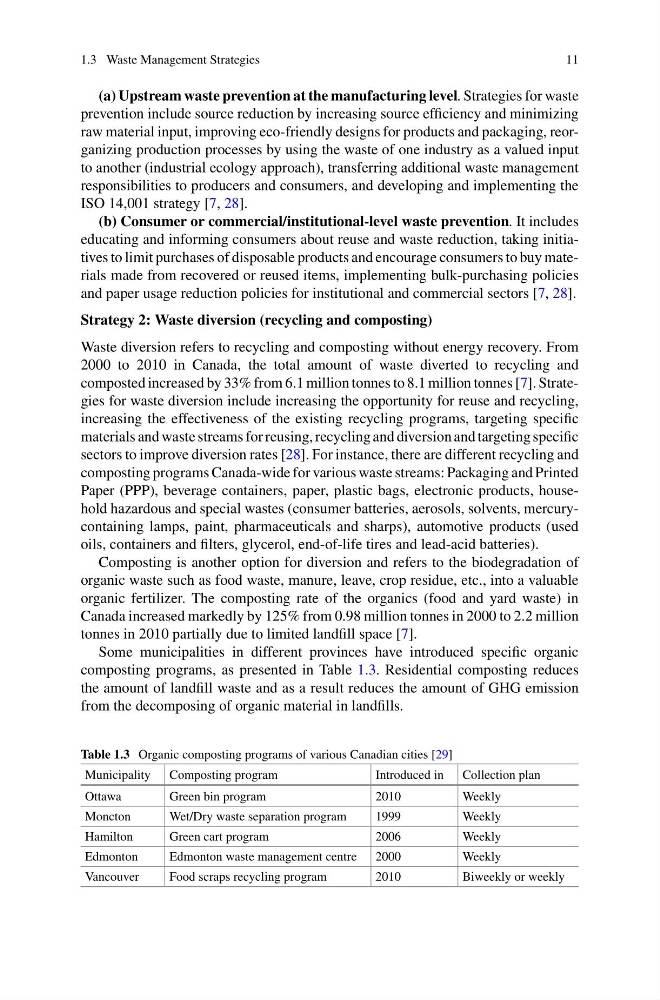
Some municipalities in different provinces have introduced specific organic
composting programs, as presented in Table 1.3. Residential composting reduces
the amount of landfill waste and as a result reduces the amount of GHG emission
from the decomposing of organic material in landfills.
Table 1.3 Organic composting programs of various Canadian cities [29]
Municipality Composting program
Introduced in Collection plan
Ottawa
Green bin program
2010
Weekly
Moncton
Wet/Dry waste separation program
1999
Weekly
Hamilton
Green cart program
2006
Weekly
Edmonton
Edmonton waste management centre 2000
Weekly
Vancouver
Food scraps recycling program
2010
Biweekly or weekly
11
(a) Upstream waste prevention at the manufacturing level. Strategies for waste
prevention include source reduction by increasing source efficiency and minimizing
raw material input, improving eco-friendly designs for products and packaging, reorganizing production processes by using the waste of one industry as a valued input
to another (industrial ecology approach), transferring additional waste management
responsibilities to producers and consumers, and developing and implementing the
ISO 14,001 strategy [7, 28].
(b) Consumer or commercial/institutional-level waste prevention. It includes
educating and informing consumers about reuse and waste reduction, taking initiatives to limit purchases of disposable products and encourage consumers to buy materials made from recovered or reused items, implementing bulk-purchasing policies
and paper usage reduction policies for institutional and commercial sectors [7, 28].
Strategy 2: Waste diversion (recycling and composting)
Waste diversion refers to recycling and composting without energy recovery. From
2000 to 2010 in Canada, the total amount of waste diverted to recycling and
composted increased by 33% from 6.1 million tonnes to 8.1 million tonnes [7]. Strategies for waste diversion include increasing the opportunity for reuse and recycling,
increasing the effectiveness of the existing recycling programs, targeting specific
materials and waste streams for reusing, recycling and diversion and targeting specific
sectors to improve diversion rates [28]. For instance, there are different recycling and
composting programs Canada-wide for various waste streams: Packaging and Printed
Paper (PPP), beverage containers, paper, plastic bags, electronic products, household hazardous and special wastes (consumer batteries, aerosols, solvents, mercurycontaining lamps, paint, pharmaceuticals and sharps), automotive products (used
oils, containers and filters, glycerol, end-of-life tires and lead-acid batteries).
Composting is another option for diversion and refers to the biodegradation of
organic waste such as food waste, manure, leave, crop residue, etc., into a valuable
organic fertilizer. The composting rate of the organics (food and yard waste) in
Canada increased markedly by 125% from 0.98 million tonnes in 2000 to 2.2 million
tonnes in 2010 partially due to limited landfill space [7].
Some municipalities in different provinces have introduced specific organic
composting programs, as presented in Table 1.3. Residential composting reduces
the amount of landfill waste and as a result reduces the amount of GHG emission
from the decomposing of organic material in landfills.
Table 1.3 Organic composting programs of various Canadian cities [29]
Municipality Composting program
Introduced in Collection plan
Ottawa
Green bin program
2010
Weekly
Moncton
Wet/Dry waste separation program
1999
Weekly
Hamilton
Green cart program
2006
Weekly
Edmonton
Edmonton waste management centre 2000
Weekly
Vancouver
Food scraps recycling program
2010
Biweekly or weekly