

196
7 Resource Utilization of Agricultural/Forestry Residues …
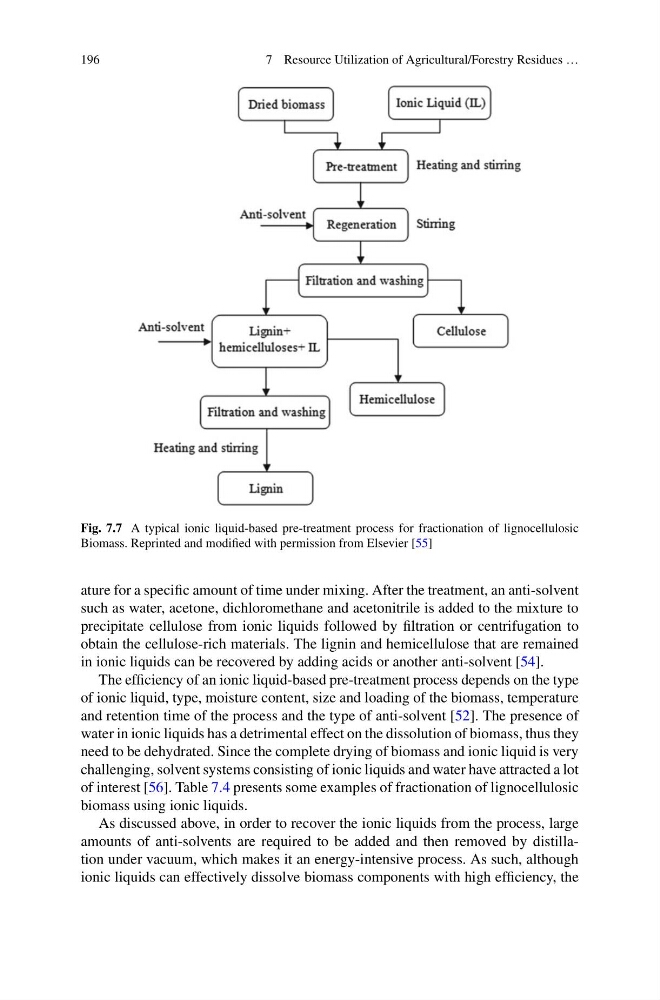
Fig. 7.7 A typical ionic liquid-based pre-treatment process for fractionation of lignocellulosic
Biomass. Reprinted and modified with permission from Elsevier [55]
ature for a specific amount of time under mixing. After the treatment, an anti-solvent
such as water, acetone, dichloromethane and acetonitrile is added to the mixture to
precipitate cellulose from ionic liquids followed by filtration or centrifugation to
obtain the cellulose-rich materials. The lignin and hemicellulose that are remained
in ionic liquids can be recovered by adding acids or another anti-solvent [54].
The efficiency of an ionic liquid-based pre-treatment process depends on the type
of ionic liquid, type, moisture content, size and loading of the biomass, temperature
and retention time of the process and the type of anti-solvent [52]. The presence of
water in ionic liquids has a detrimental effect on the dissolution of biomass, thus they
need to be dehydrated. Since the complete drying of biomass and ionic liquid is very
challenging, solvent systems consisting of ionic liquids and water have attracted a lot
of interest [56]. Table 7.4 presents some examples of fractionation of lignocellulosic
biomass using ionic liquids.
As discussed above, in order to recover the ionic liquids from the process, large
amounts of anti-solvents are required to be added and then removed by distillation under vacuum, which makes it an energy-intensive process. As such, although
ionic liquids can effectively dissolve biomass components with high efficiency, the
7 Resource Utilization of Agricultural/Forestry Residues …
Fig. 7.7 A typical ionic liquid-based pre-treatment process for fractionation of lignocellulosic
Biomass. Reprinted and modified with permission from Elsevier [55]
ature for a specific amount of time under mixing. After the treatment, an anti-solvent
such as water, acetone, dichloromethane and acetonitrile is added to the mixture to
precipitate cellulose from ionic liquids followed by filtration or centrifugation to
obtain the cellulose-rich materials. The lignin and hemicellulose that are remained
in ionic liquids can be recovered by adding acids or another anti-solvent [54].
The efficiency of an ionic liquid-based pre-treatment process depends on the type
of ionic liquid, type, moisture content, size and loading of the biomass, temperature
and retention time of the process and the type of anti-solvent [52]. The presence of
water in ionic liquids has a detrimental effect on the dissolution of biomass, thus they
need to be dehydrated. Since the complete drying of biomass and ionic liquid is very
challenging, solvent systems consisting of ionic liquids and water have attracted a lot
of interest [56]. Table 7.4 presents some examples of fractionation of lignocellulosic
biomass using ionic liquids.
As discussed above, in order to recover the ionic liquids from the process, large
amounts of anti-solvents are required to be added and then removed by distillation under vacuum, which makes it an energy-intensive process. As such, although
ionic liquids can effectively dissolve biomass components with high efficiency, the