

182
7 Resource Utilization of Agricultural/Forestry Residues …
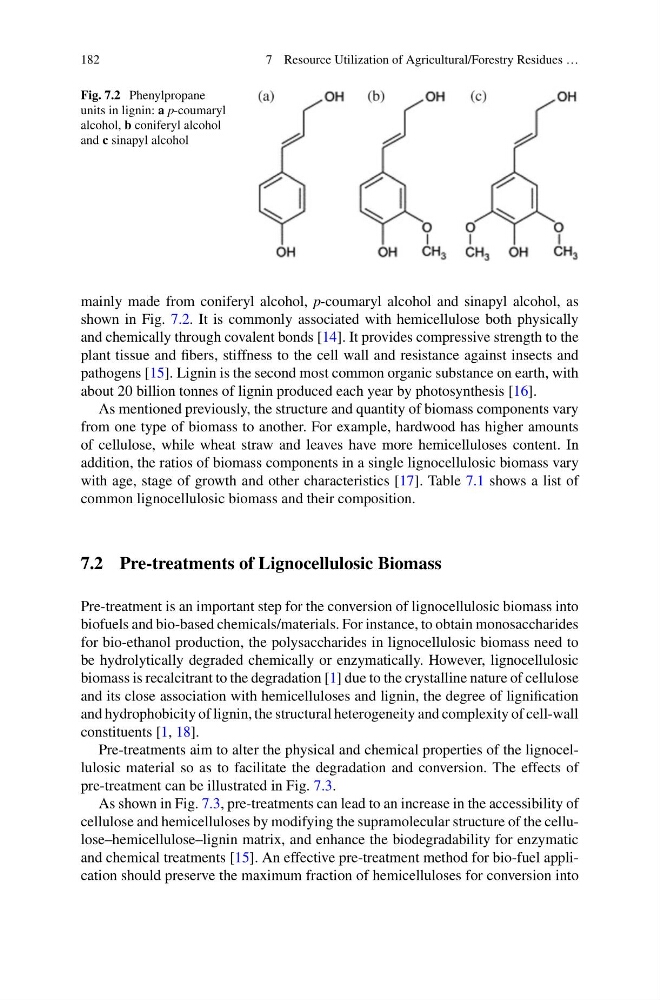
Fig. 7.2 Phenylpropane
units in lignin: a p-coumaryl
alcohol, b coniferyl alcohol
and c sinapyl alcohol
mainly made from coniferyl alcohol, p-coumaryl alcohol and sinapyl alcohol, as
shown in Fig. 7.2. It is commonly associated with hemicellulose both physically
and chemically through covalent bonds [14]. It provides compressive strength to the
plant tissue and fibers, stiffness to the cell wall and resistance against insects and
pathogens [15]. Lignin is the second most common organic substance on earth, with
about 20 billion tonnes of lignin produced each year by photosynthesis [16].
As mentioned previously, the structure and quantity of biomass components vary
from one type of biomass to another. For example, hardwood has higher amounts
of cellulose, while wheat straw and leaves have more hemicelluloses content. In
addition, the ratios of biomass components in a single lignocellulosic biomass vary
with age, stage of growth and other characteristics [17]. Table 7.1 shows a list of
common lignocellulosic biomass and their composition.
7.2 Pre-treatments of Lignocellulosic Biomass
Pre-treatment is an important step for the conversion of lignocellulosic biomass into
biofuels and bio-based chemicals/materials. For instance, to obtain monosaccharides
for bio-ethanol production, the polysaccharides in lignocellulosic biomass need to
be hydrolytically degraded chemically or enzymatically. However, lignocellulosic
biomass is recalcitrant to the degradation [1] due to the crystalline nature of cellulose
and its close association with hemicelluloses and lignin, the degree of lignification
and hydrophobicity of lignin, the structural heterogeneity and complexity of cell-wall
constituents [1, 18].
Pre-treatments aim to alter the physical and chemical properties of the lignocellulosic material so as to facilitate the degradation and conversion. The effects of
pre-treatment can be illustrated in Fig. 7.3.
As shown in Fig. 7.3, pre-treatments can lead to an increase in the accessibility of
cellulose and hemicelluloses by modifying the supramolecular structure of the cellulose–hemicellulose–lignin matrix, and enhance the biodegradability for enzymatic
and chemical treatments [15]. An effective pre-treatment method for bio-fuel application should preserve the maximum fraction of hemicelluloses for conversion into
7 Resource Utilization of Agricultural/Forestry Residues …
Fig. 7.2 Phenylpropane
units in lignin: a p-coumaryl
alcohol, b coniferyl alcohol
and c sinapyl alcohol
mainly made from coniferyl alcohol, p-coumaryl alcohol and sinapyl alcohol, as
shown in Fig. 7.2. It is commonly associated with hemicellulose both physically
and chemically through covalent bonds [14]. It provides compressive strength to the
plant tissue and fibers, stiffness to the cell wall and resistance against insects and
pathogens [15]. Lignin is the second most common organic substance on earth, with
about 20 billion tonnes of lignin produced each year by photosynthesis [16].
As mentioned previously, the structure and quantity of biomass components vary
from one type of biomass to another. For example, hardwood has higher amounts
of cellulose, while wheat straw and leaves have more hemicelluloses content. In
addition, the ratios of biomass components in a single lignocellulosic biomass vary
with age, stage of growth and other characteristics [17]. Table 7.1 shows a list of
common lignocellulosic biomass and their composition.
7.2 Pre-treatments of Lignocellulosic Biomass
Pre-treatment is an important step for the conversion of lignocellulosic biomass into
biofuels and bio-based chemicals/materials. For instance, to obtain monosaccharides
for bio-ethanol production, the polysaccharides in lignocellulosic biomass need to
be hydrolytically degraded chemically or enzymatically. However, lignocellulosic
biomass is recalcitrant to the degradation [1] due to the crystalline nature of cellulose
and its close association with hemicelluloses and lignin, the degree of lignification
and hydrophobicity of lignin, the structural heterogeneity and complexity of cell-wall
constituents [1, 18].
Pre-treatments aim to alter the physical and chemical properties of the lignocellulosic material so as to facilitate the degradation and conversion. The effects of
pre-treatment can be illustrated in Fig. 7.3.
As shown in Fig. 7.3, pre-treatments can lead to an increase in the accessibility of
cellulose and hemicelluloses by modifying the supramolecular structure of the cellulose–hemicellulose–lignin matrix, and enhance the biodegradability for enzymatic
and chemical treatments [15]. An effective pre-treatment method for bio-fuel application should preserve the maximum fraction of hemicelluloses for conversion into