

168
6 Waste Plastics Management and Conversion into Liquid …
Table 6.3
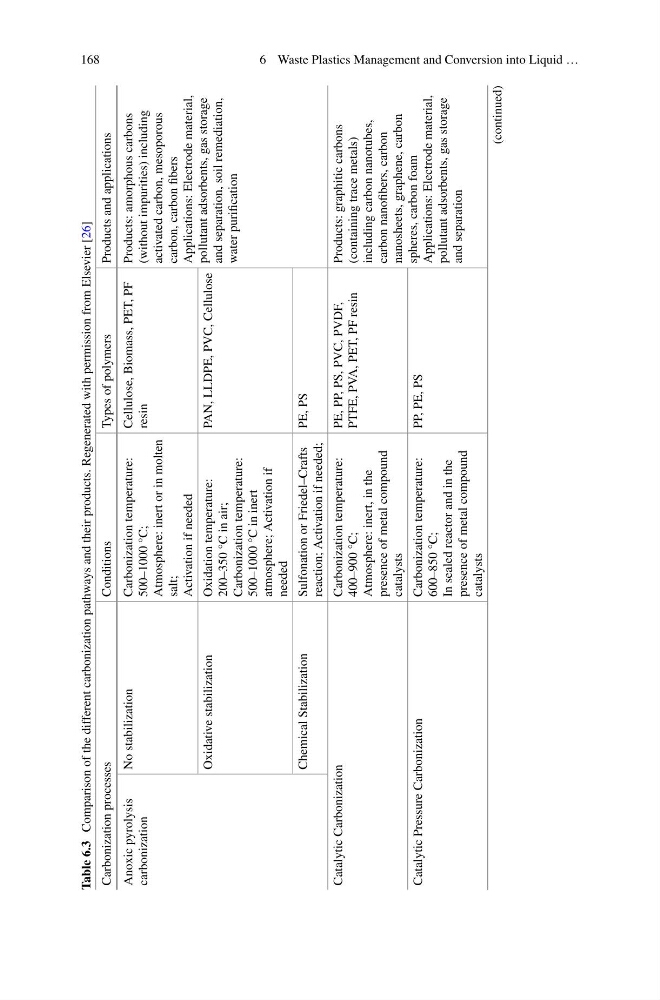
Comparison of the different carbonization pathways and their products. Regenerated with permission from Elsevier [26]
Carbonization processes
Conditions
Types of polymers
Products and applications
Anoxic pyrolysis
carbonization
No stabilization
Carbonization temperature:
500–1000 °C;
Atmosphere: inert or in molten
salt;
Activation if needed
Cellulose, Biomass, PET, PF
resin
Products: amorphous carbons
(without impurities) including
activated carbon, mesoporous
carbon, carbon fibers
Applications: Electrode material,
pollutant adsorbents, gas storage
and separation, soil remediation,
water purification
Oxidative stabilization
Oxidation temperature:
200–350 °C in air;
Carbonization temperature:
500–1000 °C in inert
atmosphere; Activation if
needed
PAN, LLDPE, PVC, Cellulose
Chemical Stabilization
Sulfonation or Friedel–Crafts
reaction; Activation if needed;
PE, PS
Catalytic Carbonization
Carbonization temperature:
400–900 °C;
Atmosphere: inert, in the
presence of metal compound
catalysts
PE, PP, PS, PVC, PVDF,
PTFE, PVA, PET, PF resin
Products: graphitic carbons
(containing trace metals)
including carbon nanotubes,
carbon nanofibers, carbon
nanosheets, graphene, carbon
spheres, carbon foam
Applications: Electrode material,
pollutant adsorbents, gas storage
and separation
Catalytic Pressure Carbonization
Carbonization temperature:
600–850 °C;
In sealed reactor and in the
presence of metal compound
catalysts
PP, PE, PS
(continued)
6 Waste Plastics Management and Conversion into Liquid …
Table 6.3
Comparison of the different carbonization pathways and their products. Regenerated with permission from Elsevier [26]
Carbonization processes
Conditions
Types of polymers
Products and applications
Anoxic pyrolysis
carbonization
No stabilization
Carbonization temperature:
500–1000 °C;
Atmosphere: inert or in molten
salt;
Activation if needed
Cellulose, Biomass, PET, PF
resin
Products: amorphous carbons
(without impurities) including
activated carbon, mesoporous
carbon, carbon fibers
Applications: Electrode material,
pollutant adsorbents, gas storage
and separation, soil remediation,
water purification
Oxidative stabilization
Oxidation temperature:
200–350 °C in air;
Carbonization temperature:
500–1000 °C in inert
atmosphere; Activation if
needed
PAN, LLDPE, PVC, Cellulose
Chemical Stabilization
Sulfonation or Friedel–Crafts
reaction; Activation if needed;
PE, PS
Catalytic Carbonization
Carbonization temperature:
400–900 °C;
Atmosphere: inert, in the
presence of metal compound
catalysts
PE, PP, PS, PVC, PVDF,
PTFE, PVA, PET, PF resin
Products: graphitic carbons
(containing trace metals)
including carbon nanotubes,
carbon nanofibers, carbon
nanosheets, graphene, carbon
spheres, carbon foam
Applications: Electrode material,
pollutant adsorbents, gas storage
and separation
Catalytic Pressure Carbonization
Carbonization temperature:
600–850 °C;
In sealed reactor and in the
presence of metal compound
catalysts
PP, PE, PS
(continued)