

166
6 Waste Plastics Management and Conversion into Liquid …
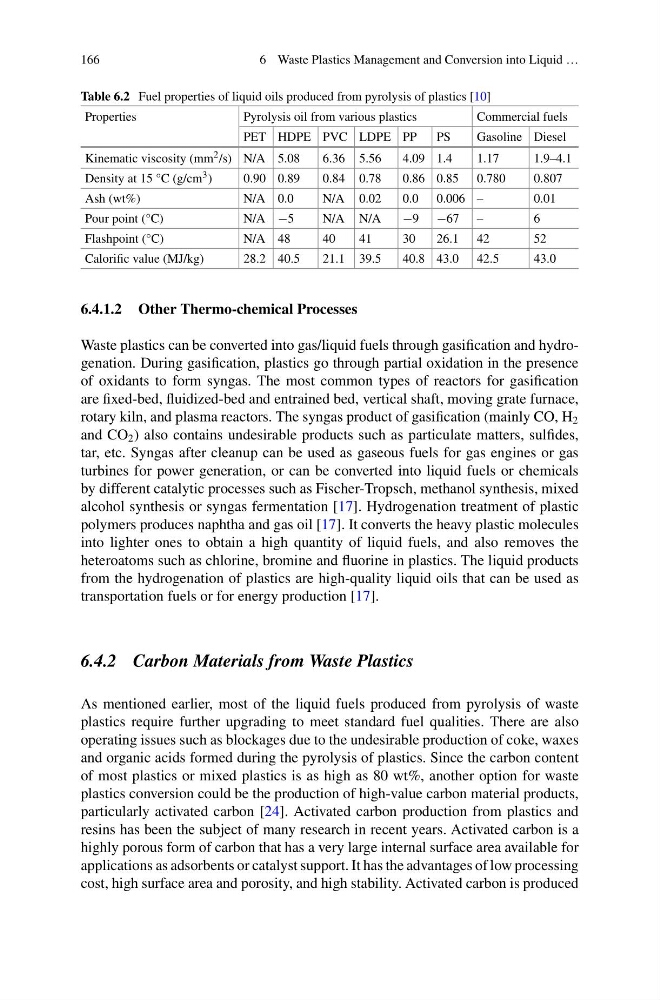
Table 6.2 Fuel properties of liquid oils produced from pyrolysis of plastics [10]
Properties
Pyrolysis oil from various plastics
Commercial fuels
PET HDPE PVC LDPE PP
PS
Gasoline Diesel
Kinematic viscosity (mm 2 /s) N/A 5.08
6.36 5.56
4.09 1.4
1.17
1.9–4.1
Density at 15 °C (g/cm 3 )
0.90 0.89
0.84 0.78
0.86 0.85 0.780
0.807
Ash (wt%)
N/A 0.0
N/A 0.02
0.0 0.006 –
0.01
Pour point (°C)
N/A −5
N/A N/A
−9 −67 –
6
Flashpoint (°C)
N/A 48
40
41
30
26.1 42
52
Calorific value (MJ/kg)
28.2 40.5
21.1 39.5
40.8 43.0 42.5
43.0
6.4.1.2 Other Thermo-chemical Processes
Waste plastics can be converted into gas/liquid fuels through gasification and hydrogenation. During gasification, plastics go through partial oxidation in the presence
of oxidants to form syngas. The most common types of reactors for gasification
are fixed-bed, fluidized-bed and entrained bed, vertical shaft, moving grate furnace,
rotary kiln, and plasma reactors. The syngas product of gasification (mainly CO, H 2
and CO 2 ) also contains undesirable products such as particulate matters, sulfides,
tar, etc. Syngas after cleanup can be used as gaseous fuels for gas engines or gas
turbines for power generation, or can be converted into liquid fuels or chemicals
by different catalytic processes such as Fischer-Tropsch, methanol synthesis, mixed
alcohol synthesis or syngas fermentation [17]. Hydrogenation treatment of plastic
polymers produces naphtha and gas oil [17]. It converts the heavy plastic molecules
into lighter ones to obtain a high quantity of liquid fuels, and also removes the
heteroatoms such as chlorine, bromine and fluorine in plastics. The liquid products
from the hydrogenation of plastics are high-quality liquid oils that can be used as
transportation fuels or for energy production [17].
6.4.2 Carbon Materials from Waste Plastics
As mentioned earlier, most of the liquid fuels produced from pyrolysis of waste
plastics require further upgrading to meet standard fuel qualities. There are also
operating issues such as blockages due to the undesirable production of coke, waxes
and organic acids formed during the pyrolysis of plastics. Since the carbon content
of most plastics or mixed plastics is as high as 80 wt%, another option for waste
plastics conversion could be the production of high-value carbon material products,
particularly activated carbon [24]. Activated carbon production from plastics and
resins has been the subject of many research in recent years. Activated carbon is a
highly porous form of carbon that has a very large internal surface area available for
applications as adsorbents or catalyst support. It has the advantages of low processing
cost, high surface area and porosity, and high stability. Activated carbon is produced
6 Waste Plastics Management and Conversion into Liquid …
Table 6.2 Fuel properties of liquid oils produced from pyrolysis of plastics [10]
Properties
Pyrolysis oil from various plastics
Commercial fuels
PET HDPE PVC LDPE PP
PS
Gasoline Diesel
Kinematic viscosity (mm 2 /s) N/A 5.08
6.36 5.56
4.09 1.4
1.17
1.9–4.1
Density at 15 °C (g/cm 3 )
0.90 0.89
0.84 0.78
0.86 0.85 0.780
0.807
Ash (wt%)
N/A 0.0
N/A 0.02
0.0 0.006 –
0.01
Pour point (°C)
N/A −5
N/A N/A
−9 −67 –
6
Flashpoint (°C)
N/A 48
40
41
30
26.1 42
52
Calorific value (MJ/kg)
28.2 40.5
21.1 39.5
40.8 43.0 42.5
43.0
6.4.1.2 Other Thermo-chemical Processes
Waste plastics can be converted into gas/liquid fuels through gasification and hydrogenation. During gasification, plastics go through partial oxidation in the presence
of oxidants to form syngas. The most common types of reactors for gasification
are fixed-bed, fluidized-bed and entrained bed, vertical shaft, moving grate furnace,
rotary kiln, and plasma reactors. The syngas product of gasification (mainly CO, H 2
and CO 2 ) also contains undesirable products such as particulate matters, sulfides,
tar, etc. Syngas after cleanup can be used as gaseous fuels for gas engines or gas
turbines for power generation, or can be converted into liquid fuels or chemicals
by different catalytic processes such as Fischer-Tropsch, methanol synthesis, mixed
alcohol synthesis or syngas fermentation [17]. Hydrogenation treatment of plastic
polymers produces naphtha and gas oil [17]. It converts the heavy plastic molecules
into lighter ones to obtain a high quantity of liquid fuels, and also removes the
heteroatoms such as chlorine, bromine and fluorine in plastics. The liquid products
from the hydrogenation of plastics are high-quality liquid oils that can be used as
transportation fuels or for energy production [17].
6.4.2 Carbon Materials from Waste Plastics
As mentioned earlier, most of the liquid fuels produced from pyrolysis of waste
plastics require further upgrading to meet standard fuel qualities. There are also
operating issues such as blockages due to the undesirable production of coke, waxes
and organic acids formed during the pyrolysis of plastics. Since the carbon content
of most plastics or mixed plastics is as high as 80 wt%, another option for waste
plastics conversion could be the production of high-value carbon material products,
particularly activated carbon [24]. Activated carbon production from plastics and
resins has been the subject of many research in recent years. Activated carbon is a
highly porous form of carbon that has a very large internal surface area available for
applications as adsorbents or catalyst support. It has the advantages of low processing
cost, high surface area and porosity, and high stability. Activated carbon is produced