

6.4 Conversion of Waste Plastics and Resins into Liquid Fuels and Carbon Materials
165
Table 6.1 Oil yields and operating conditions from pyrolysis of waste plastics. Regenerated with
permission from Elsevier [17]
Plastics
type
Reactor type Operating conditions
Oil yield
(wt%)
Refs.
Temperature
( o C)
Pressure
Residence
time (min)
LDPE
Pressurized
batch
425
0.8–4.3 MPa
60
89.9
[18]
HDPE
Semi-batch
450
1 atm
–
91.2
[19]
PVC
Vacuum
batch
520
2 kPa
60
12.8 a
[20]
PET
Fixed-bed
500
–
60
23.1
[21]
PP
Semi-batch
450
1 atm
–
92.3
[22]
PS
Pressurized
batch
425
0.31–1.6 MPa
60
97.0
[23]
a The liquid product includes 58.2 wt% HCl
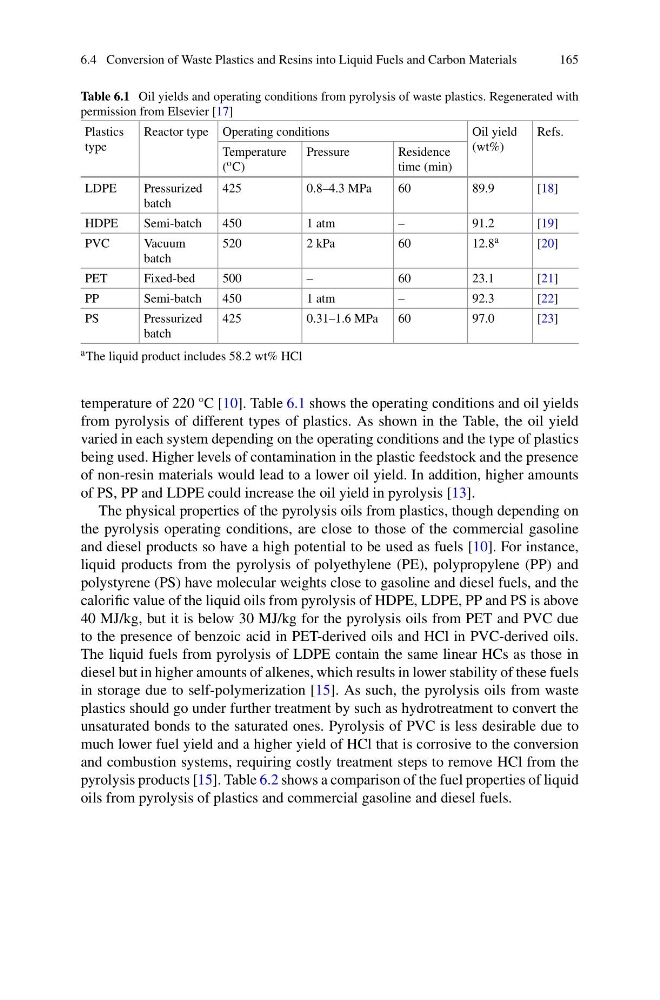
temperature of 220 °C [10]. Table 6.1 shows the operating conditions and oil yields
from pyrolysis of different types of plastics. As shown in the Table, the oil yield
varied in each system depending on the operating conditions and the type of plastics
being used. Higher levels of contamination in the plastic feedstock and the presence
of non-resin materials would lead to a lower oil yield. In addition, higher amounts
of PS, PP and LDPE could increase the oil yield in pyrolysis [13].
The physical properties of the pyrolysis oils from plastics, though depending on
the pyrolysis operating conditions, are close to those of the commercial gasoline
and diesel products so have a high potential to be used as fuels [10]. For instance,
liquid products from the pyrolysis of polyethylene (PE), polypropylene (PP) and
polystyrene (PS) have molecular weights close to gasoline and diesel fuels, and the
calorific value of the liquid oils from pyrolysis of HDPE, LDPE, PP and PS is above
40 MJ/kg, but it is below 30 MJ/kg for the pyrolysis oils from PET and PVC due
to the presence of benzoic acid in PET-derived oils and HCl in PVC-derived oils.
The liquid fuels from pyrolysis of LDPE contain the same linear HCs as those in
diesel but in higher amounts of alkenes, which results in lower stability of these fuels
in storage due to self-polymerization [15]. As such, the pyrolysis oils from waste
plastics should go under further treatment by such as hydrotreatment to convert the
unsaturated bonds to the saturated ones. Pyrolysis of PVC is less desirable due to
much lower fuel yield and a higher yield of HCl that is corrosive to the conversion
and combustion systems, requiring costly treatment steps to remove HCl from the
pyrolysis products [15]. Table 6.2 shows a comparison of the fuel properties of liquid
oils from pyrolysis of plastics and commercial gasoline and diesel fuels.
165
Table 6.1 Oil yields and operating conditions from pyrolysis of waste plastics. Regenerated with
permission from Elsevier [17]
Plastics
type
Reactor type Operating conditions
Oil yield
(wt%)
Refs.
Temperature
( o C)
Pressure
Residence
time (min)
LDPE
Pressurized
batch
425
0.8–4.3 MPa
60
89.9
[18]
HDPE
Semi-batch
450
1 atm
–
91.2
[19]
PVC
Vacuum
batch
520
2 kPa
60
12.8 a
[20]
PET
Fixed-bed
500
–
60
23.1
[21]
PP
Semi-batch
450
1 atm
–
92.3
[22]
PS
Pressurized
batch
425
0.31–1.6 MPa
60
97.0
[23]
a The liquid product includes 58.2 wt% HCl
temperature of 220 °C [10]. Table 6.1 shows the operating conditions and oil yields
from pyrolysis of different types of plastics. As shown in the Table, the oil yield
varied in each system depending on the operating conditions and the type of plastics
being used. Higher levels of contamination in the plastic feedstock and the presence
of non-resin materials would lead to a lower oil yield. In addition, higher amounts
of PS, PP and LDPE could increase the oil yield in pyrolysis [13].
The physical properties of the pyrolysis oils from plastics, though depending on
the pyrolysis operating conditions, are close to those of the commercial gasoline
and diesel products so have a high potential to be used as fuels [10]. For instance,
liquid products from the pyrolysis of polyethylene (PE), polypropylene (PP) and
polystyrene (PS) have molecular weights close to gasoline and diesel fuels, and the
calorific value of the liquid oils from pyrolysis of HDPE, LDPE, PP and PS is above
40 MJ/kg, but it is below 30 MJ/kg for the pyrolysis oils from PET and PVC due
to the presence of benzoic acid in PET-derived oils and HCl in PVC-derived oils.
The liquid fuels from pyrolysis of LDPE contain the same linear HCs as those in
diesel but in higher amounts of alkenes, which results in lower stability of these fuels
in storage due to self-polymerization [15]. As such, the pyrolysis oils from waste
plastics should go under further treatment by such as hydrotreatment to convert the
unsaturated bonds to the saturated ones. Pyrolysis of PVC is less desirable due to
much lower fuel yield and a higher yield of HCl that is corrosive to the conversion
and combustion systems, requiring costly treatment steps to remove HCl from the
pyrolysis products [15]. Table 6.2 shows a comparison of the fuel properties of liquid
oils from pyrolysis of plastics and commercial gasoline and diesel fuels.