

150
5 Recovery of Metals from Electronic Waste
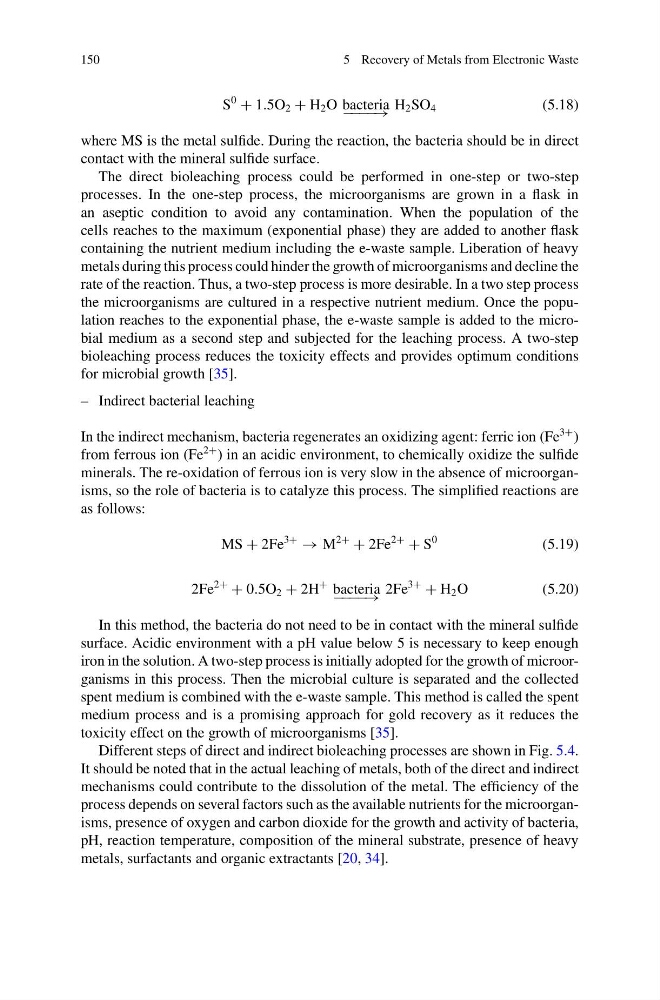
S
0
+ 1.5O 2 + H 2 O bacteria
− −−−→
H 2 SO 4
(5.18)
where MS is the metal sulfide. During the reaction, the bacteria should be in direct
contact with the mineral sulfide surface.
The direct bioleaching process could be performed in one-step or two-step
processes. In the one-step process, the microorganisms are grown in a flask in
an aseptic condition to avoid any contamination. When the population of the
cells reaches to the maximum (exponential phase) they are added to another flask
containing the nutrient medium including the e-waste sample. Liberation of heavy
metals during this process could hinder the growth of microorganisms and decline the
rate of the reaction. Thus, a two-step process is more desirable. In a two step process
the microorganisms are cultured in a respective nutrient medium. Once the population reaches to the exponential phase, the e-waste sample is added to the microbial medium as a second step and subjected for the leaching process. A two-step
bioleaching process reduces the toxicity effects and provides optimum conditions
for microbial growth [35].
– Indirect bacterial leaching
In the indirect mechanism, bacteria regenerates an oxidizing agent: ferric ion (Fe
3+ )
from ferrous ion (Fe
2+ ) in an acidic environment, to chemically oxidize the sulfide
minerals. The re-oxidation of ferrous ion is very slow in the absence of microorganisms, so the role of bacteria is to catalyze this process. The simplified reactions are
as follows:
MS + 2Fe
3+
→ M
2+
+ 2Fe
2+
+ S
0
(5.19)
2Fe
2+
+ 0.5O 2 + 2H
+ bacteria
− −−−→
2Fe
3+
+ H 2 O
(5.20)
In this method, the bacteria do not need to be in contact with the mineral sulfide
surface. Acidic environment with a pH value below 5 is necessary to keep enough
iron in the solution. A two-step process is initially adopted for the growth of microorganisms in this process. Then the microbial culture is separated and the collected
spent medium is combined with the e-waste sample. This method is called the spent
medium process and is a promising approach for gold recovery as it reduces the
toxicity effect on the growth of microorganisms [35].
Different steps of direct and indirect bioleaching processes are shown in Fig. 5.4.
It should be noted that in the actual leaching of metals, both of the direct and indirect
mechanisms could contribute to the dissolution of the metal. The efficiency of the
process depends on several factors such as the available nutrients for the microorganisms, presence of oxygen and carbon dioxide for the growth and activity of bacteria,
pH, reaction temperature, composition of the mineral substrate, presence of heavy
metals, surfactants and organic extractants [20, 34].
5 Recovery of Metals from Electronic Waste
S
0
+ 1.5O 2 + H 2 O bacteria
− −−−→
H 2 SO 4
(5.18)
where MS is the metal sulfide. During the reaction, the bacteria should be in direct
contact with the mineral sulfide surface.
The direct bioleaching process could be performed in one-step or two-step
processes. In the one-step process, the microorganisms are grown in a flask in
an aseptic condition to avoid any contamination. When the population of the
cells reaches to the maximum (exponential phase) they are added to another flask
containing the nutrient medium including the e-waste sample. Liberation of heavy
metals during this process could hinder the growth of microorganisms and decline the
rate of the reaction. Thus, a two-step process is more desirable. In a two step process
the microorganisms are cultured in a respective nutrient medium. Once the population reaches to the exponential phase, the e-waste sample is added to the microbial medium as a second step and subjected for the leaching process. A two-step
bioleaching process reduces the toxicity effects and provides optimum conditions
for microbial growth [35].
– Indirect bacterial leaching
In the indirect mechanism, bacteria regenerates an oxidizing agent: ferric ion (Fe
3+ )
from ferrous ion (Fe
2+ ) in an acidic environment, to chemically oxidize the sulfide
minerals. The re-oxidation of ferrous ion is very slow in the absence of microorganisms, so the role of bacteria is to catalyze this process. The simplified reactions are
as follows:
MS + 2Fe
3+
→ M
2+
+ 2Fe
2+
+ S
0
(5.19)
2Fe
2+
+ 0.5O 2 + 2H
+ bacteria
− −−−→
2Fe
3+
+ H 2 O
(5.20)
In this method, the bacteria do not need to be in contact with the mineral sulfide
surface. Acidic environment with a pH value below 5 is necessary to keep enough
iron in the solution. A two-step process is initially adopted for the growth of microorganisms in this process. Then the microbial culture is separated and the collected
spent medium is combined with the e-waste sample. This method is called the spent
medium process and is a promising approach for gold recovery as it reduces the
toxicity effect on the growth of microorganisms [35].
Different steps of direct and indirect bioleaching processes are shown in Fig. 5.4.
It should be noted that in the actual leaching of metals, both of the direct and indirect
mechanisms could contribute to the dissolution of the metal. The efficiency of the
process depends on several factors such as the available nutrients for the microorganisms, presence of oxygen and carbon dioxide for the growth and activity of bacteria,
pH, reaction temperature, composition of the mineral substrate, presence of heavy
metals, surfactants and organic extractants [20, 34].