

4
1 Wastes Generation, Characterization, Management Strategies …
Class 5—Oxidizing substances and organic peroxides: This class includes the
substances that yield oxygen and lead or contribute to the combustion of other
materials. It also includes organic peroxides which are thermally unstable and
contain oxygen in the bivalent “-O-O-” structure, are likely to undergo exothermic
self-accelerating decomposition, liable to explosive decomposition, are sensitive to
impact or friction, can burn rapidly and react dangerously with other substances and
can cause damage to the eyes.
Class 6—Toxic and infectious substances: Toxic substances can cause death or
serious injury or can cause harm to human health if they are swallowed or inhaled or
if they come into contact with skin. Infectious substances contain microorganisms
such as bacteria, viruses, rickettsia, parasites, fungi, etc., that can cause disease in
humans or animals.
Class 7—Radioactive materials: Radioactive materials include the radioactive
elements found in the environment such as uranium (U-238 or U-235), thorium (Th232) and potassium (K-40) and any of their radioactive decay products, such as
radium (Ra-226) and radon (Rn-222).
Class 8—Corrosive substances: This category includes the substances that can
cause destruction of human skin, permanent skin lesions, destruction of all layers of
the outer skin through to the internal tissues, or exhibit a corrosion rate that exceeds
6.25 mm per year on a solid surface at a test temperature of 55 °C.
Class 9—Miscellaneous products, substances or organics: Any other type of
hazardous waste that is not included in the previous classification can be in this group,
e.g., a marine pollutant and hazardous household wastes, including but not limited to
medication, paints or solvents, unwanted engine oil or anti-freeze, dead or unwanted
car batteries or any other type of batteries (that contain heavy metals), discarded
electronic devices such as cell phones and televisions, and burnt out fluorescent
lights/tubes (that contain mercury), etc.
The nine classes of hazardous waste are usually represented by dangerous goods
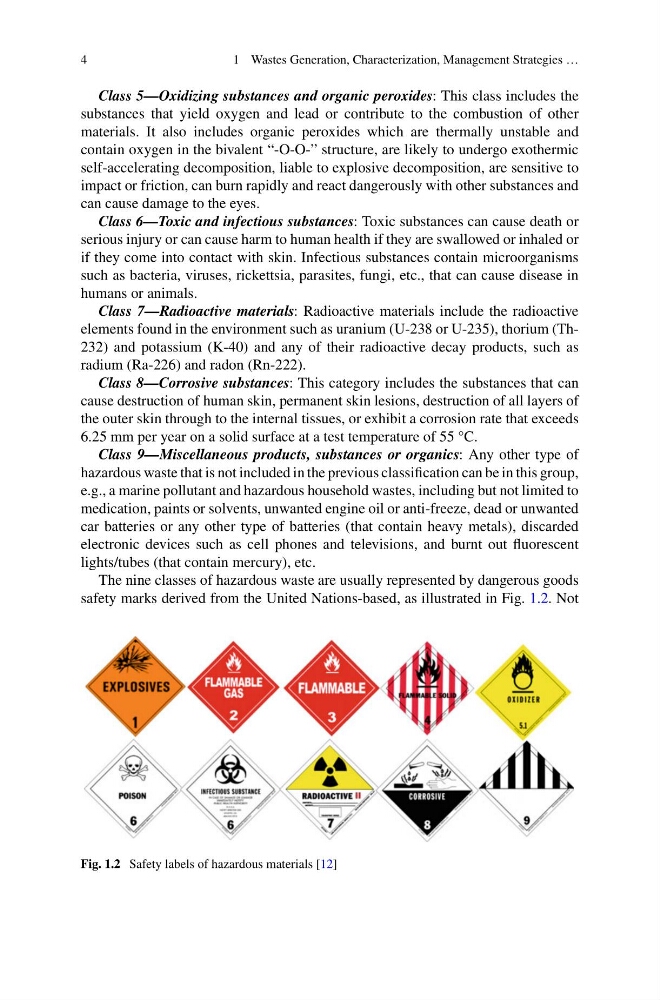
safety marks derived from the United Nations-based, as illustrated in Fig. 1.2. Not
Fig. 1.2 Safety labels of hazardous materials [12]
1 Wastes Generation, Characterization, Management Strategies …
Class 5—Oxidizing substances and organic peroxides: This class includes the
substances that yield oxygen and lead or contribute to the combustion of other
materials. It also includes organic peroxides which are thermally unstable and
contain oxygen in the bivalent “-O-O-” structure, are likely to undergo exothermic
self-accelerating decomposition, liable to explosive decomposition, are sensitive to
impact or friction, can burn rapidly and react dangerously with other substances and
can cause damage to the eyes.
Class 6—Toxic and infectious substances: Toxic substances can cause death or
serious injury or can cause harm to human health if they are swallowed or inhaled or
if they come into contact with skin. Infectious substances contain microorganisms
such as bacteria, viruses, rickettsia, parasites, fungi, etc., that can cause disease in
humans or animals.
Class 7—Radioactive materials: Radioactive materials include the radioactive
elements found in the environment such as uranium (U-238 or U-235), thorium (Th232) and potassium (K-40) and any of their radioactive decay products, such as
radium (Ra-226) and radon (Rn-222).
Class 8—Corrosive substances: This category includes the substances that can
cause destruction of human skin, permanent skin lesions, destruction of all layers of
the outer skin through to the internal tissues, or exhibit a corrosion rate that exceeds
6.25 mm per year on a solid surface at a test temperature of 55 °C.
Class 9—Miscellaneous products, substances or organics: Any other type of
hazardous waste that is not included in the previous classification can be in this group,
e.g., a marine pollutant and hazardous household wastes, including but not limited to
medication, paints or solvents, unwanted engine oil or anti-freeze, dead or unwanted
car batteries or any other type of batteries (that contain heavy metals), discarded
electronic devices such as cell phones and televisions, and burnt out fluorescent
lights/tubes (that contain mercury), etc.
The nine classes of hazardous waste are usually represented by dangerous goods
safety marks derived from the United Nations-based, as illustrated in Fig. 1.2. Not
Fig. 1.2 Safety labels of hazardous materials [12]