

80
2 Work, Heat, and Energy: The First Law of Thermodynamics
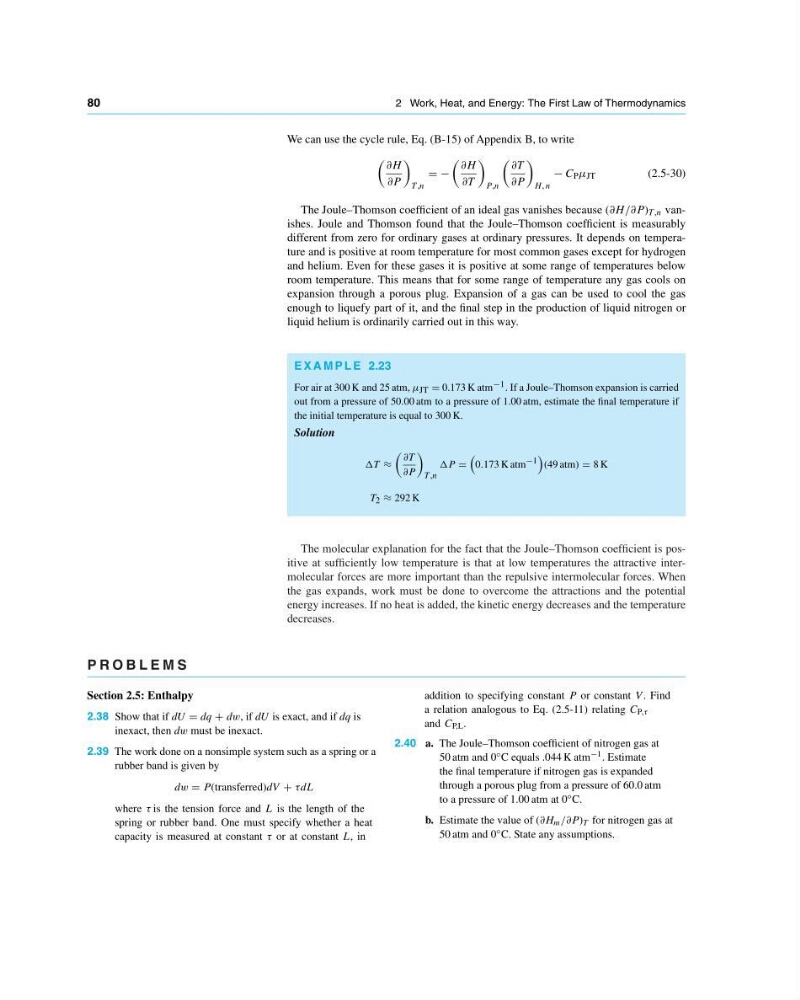
We can use the cycle rule, Eq. (B-15) of Appendix B, to write
∂H
∂P
T ,n
−
∂H
∂T
P,n
∂T
∂P
H, n
− C P µ JT
(2.5-30)
The Joule–Thomson coefficient of an ideal gas vanishes because (∂H/∂P) T ,n vanishes. Joule and Thomson found that the Joule–Thomson coefficient is measurably
different from zero for ordinary gases at ordinary pressures. It depends on temperature and is positive at room temperature for most common gases except for hydrogen
and helium. Even for these gases it is positive at some range of temperatures below
room temperature. This means that for some range of temperature any gas cools on
expansion through a porous plug. Expansion of a gas can be used to cool the gas
enough to liquefy part of it, and the final step in the production of liquid nitrogen or
liquid helium is ordinarily carried out in this way.
E X A M P L E 2.23
For air at 300 K and 25 atm, µ JT 0.173 K atm −1 . If a Joule–Thomson expansion is carried
out from a pressure of 50.00 atm to a pressure of 1.00 atm, estimate the final temperature if
the initial temperature is equal to 300 K.
Solution
∆T ≈
∂T
∂P
T ,n
∆P
0.173 K atm −1
(49 atm) 8 K
T 2 ≈ 292 K
The molecular explanation for the fact that the Joule–Thomson coefficient is positive at sufficiently low temperature is that at low temperatures the attractive intermolecular forces are more important than the repulsive intermolecular forces. When
the gas expands, work must be done to overcome the attractions and the potential
energy increases. If no heat is added, the kinetic energy decreases and the temperature
decreases.
P R O B L E M S
Section 2.5: Enthalpy
2.38 Show that if dU dq + dw, if dU is exact, and if dq is
inexact, then dw must be inexact.
2.39 The work done on a nonsimple system such as a spring or a
rubber band is given by
dw P(transferred)dV + τdL
where τ is the tension force and L is the length of the
spring or rubber band. One must specify whether a heat
capacity is measured at constant τ or at constant L, in
addition to specifying constant P or constant V . Find
a relation analogous to Eq. (2.5-11) relating C P,τ
and C P,L .
2.40 a. The Joule–Thomson coefficient of nitrogen gas at
50 atm and 0 ◦ C equals .044 K atm −1 . Estimate
the final temperature if nitrogen gas is expanded
through a porous plug from a pressure of 60.0 atm
to a pressure of 1.00 atm at 0 ◦ C.
b. Estimate the value of (∂H m /∂P) T for nitrogen gas at
50 atm and 0 ◦ C. State any assumptions.
2 Work, Heat, and Energy: The First Law of Thermodynamics
We can use the cycle rule, Eq. (B-15) of Appendix B, to write
∂H
∂P
T ,n
−
∂H
∂T
P,n
∂T
∂P
H, n
− C P µ JT
(2.5-30)
The Joule–Thomson coefficient of an ideal gas vanishes because (∂H/∂P) T ,n vanishes. Joule and Thomson found that the Joule–Thomson coefficient is measurably
different from zero for ordinary gases at ordinary pressures. It depends on temperature and is positive at room temperature for most common gases except for hydrogen
and helium. Even for these gases it is positive at some range of temperatures below
room temperature. This means that for some range of temperature any gas cools on
expansion through a porous plug. Expansion of a gas can be used to cool the gas
enough to liquefy part of it, and the final step in the production of liquid nitrogen or
liquid helium is ordinarily carried out in this way.
E X A M P L E 2.23
For air at 300 K and 25 atm, µ JT 0.173 K atm −1 . If a Joule–Thomson expansion is carried
out from a pressure of 50.00 atm to a pressure of 1.00 atm, estimate the final temperature if
the initial temperature is equal to 300 K.
Solution
∆T ≈
∂T
∂P
T ,n
∆P
0.173 K atm −1
(49 atm) 8 K
T 2 ≈ 292 K
The molecular explanation for the fact that the Joule–Thomson coefficient is positive at sufficiently low temperature is that at low temperatures the attractive intermolecular forces are more important than the repulsive intermolecular forces. When
the gas expands, work must be done to overcome the attractions and the potential
energy increases. If no heat is added, the kinetic energy decreases and the temperature
decreases.
P R O B L E M S
Section 2.5: Enthalpy
2.38 Show that if dU dq + dw, if dU is exact, and if dq is
inexact, then dw must be inexact.
2.39 The work done on a nonsimple system such as a spring or a
rubber band is given by
dw P(transferred)dV + τdL
where τ is the tension force and L is the length of the
spring or rubber band. One must specify whether a heat
capacity is measured at constant τ or at constant L, in
addition to specifying constant P or constant V . Find
a relation analogous to Eq. (2.5-11) relating C P,τ
and C P,L .
2.40 a. The Joule–Thomson coefficient of nitrogen gas at
50 atm and 0 ◦ C equals .044 K atm −1 . Estimate
the final temperature if nitrogen gas is expanded
through a porous plug from a pressure of 60.0 atm
to a pressure of 1.00 atm at 0 ◦ C.
b. Estimate the value of (∂H m /∂P) T for nitrogen gas at
50 atm and 0 ◦ C. State any assumptions.