

2.6 Calculation of Enthalpy Changes of Processes without Chemical Reactions
81
2.41 A sample of 3.00 mol of argon is heated from 25.00 ◦ C to
100.00 ◦ C, beginning at a pressure of 1.000 atm
(101,325 Pa).
a. Find q, w, ∆U, and ∆H if the heating is done at
constant volume.
b. Find q, w, ∆U, and ∆H if the heating is done at
constant pressure.
2.6
Calculation of Enthalpy Changes of Processes
without Chemical Reactions
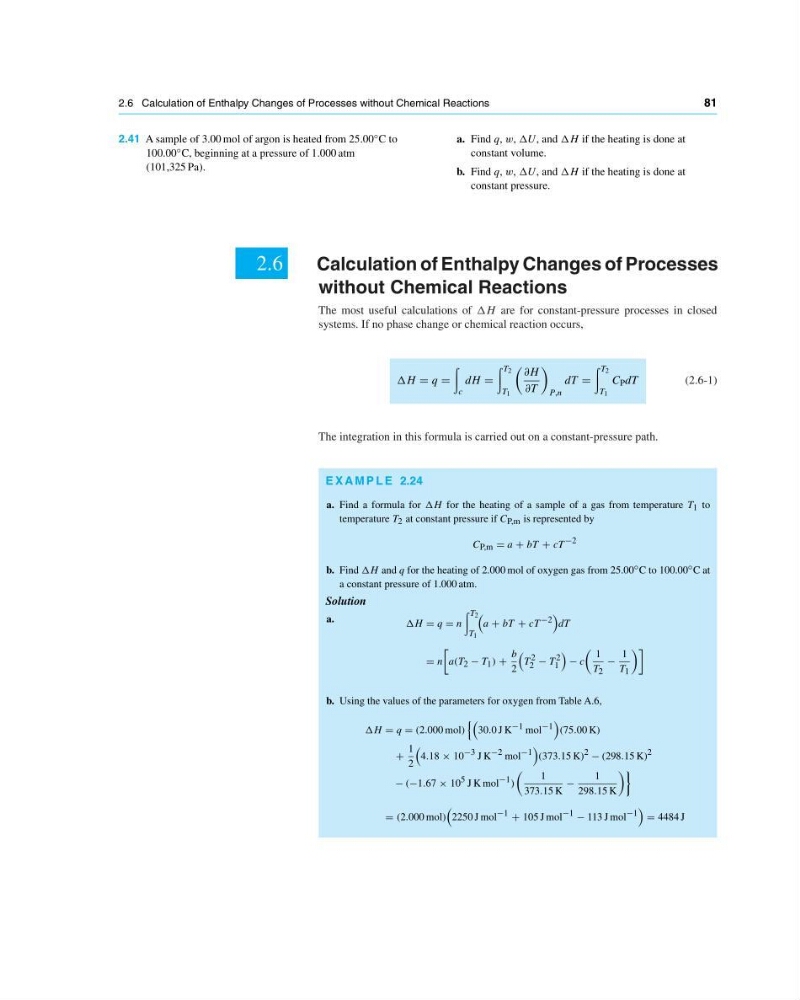
The most useful calculations of ∆H are for constant-pressure processes in closed
systems. If no phase change or chemical reaction occurs,
∆H q
c
dH
T 2
T 1
∂H
∂T
P,n
dT
T 2
T 1
C P dT
(2.6-1)
The integration in this formula is carried out on a constant-pressure path.
E X A M P L E 2.24
a. Find a formula for ∆H for the heating of a sample of a gas from temperature T 1 to
temperature T 2 at constant pressure if C P,m is represented by
C P,m a + bT + cT −2
b. Find ∆H and q for the heating of 2.000 mol of oxygen gas from 25.00 ◦ C to 100.00 ◦ C at
a constant pressure of 1.000 atm.
Solution
a.
∆H q n
T 2
T 1
a + bT + cT −2
dT
n
a(T 2 − T 1 ) +
b
2
T 2
2 − T 2
1
− c
1
T 2
−
1
T 1
b. Using the values of the parameters for oxygen from Table A.6,
∆H q (2.000 mol)
30.0 J K −1 mol −1
(75.00 K)
+
1
2
4.18 × 10 −3 J K −2 mol −1
(373.15 K) 2 − (298.15 K) 2
− (−1.67 × 10 5 J K mol −1 )
1
373.15 K
−
1
298.15 K
(2.000 mol)
2250 J mol −1 + 105 J mol −1 − 113 J mol −1
4484 J
81
2.41 A sample of 3.00 mol of argon is heated from 25.00 ◦ C to
100.00 ◦ C, beginning at a pressure of 1.000 atm
(101,325 Pa).
a. Find q, w, ∆U, and ∆H if the heating is done at
constant volume.
b. Find q, w, ∆U, and ∆H if the heating is done at
constant pressure.
2.6
Calculation of Enthalpy Changes of Processes
without Chemical Reactions
The most useful calculations of ∆H are for constant-pressure processes in closed
systems. If no phase change or chemical reaction occurs,
∆H q
c
dH
T 2
T 1
∂H
∂T
P,n
dT
T 2
T 1
C P dT
(2.6-1)
The integration in this formula is carried out on a constant-pressure path.
E X A M P L E 2.24
a. Find a formula for ∆H for the heating of a sample of a gas from temperature T 1 to
temperature T 2 at constant pressure if C P,m is represented by
C P,m a + bT + cT −2
b. Find ∆H and q for the heating of 2.000 mol of oxygen gas from 25.00 ◦ C to 100.00 ◦ C at
a constant pressure of 1.000 atm.
Solution
a.
∆H q n
T 2
T 1
a + bT + cT −2
dT
n
a(T 2 − T 1 ) +
b
2
T 2
2 − T 2
1
− c
1
T 2
−
1
T 1
b. Using the values of the parameters for oxygen from Table A.6,
∆H q (2.000 mol)
30.0 J K −1 mol −1
(75.00 K)
+
1
2
4.18 × 10 −3 J K −2 mol −1
(373.15 K) 2 − (298.15 K) 2
− (−1.67 × 10 5 J K mol −1 )
1
373.15 K
−
1
298.15 K
(2.000 mol)
2250 J mol −1 + 105 J mol −1 − 113 J mol −1
4484 J