

2.4 Calculation of Amounts of Heat and Energy Changes
65
Solution
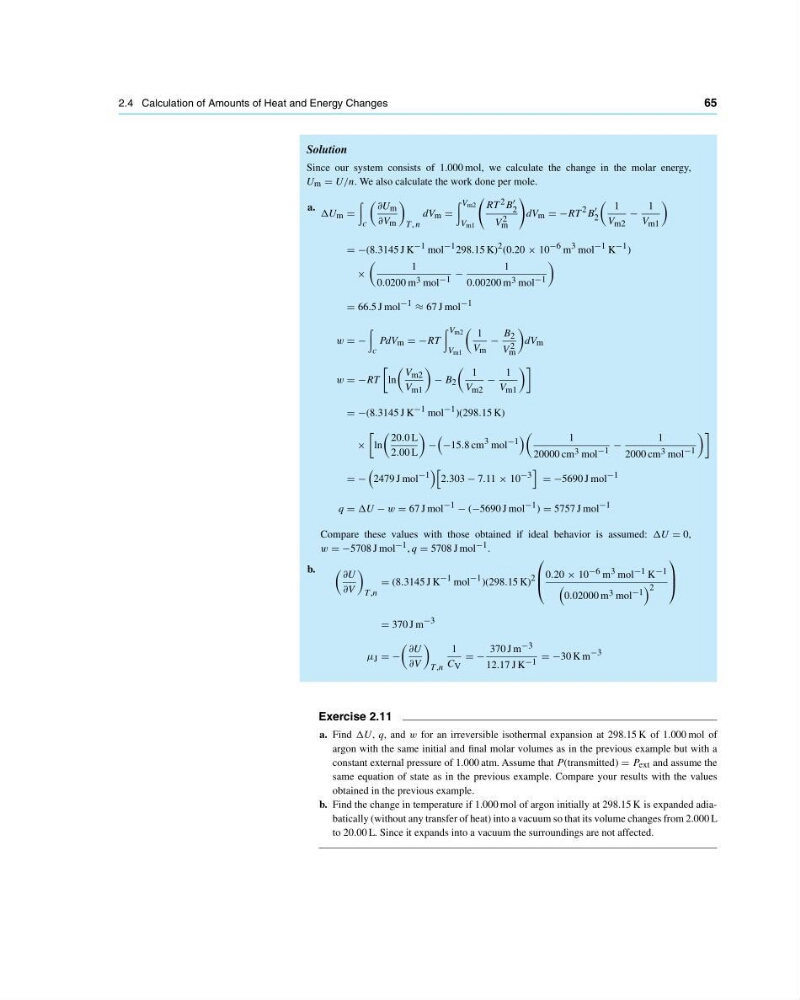
Since our system consists of 1.000 mol, we calculate the change in the molar energy,
U m U/n. We also calculate the work done per mole.
a. ∆U m
c
∂U m
∂V m
T , n
dV m
V m2
V m1
RT 2 B
2
V 2
m
dV m −RT 2 B
2
1
V m2
−
1
V m1
−(8.3145 J K −1 mol −1 298.15 K) 2 (0.20 × 10 −6 m 3 mol −1 K −1 )
×
1
0.0200 m 3 mol −1 −
1
0.00200 m 3 mol −1
66.5 J mol −1 ≈ 67 J mol −1
w −
c
PdV m −RT
V m2
V m1
1
V m
−
B 2
V 2
m
dV m
w −RT
ln
V m2
V m1
− B 2
1
V m2
−
1
V m1
−(8.3145 J K −1 mol −1 )(298.15 K)
×
ln
20.0 L
2.00 L
−
−15.8 cm 3 mol −1
1
20000 cm 3 mol −1 −
1
2000 cm 3 mol −1
−
2479 J mol −1
2.303 − 7.11 × 10 −3
−5690 J mol −1
q ∆U − w 67 J mol −1 − (−5690 J mol −1 ) 5757 J mol −1
Compare these values with those obtained if ideal behavior is assumed: ∆U 0,
w −5708 J mol −1 , q 5708 J mol −1 .
b.
∂U
∂V
T ,n
(8.3145 J K −1 mol −1 )(298.15 K) 2
⎛
⎜
⎝
0.20 × 10 −6 m 3 mol −1 K −1
0.02000 m 3 mol −1
2
⎞
⎟
⎠
370 J m −3
µ J −
∂U
∂V
T ,n
1
C V
−
370 J m −3
12.17 J K −1 −30 K m −3
Exercise 2.11
a. Find ∆U, q, and w for an irreversible isothermal expansion at 298.15 K of 1.000 mol of
argon with the same initial and final molar volumes as in the previous example but with a
constant external pressure of 1.000 atm. Assume that P(transmitted) P ext and assume the
same equation of state as in the previous example. Compare your results with the values
obtained in the previous example.
b. Find the change in temperature if 1.000 mol of argon initially at 298.15 K is expanded adiabatically (without any transfer of heat) into a vacuum so that its volume changes from 2.000 L
to 20.00 L. Since it expands into a vacuum the surroundings are not affected.
65
Solution
Since our system consists of 1.000 mol, we calculate the change in the molar energy,
U m U/n. We also calculate the work done per mole.
a. ∆U m
c
∂U m
∂V m
T , n
dV m
V m2
V m1
RT 2 B
2
V 2
m
dV m −RT 2 B
2
1
V m2
−
1
V m1
−(8.3145 J K −1 mol −1 298.15 K) 2 (0.20 × 10 −6 m 3 mol −1 K −1 )
×
1
0.0200 m 3 mol −1 −
1
0.00200 m 3 mol −1
66.5 J mol −1 ≈ 67 J mol −1
w −
c
PdV m −RT
V m2
V m1
1
V m
−
B 2
V 2
m
dV m
w −RT
ln
V m2
V m1
− B 2
1
V m2
−
1
V m1
−(8.3145 J K −1 mol −1 )(298.15 K)
×
ln
20.0 L
2.00 L
−
−15.8 cm 3 mol −1
1
20000 cm 3 mol −1 −
1
2000 cm 3 mol −1
−
2479 J mol −1
2.303 − 7.11 × 10 −3
−5690 J mol −1
q ∆U − w 67 J mol −1 − (−5690 J mol −1 ) 5757 J mol −1
Compare these values with those obtained if ideal behavior is assumed: ∆U 0,
w −5708 J mol −1 , q 5708 J mol −1 .
b.
∂U
∂V
T ,n
(8.3145 J K −1 mol −1 )(298.15 K) 2
⎛
⎜
⎝
0.20 × 10 −6 m 3 mol −1 K −1
0.02000 m 3 mol −1
2
⎞
⎟
⎠
370 J m −3
µ J −
∂U
∂V
T ,n
1
C V
−
370 J m −3
12.17 J K −1 −30 K m −3
Exercise 2.11
a. Find ∆U, q, and w for an irreversible isothermal expansion at 298.15 K of 1.000 mol of
argon with the same initial and final molar volumes as in the previous example but with a
constant external pressure of 1.000 atm. Assume that P(transmitted) P ext and assume the
same equation of state as in the previous example. Compare your results with the values
obtained in the previous example.
b. Find the change in temperature if 1.000 mol of argon initially at 298.15 K is expanded adiabatically (without any transfer of heat) into a vacuum so that its volume changes from 2.000 L
to 20.00 L. Since it expands into a vacuum the surroundings are not affected.