

64
2 Work, Heat, and Energy: The First Law of Thermodynamics
would differ from the initial temperature. If the heat capacity of the apparatus and the
heat capacity of the gas are known, the change in temperature of the gas could be
calculated.
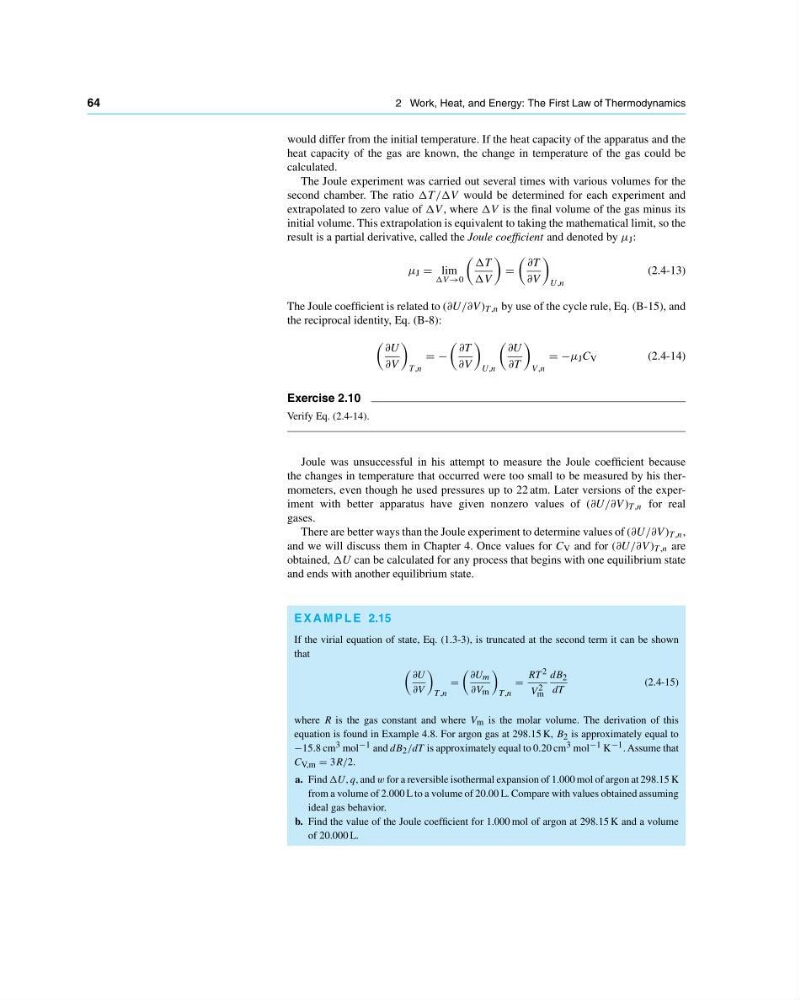
The Joule experiment was carried out several times with various volumes for the
second chamber. The ratio ∆T /∆V would be determined for each experiment and
extrapolated to zero value of ∆V , where ∆V is the final volume of the gas minus its
initial volume. This extrapolation is equivalent to taking the mathematical limit, so the
result is a partial derivative, called the Joule coefficient and denoted by µ J :
µ J lim
∆V →0
∆T
∆V
∂T
∂V
U,n
(2.4-13)
The Joule coefficient is related to (∂U/∂V ) T ,n by use of the cycle rule, Eq. (B-15), and
the reciprocal identity, Eq. (B-8):
∂U
∂V
T ,n
−
∂T
∂V
U,n
∂U
∂T
V ,n
−µ J C V
(2.4-14)
Exercise 2.10
Verify Eq. (2.4-14).
Joule was unsuccessful in his attempt to measure the Joule coefficient because
the changes in temperature that occurred were too small to be measured by his thermometers, even though he used pressures up to 22 atm. Later versions of the experiment with better apparatus have given nonzero values of (∂U/∂V ) T ,n for real
gases.
There are better ways than the Joule experiment to determine values of (∂U/∂V ) T ,n ,
and we will discuss them in Chapter 4. Once values for C V and for (∂U/∂V ) T ,n are
obtained, ∆U can be calculated for any process that begins with one equilibrium state
and ends with another equilibrium state.
E X A M P L E 2.15
If the virial equation of state, Eq. (1.3-3), is truncated at the second term it can be shown
that
∂U
∂V
T ,n
∂U m
∂V m
T ,n
RT 2
V 2
m
dB 2
dT
(2.4-15)
where R is the gas constant and where V m is the molar volume. The derivation of this
equation is found in Example 4.8. For argon gas at 298.15 K, B 2 is approximately equal to
−15.8 cm 3 mol −1 and dB 2 /dT is approximately equal to 0.20 cm 3 mol −1 K −1 . Assume that
C V,m 3R/2.
a. Find ∆U, q, and w for a reversible isothermal expansion of 1.000 mol of argon at 298.15 K
from a volume of 2.000 L to a volume of 20.00 L. Compare with values obtained assuming
ideal gas behavior.
b. Find the value of the Joule coefficient for 1.000 mol of argon at 298.15 K and a volume
of 20.000 L.
2 Work, Heat, and Energy: The First Law of Thermodynamics
would differ from the initial temperature. If the heat capacity of the apparatus and the
heat capacity of the gas are known, the change in temperature of the gas could be
calculated.
The Joule experiment was carried out several times with various volumes for the
second chamber. The ratio ∆T /∆V would be determined for each experiment and
extrapolated to zero value of ∆V , where ∆V is the final volume of the gas minus its
initial volume. This extrapolation is equivalent to taking the mathematical limit, so the
result is a partial derivative, called the Joule coefficient and denoted by µ J :
µ J lim
∆V →0
∆T
∆V
∂T
∂V
U,n
(2.4-13)
The Joule coefficient is related to (∂U/∂V ) T ,n by use of the cycle rule, Eq. (B-15), and
the reciprocal identity, Eq. (B-8):
∂U
∂V
T ,n
−
∂T
∂V
U,n
∂U
∂T
V ,n
−µ J C V
(2.4-14)
Exercise 2.10
Verify Eq. (2.4-14).
Joule was unsuccessful in his attempt to measure the Joule coefficient because
the changes in temperature that occurred were too small to be measured by his thermometers, even though he used pressures up to 22 atm. Later versions of the experiment with better apparatus have given nonzero values of (∂U/∂V ) T ,n for real
gases.
There are better ways than the Joule experiment to determine values of (∂U/∂V ) T ,n ,
and we will discuss them in Chapter 4. Once values for C V and for (∂U/∂V ) T ,n are
obtained, ∆U can be calculated for any process that begins with one equilibrium state
and ends with another equilibrium state.
E X A M P L E 2.15
If the virial equation of state, Eq. (1.3-3), is truncated at the second term it can be shown
that
∂U
∂V
T ,n
∂U m
∂V m
T ,n
RT 2
V 2
m
dB 2
dT
(2.4-15)
where R is the gas constant and where V m is the molar volume. The derivation of this
equation is found in Example 4.8. For argon gas at 298.15 K, B 2 is approximately equal to
−15.8 cm 3 mol −1 and dB 2 /dT is approximately equal to 0.20 cm 3 mol −1 K −1 . Assume that
C V,m 3R/2.
a. Find ∆U, q, and w for a reversible isothermal expansion of 1.000 mol of argon at 298.15 K
from a volume of 2.000 L to a volume of 20.00 L. Compare with values obtained assuming
ideal gas behavior.
b. Find the value of the Joule coefficient for 1.000 mol of argon at 298.15 K and a volume
of 20.000 L.