

686
16 The Principles of Quantum Mechanics. II. The Postulates of Quantum Mechanics
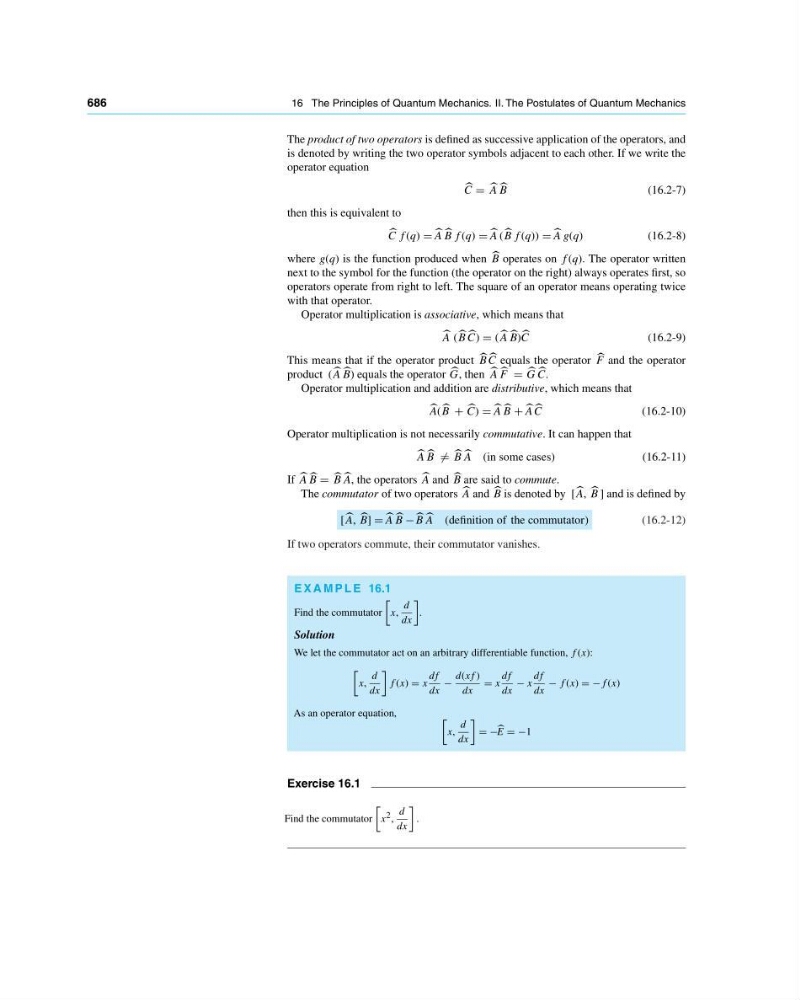
The product of two operators is defined as successive application of the operators, and
is denoted by writing the two operator symbols adjacent to each other. If we write the
operator equation
C
A
B
(16.2-7)
then this is equivalent to
C f (q)
A
B f (q)
A (
B f (q))
A g(q)
(16.2-8)
where g(q) is the function produced when
B operates on f (q). The operator written
next to the symbol for the function (the operator on the right) always operates first, so
operators operate from right to left. The square of an operator means operating twice
with that operator.
Operator multiplication is associative, which means that
A (
B
C) (
A
B)
C
(16.2-9)
This means that if the operator product
B
C equals the operator
F and the operator
product (
A
B) equals the operator
G, then
A
F
G
C.
Operator multiplication and addition are distributive, which means that
A(
B +
C)
A
B +
A
C
(16.2-10)
Operator multiplication is not necessarily commutative. It can happen that
A
B
B
A (in some cases)
(16.2-11)
If
A
B
B
A, the operators
A and
B are said to commute.
The commutator of two operators
A and
B is denoted by [
A,
B ] and is defined by
[
A,
B]
A
B −
B
A (definition of the commutator)
(16.2-12)
If two operators commute, their commutator vanishes.
E X A M P L E 16.1
Find the commutator
x,
d
dx
.
Solution
We let the commutator act on an arbitrary differentiable function, f (x):
x,
d
dx
f (x) x
df
dx
−
d(xf )
dx
x
df
dx
− x
df
dx
− f (x) −f (x)
As an operator equation,
x,
d
dx
−
E −1
Exercise 16.1
Find the commutator
x 2 ,
d
dx
.