

16.2 The Third Postulate. Mathematical Operators and Mechanical Variables
685
can take on. The third and fourth postulates must be used to obtain the possible values
of other mechanical variables such as the momentum and the angular momentum. The
third postulate is:
Postulate 3. There is a linear hermitian mathematical operator in one-to-one correspondence with every mechanical variable.
This postulate states that for each operator there is one and only one variable, and
for each variable there is one and only one mathematical operator. A mathematical
operator is a symbol that stands for performing one or more mathematical operations.
When the symbol for an operator is written to the left of the symbol for a function, the
operation is to be applied to that function. For example, d/dx is a derivative operator,
standing for differentiation of the function with respect to x; c is a multiplication
operator, standing for multiplication of the function by the constant c; h(x) is also a
multiplication operator, standing for multiplication by the function h(x). We usually
denote an operator by a letter with a caret () over it.
The result of operating on a function with an operator is another function. If
A is an
operator and f is a function,
A f(q) g(q)
(16.2-1)
where g is another function. The symbol q is an abbreviation for whatever independent
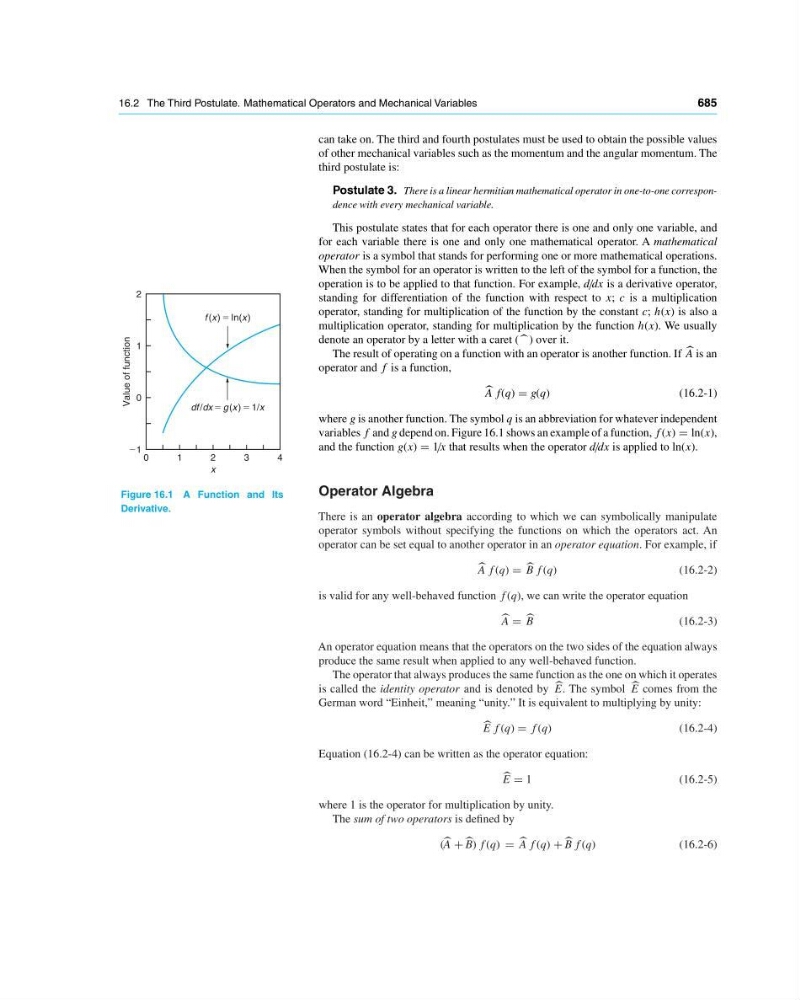
variables f and g depend on. Figure 16.1 shows an example of a function, f (x) ln(x),
and the function g(x) 1/x that results when the operator d/dx is applied to ln(x).
0
0
Value of function
1
2
21
1
2
3
x
df /dx 5 g (x ) 5 1/x
f (x ) 5 In(x )
4
Figure 16.1 A Function and Its
Derivative.
Operator Algebra
There is an operator algebra according to which we can symbolically manipulate
operator symbols without specifying the functions on which the operators act. An
operator can be set equal to another operator in an operator equation. For example, if
A f (q)
B f (q)
(16.2-2)
is valid for any well-behaved function f (q), we can write the operator equation
A
B
(16.2-3)
An operator equation means that the operators on the two sides of the equation always
produce the same result when applied to any well-behaved function.
The operator that always produces the same function as the one on which it operates
is called the identity operator and is denoted by
E. The symbol
E comes from the
German word “Einheit,” meaning “unity.” It is equivalent to multiplying by unity:
E f (q) f (q)
(16.2-4)
Equation (16.2-4) can be written as the operator equation:
E 1
(16.2-5)
where 1 is the operator for multiplication by unity.
The sum of two operators is defined by
(
A +
B) f (q)
A f (q) +
B f (q)
(16.2-6)