

14.4 The Old Quantum Theory
649
where we assign the value of V to approach zero as r → ∞. (Remember that we
can always pick the state at which we assign V to equal zero.) The kinetic energy is
given by
K
1
2
m e ν
2
1
2
e 2
4πε 0 r
1
2
|V |
(14.4-18)
where Eq. (14.4-13) has been used to replace v 2 . The kinetic energy is equal to half
of the magnitude of the potential energy. This is one of the consequences of the virial
theorem of mechanics and holds for any system acted upon only by electrostatic forces. 4
The energy of the hydrogen atom is given by the formula:
E E n K + V −
1
2
e 2
4πε 0 r
−
2π 2 m e e 4
(4πε 0 ) 2 h 2 n 2
(14.4-19a)
where we have used Eq. (14.4-15) for the value of r. The energy is quantized and is
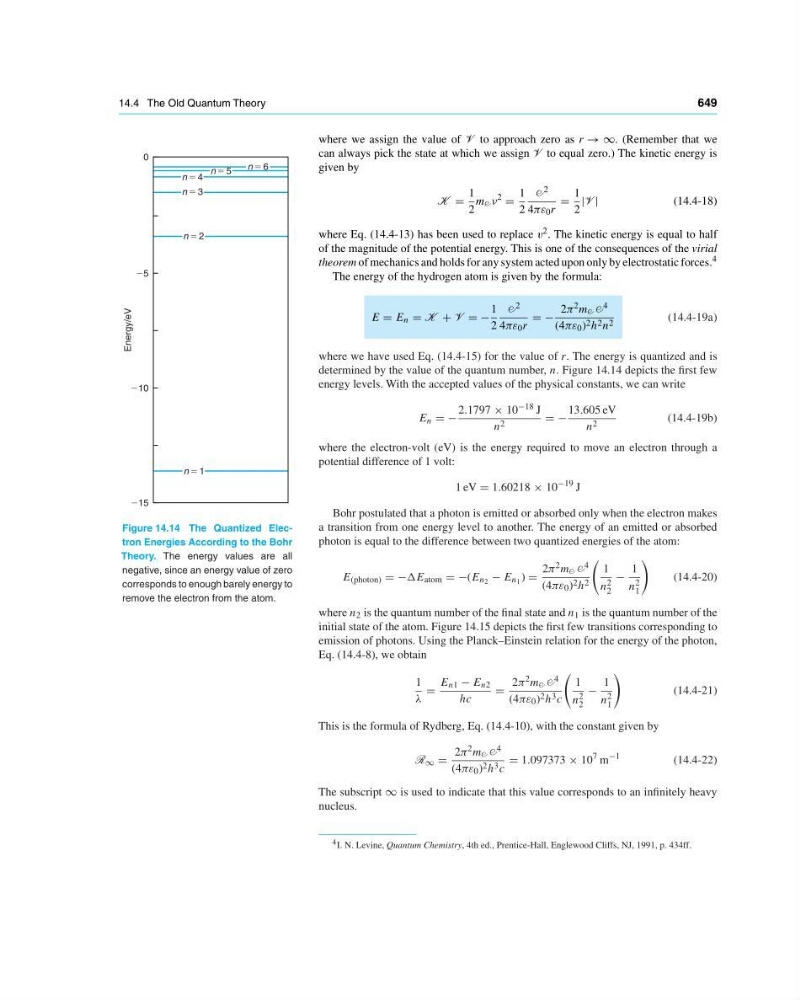
determined by the value of the quantum number, n. Figure 14.14 depicts the first few
energy levels. With the accepted values of the physical constants, we can write
E n −
2.1797 × 10 −18 J
n 2
−
13.605 eV
n 2
(14.4-19b)
where the electron-volt (eV) is the energy required to move an electron through a
potential difference of 1 volt:
1 eV 1.60218 × 10
−19 J
Bohr postulated that a photon is emitted or absorbed only when the electron makes
a transition from one energy level to another. The energy of an emitted or absorbed
photon is equal to the difference between two quantized energies of the atom:
E (photon) −∆E atom −(E n 2 − E n 1 )
2π 2 m e e 4
(4πε 0 ) 2 h 2
1
n 2
2
−
1
n 2
1
(14.4-20)
where n 2 is the quantum number of the final state and n 1 is the quantum number of the
initial state of the atom. Figure 14.15 depicts the first few transitions corresponding to
emission of photons. Using the Planck–Einstein relation for the energy of the photon,
Eq. (14.4-8), we obtain
1
λ
E n1 − E n2
hc
2π 2 m e e 4
(4πε 0 ) 2 h 3 c
1
n 2
2
−
1
n 2
1
(14.4-21)
This is the formula of Rydberg, Eq. (14.4-10), with the constant given by
R ∞
2π 2 m e e 4
(4πε 0 ) 2 h 3 c
1.097373 × 10
7 m
−1
(14.4-22)
The subscript ∞ is used to indicate that this value corresponds to an infinitely heavy
nucleus.
n 5 6
n 5 5
n 5 4
n 5 3
n 5 1
215
210
25
0
Energy/eV
n 5 2
Figure 14.14 The Quantized Electron Energies According to the Bohr
Theory. The energy values are all
negative, since an energy value of zero
corresponds to enough barely energy to
remove the electron from the atom.
4 I. N. Levine, Quantum Chemistry, 4th ed., Prentice-Hall, Englewood Cliffs, NJ, 1991, p. 434ff.