

648
14 Classical Mechanics and the Old Quantum Theory
The centripetal force is provided by the electrostatic attraction of the positive nucleus
for the negative electron. Coulomb’s law for the force between a charge Q 1 and another
charge Q 2 separated by a vacuum is
F 12
Q 1 Q 2
4πε 0 r 12
(14.4-12)
where ε 0 is the permittivity of the vacuum, equal to 8.8545 × 10 −12 C
2 N −1 m −2 , and
where r 12 is the distance between the charges. If the two charges are of opposite sign,
the force is negative, corresponding to attraction. We equate the centripetal force and
the electrostatic force:
m e v 2
r
e 2
4πε 0 r 2
(14.4-13)
Coulomb’s law is named for Charles
Augustin de Coulomb, 1736–1806, the
French physicist who discovered
this law.
The angular momentum of the electron in a circular orbit is a vector denoted by L
and is given by Eq. (E-19) of Appendix E. It is quantized, according to assumption 2,
taking on the possible magnitudes
L rm e ν
nh
2π
(14.4-14)
where the quantum number n is a positive integer. Equation (14.4-14) is solved for the
speed ν and the result is substituted into Eq. (14.4-13). The resulting equation is solved
for the radius of the orbit to give
r
h 2 4πε 0
4π 2 m 2
e
n 2 a 0 n 2
(14.4-15)
where a 0 is equal to 5.29198 × 10 −11 m (52.9198 pm or 0.529198 Å) and is called
the Bohr radius. This value corresponds to an infinitely massive nucleus. The radius
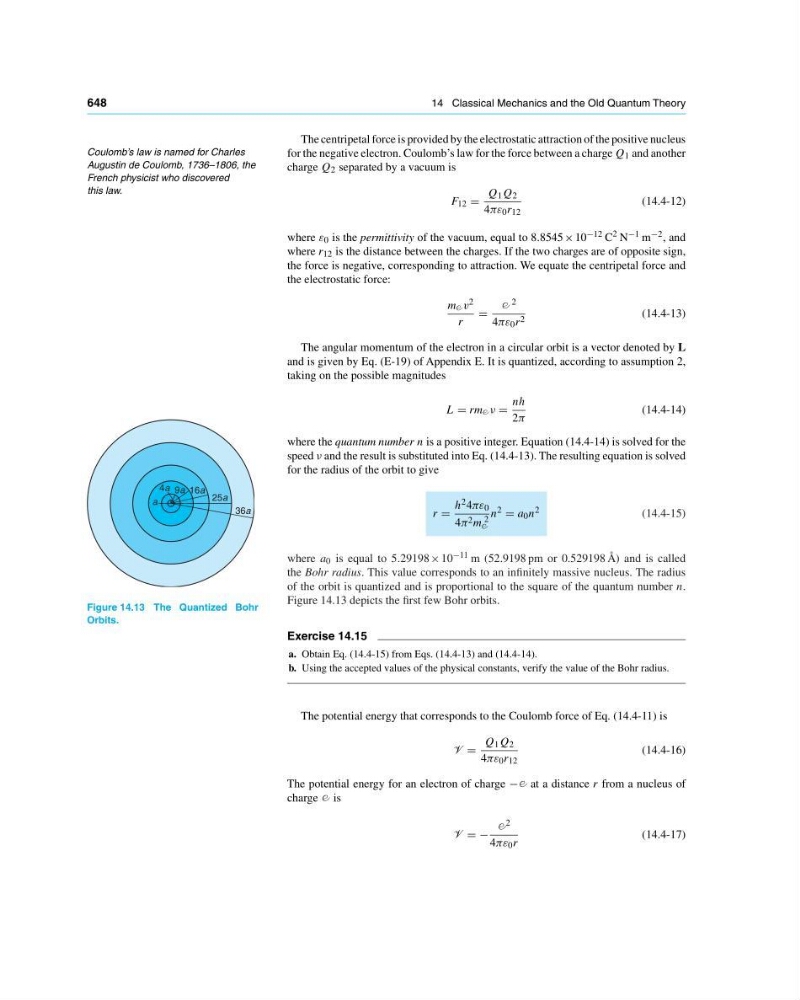
of the orbit is quantized and is proportional to the square of the quantum number n.
Figure 14.13 depicts the first few Bohr orbits.
a
4a 9a 16a
25a
36a
Figure 14.13 The Quantized Bohr
Orbits.
Exercise 14.15
a. Obtain Eq. (14.4-15) from Eqs. (14.4-13) and (14.4-14).
b. Using the accepted values of the physical constants, verify the value of the Bohr radius.
The potential energy that corresponds to the Coulomb force of Eq. (14.4-11) is
V
Q 1 Q 2
4πε 0 r 12
(14.4-16)
The potential energy for an electron of charge −e at a distance r from a nucleus of
charge e is
V −
e 2
4πε 0 r
(14.4-17)