

636
14 Classical Mechanics and the Old Quantum Theory
1
0
n 5 3
n 5 2
n 5 1
Sum of
3 harmonics
0.0
0.2
0.4
x/L
(a)
0.6
0.8
1.0
Wave displacement
21
1
0
n 5 3
n 5 2
n 5 1
Sum of
3 harmonics
0.0
0.2
0.4
x/L
(b)
0.6
0.8
1.0
Wave displacement
21
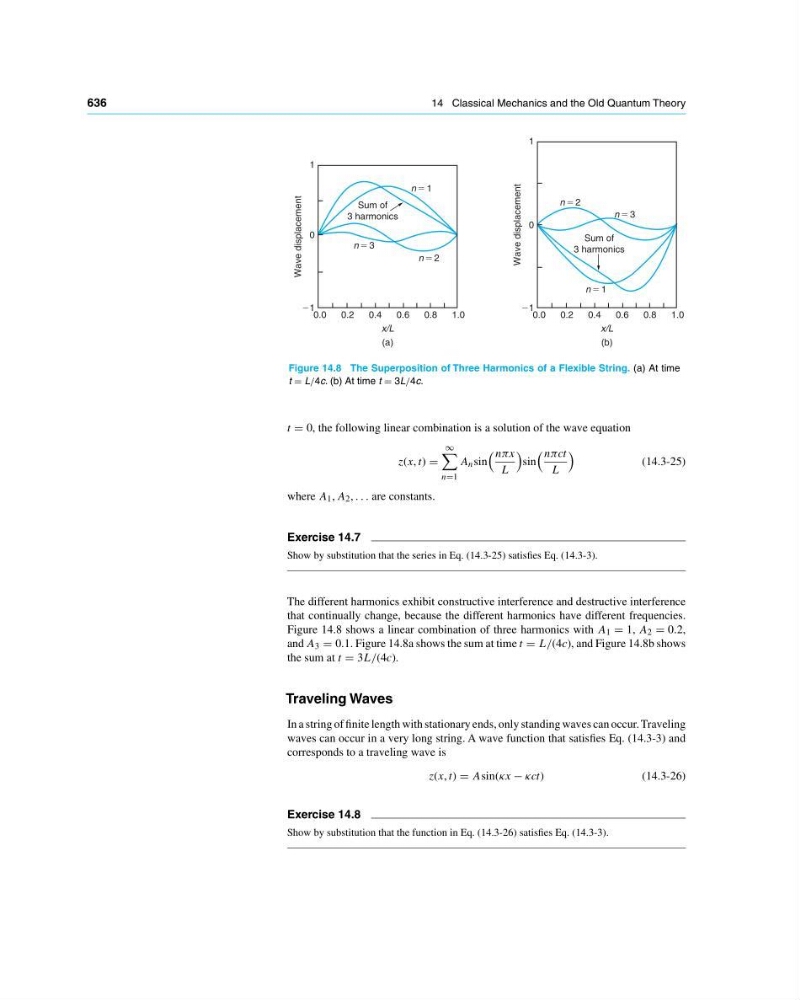
Figure 14.8 The Superposition of Three Harmonics of a Flexible String. (a) At time
t L/4c. (b) At time t 3L/4c.
t 0, the following linear combination is a solution of the wave equation
z(x, t)
∞
n1
A n sin
nπx
L
sin
nπct
L
(14.3-25)
where A 1 , A 2 , . . . are constants.
Exercise 14.7
Show by substitution that the series in Eq. (14.3-25) satisfies Eq. (14.3-3).
The different harmonics exhibit constructive interference and destructive interference
that continually change, because the different harmonics have different frequencies.
Figure 14.8 shows a linear combination of three harmonics with A 1 1, A 2 0.2,
and A 3 0.1. Figure 14.8a shows the sum at time t L/(4c), and Figure 14.8b shows
the sum at t 3L/(4c).
Traveling Waves
In a string of finite length with stationary ends, only standing waves can occur. Traveling
waves can occur in a very long string. A wave function that satisfies Eq. (14.3-3) and
corresponds to a traveling wave is
z(x, t) Asin(κx − κct)
(14.3-26)
Exercise 14.8
Show by substitution that the function in Eq. (14.3-26) satisfies Eq. (14.3-3).