

14.3 Classical Waves
635
1.5
1.0
Wave displacement
0.5
0.0
20.5
21.0
21.5
0.0
0.2
0.4
0.6
x / L
(a)
0.8 1.0
1.5
1.0
Wave displacement
0.5
0.0
20.5
21.0
21.5
0.0
0.2
0.4
0.6
x / L
(b)
0.8 1.0
1.5
1.0
Wave displacement
0.5
0.0
20.5
21.0
21.5
0.0
0.2
0.4
0.6
x / L
(d)
0.8 1.0
1.5
1.0
Wave displacement
0.5
0.0
20.5
21.0
21.5
0.0
0.2
0.4
0.6
x / L
(c)
0.8 1.0
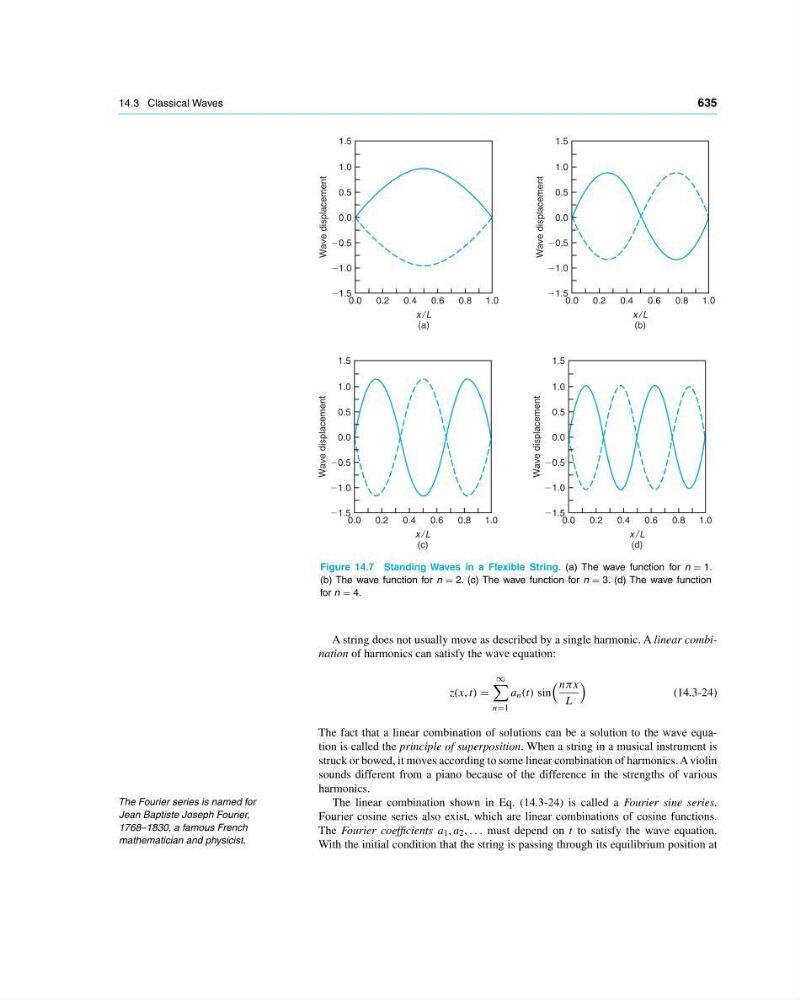
Figure 14.7 Standing Waves in a Flexible String. (a) The wave function for n 1.
(b) The wave function for n 2. (c) The wave function for n 3. (d) The wave function
for n 4.
A string does not usually move as described by a single harmonic. A linear combination of harmonics can satisfy the wave equation:
z(x, t)
∞
n1
a n (t) sin
nπx
L
(14.3-24)
The fact that a linear combination of solutions can be a solution to the wave equation is called the principle of superposition. When a string in a musical instrument is
struck or bowed, it moves according to some linear combination of harmonics. A violin
sounds different from a piano because of the difference in the strengths of various
harmonics.
The Fourier series is named for
Jean Baptiste Joseph Fourier,
1768–1830, a famous French
mathematician and physicist.
The linear combination shown in Eq. (14.3-24) is called a Fourier sine series.
Fourier cosine series also exist, which are linear combinations of cosine functions.
The Fourier coefficients a 1 , a 2 , . . . must depend on t to satisfy the wave equation.
With the initial condition that the string is passing through its equilibrium position at