

2.1 Work and the State of a System
41
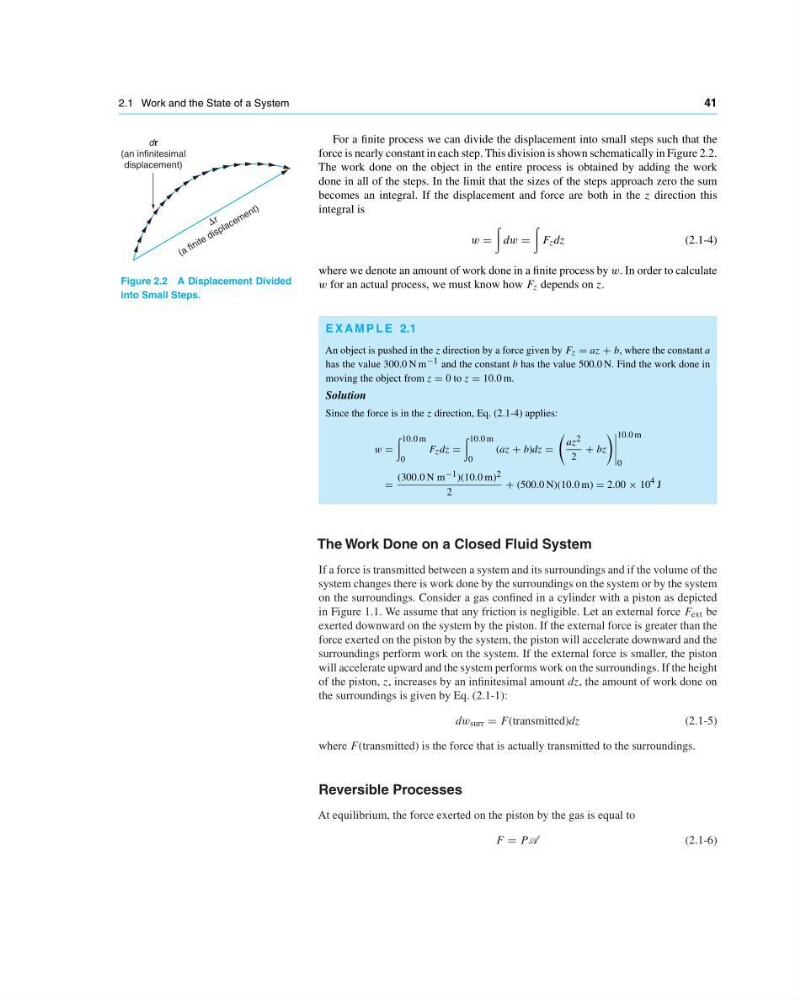
For a finite process we can divide the displacement into small steps such that the
force is nearly constant in each step. This division is shown schematically in Figure 2.2.
The work done on the object in the entire process is obtained by adding the work
done in all of the steps. In the limit that the sizes of the steps approach zero the sum
becomes an integral. If the displacement and force are both in the z direction this
integral is
w
dw
F z dz
(2.1-4)
where we denote an amount of work done in a finite process by w. In order to calculate
w for an actual process, we must know how F z depends on z.
dr
(an infinitesimal
displacement)
⌬ r
( a f in it e d is p la c e m e n t )
Figure 2.2 A Displacement Divided
into Small Steps.
E X A M P L E 2.1
An object is pushed in the z direction by a force given by F z az + b, where the constant a
has the value 300.0 N m −1 and the constant b has the value 500.0 N. Find the work done in
moving the object from z 0 to z 10.0 m.
Solution
Since the force is in the z direction, Eq. (2.1-4) applies:
w
10.0 m
0
F z dz
10.0 m
0
(az + b)dz
az 2
2
+ bz
10.0 m
0
(300.0 N m −1 )(10.0 m) 2
2
+ (500.0 N)(10.0 m) 2.00 × 10 4 J
The Work Done on a Closed Fluid System
If a force is transmitted between a system and its surroundings and if the volume of the
system changes there is work done by the surroundings on the system or by the system
on the surroundings. Consider a gas confined in a cylinder with a piston as depicted
in Figure 1.1. We assume that any friction is negligible. Let an external force F ext be
exerted downward on the system by the piston. If the external force is greater than the
force exerted on the piston by the system, the piston will accelerate downward and the
surroundings perform work on the system. If the external force is smaller, the piston
will accelerate upward and the system performs work on the surroundings. If the height
of the piston, z, increases by an infinitesimal amount dz, the amount of work done on
the surroundings is given by Eq. (2.1-1):
dw surr F (transmitted)dz
(2.1-5)
where F (transmitted) is the force that is actually transmitted to the surroundings.
Reversible Processes
At equilibrium, the force exerted on the piston by the gas is equal to
F PA
(2.1-6)
41
For a finite process we can divide the displacement into small steps such that the
force is nearly constant in each step. This division is shown schematically in Figure 2.2.
The work done on the object in the entire process is obtained by adding the work
done in all of the steps. In the limit that the sizes of the steps approach zero the sum
becomes an integral. If the displacement and force are both in the z direction this
integral is
w
dw
F z dz
(2.1-4)
where we denote an amount of work done in a finite process by w. In order to calculate
w for an actual process, we must know how F z depends on z.
dr
(an infinitesimal
displacement)
⌬ r
( a f in it e d is p la c e m e n t )
Figure 2.2 A Displacement Divided
into Small Steps.
E X A M P L E 2.1
An object is pushed in the z direction by a force given by F z az + b, where the constant a
has the value 300.0 N m −1 and the constant b has the value 500.0 N. Find the work done in
moving the object from z 0 to z 10.0 m.
Solution
Since the force is in the z direction, Eq. (2.1-4) applies:
w
10.0 m
0
F z dz
10.0 m
0
(az + b)dz
az 2
2
+ bz
10.0 m
0
(300.0 N m −1 )(10.0 m) 2
2
+ (500.0 N)(10.0 m) 2.00 × 10 4 J
The Work Done on a Closed Fluid System
If a force is transmitted between a system and its surroundings and if the volume of the
system changes there is work done by the surroundings on the system or by the system
on the surroundings. Consider a gas confined in a cylinder with a piston as depicted
in Figure 1.1. We assume that any friction is negligible. Let an external force F ext be
exerted downward on the system by the piston. If the external force is greater than the
force exerted on the piston by the system, the piston will accelerate downward and the
surroundings perform work on the system. If the external force is smaller, the piston
will accelerate upward and the system performs work on the surroundings. If the height
of the piston, z, increases by an infinitesimal amount dz, the amount of work done on
the surroundings is given by Eq. (2.1-1):
dw surr F (transmitted)dz
(2.1-5)
where F (transmitted) is the force that is actually transmitted to the surroundings.
Reversible Processes
At equilibrium, the force exerted on the piston by the gas is equal to
F PA
(2.1-6)