

40
2 Work, Heat, and Energy: The First Law of Thermodynamics
2.1
Work and the State of a System
Thermodynamics involves work and heat. It began in the 19th century with the
efforts of engineers to increase the efficiency of steam engines, but it has become
the general theory of the macroscopic behavior of matter at equilibrium. It is
based on empirical laws, as is classical mechanics. Although classical mechanics
has been superseded by relativistic mechanics and quantum mechanics, thermodynamics is an unchallenged theory. No exceptions have been found to the laws of
thermodynamics.
Mechanical Work
The quantitative measurement of work was introduced by Carnot, who defined an
amount of work done on an object as the height it is lifted times its weight. This
definition was extended by Coriolis, who provided the presently used definition of
work: The amount of work done on an object equals the force exerted on it times the
distance it is moved in the direction of the force. If a force F z is exerted on an object in
the z direction, the work done on the object in an infinitesimal displacement dz in the
z direction is
dw F z dz (definition of work)
(2.1-1)
where dw is the quantity of work. The SI unit of force is the newton (N kg m s
−2 ),
and the SI unit of work is the joule (J kg m 2 s −2 N m),
Nicolas Leonard Sadi Carnot, 1796–1832,
was a French engineer who was the
first to consider quantitatively the
interconversion of work and heat and
who is credited with founding the
science of thermodynamics.
Gaspard de Coriolis, 1792–1843, was a
French physicist best known for the
Coriolis force.
If the force and the displacement are not in the same direction, they must be
treated as vectors. A vector is a quantity that has both magnitude and direction. Vectors
are discussed briefly in Appendix B. We denote vectors by boldface letters and denote
the magnitude of a vector by the symbol for the vector between vertical bars or by
the letter in plain type. The amount of work dw can be written as the scalar product
of the two vectors F and dr where F is the force exerted on the object and dr is its
displacement:
dw F · dr |F||dr| cos(α)
(2.1-2)
where α denotes the angle between the vector F and the vector dr. The scalar product of the vectors F and dr, denoted by F · dr, is defined by the second equality in
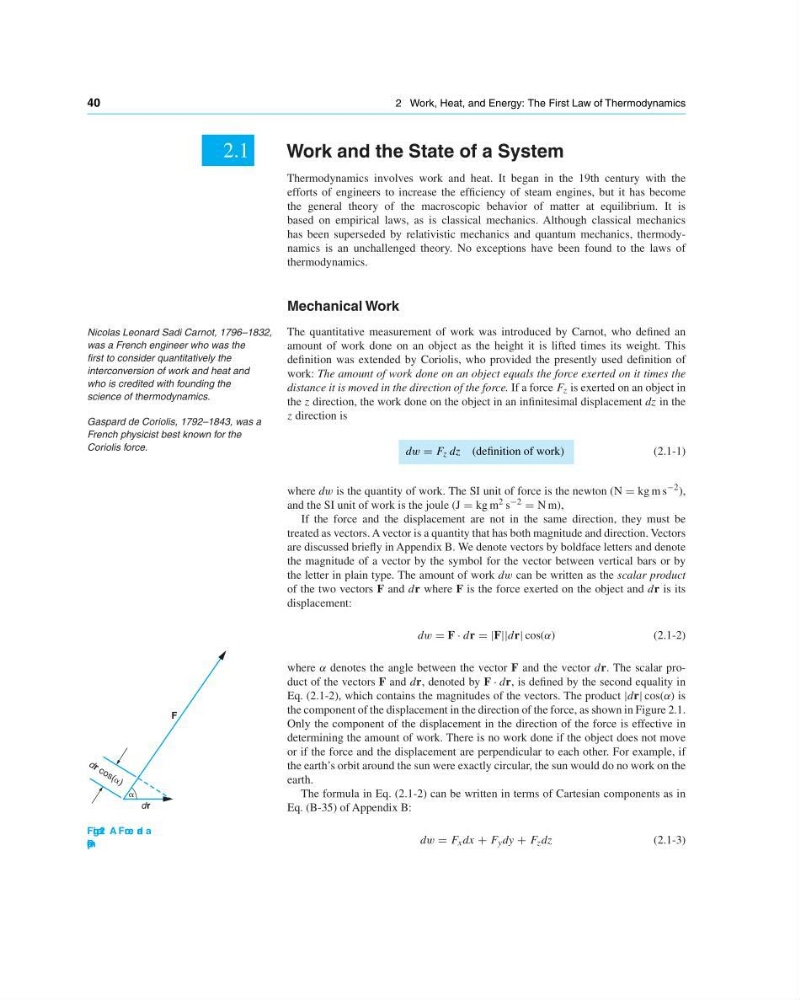
Eq. (2.1-2), which contains the magnitudes of the vectors. The product |dr| cos(α) is
the component of the displacement in the direction of the force, as shown in Figure 2.1.
Only the component of the displacement in the direction of the force is effective in
determining the amount of work. There is no work done if the object does not move
or if the force and the displacement are perpendicular to each other. For example, if
the earth’s orbit around the sun were exactly circular, the sun would do no work on the
earth.
d r c o s ( a )
a
dr
F
Fi g u re2 . 1 A Fo rc e a n d a
D i s p l a c e m e n t .
The formula in Eq. (2.1-2) can be written in terms of Cartesian components as in
Eq. (B-35) of Appendix B:
dw F x dx + F y dy + F z dz
(2.1-3)
2 Work, Heat, and Energy: The First Law of Thermodynamics
2.1
Work and the State of a System
Thermodynamics involves work and heat. It began in the 19th century with the
efforts of engineers to increase the efficiency of steam engines, but it has become
the general theory of the macroscopic behavior of matter at equilibrium. It is
based on empirical laws, as is classical mechanics. Although classical mechanics
has been superseded by relativistic mechanics and quantum mechanics, thermodynamics is an unchallenged theory. No exceptions have been found to the laws of
thermodynamics.
Mechanical Work
The quantitative measurement of work was introduced by Carnot, who defined an
amount of work done on an object as the height it is lifted times its weight. This
definition was extended by Coriolis, who provided the presently used definition of
work: The amount of work done on an object equals the force exerted on it times the
distance it is moved in the direction of the force. If a force F z is exerted on an object in
the z direction, the work done on the object in an infinitesimal displacement dz in the
z direction is
dw F z dz (definition of work)
(2.1-1)
where dw is the quantity of work. The SI unit of force is the newton (N kg m s
−2 ),
and the SI unit of work is the joule (J kg m 2 s −2 N m),
Nicolas Leonard Sadi Carnot, 1796–1832,
was a French engineer who was the
first to consider quantitatively the
interconversion of work and heat and
who is credited with founding the
science of thermodynamics.
Gaspard de Coriolis, 1792–1843, was a
French physicist best known for the
Coriolis force.
If the force and the displacement are not in the same direction, they must be
treated as vectors. A vector is a quantity that has both magnitude and direction. Vectors
are discussed briefly in Appendix B. We denote vectors by boldface letters and denote
the magnitude of a vector by the symbol for the vector between vertical bars or by
the letter in plain type. The amount of work dw can be written as the scalar product
of the two vectors F and dr where F is the force exerted on the object and dr is its
displacement:
dw F · dr |F||dr| cos(α)
(2.1-2)
where α denotes the angle between the vector F and the vector dr. The scalar product of the vectors F and dr, denoted by F · dr, is defined by the second equality in
Eq. (2.1-2), which contains the magnitudes of the vectors. The product |dr| cos(α) is
the component of the displacement in the direction of the force, as shown in Figure 2.1.
Only the component of the displacement in the direction of the force is effective in
determining the amount of work. There is no work done if the object does not move
or if the force and the displacement are perpendicular to each other. For example, if
the earth’s orbit around the sun were exactly circular, the sun would do no work on the
earth.
d r c o s ( a )
a
dr
F
Fi g u re2 . 1 A Fo rc e a n d a
D i s p l a c e m e n t .
The formula in Eq. (2.1-2) can be written in terms of Cartesian components as in
Eq. (B-35) of Appendix B:
dw F x dx + F y dy + F z dz
(2.1-3)