

578
13 Chemical Reaction Mechanisms II: Catalysis and Miscellaneous Topics
0 [R] 5 K m
k 2 [E] total
[R]
r
initial
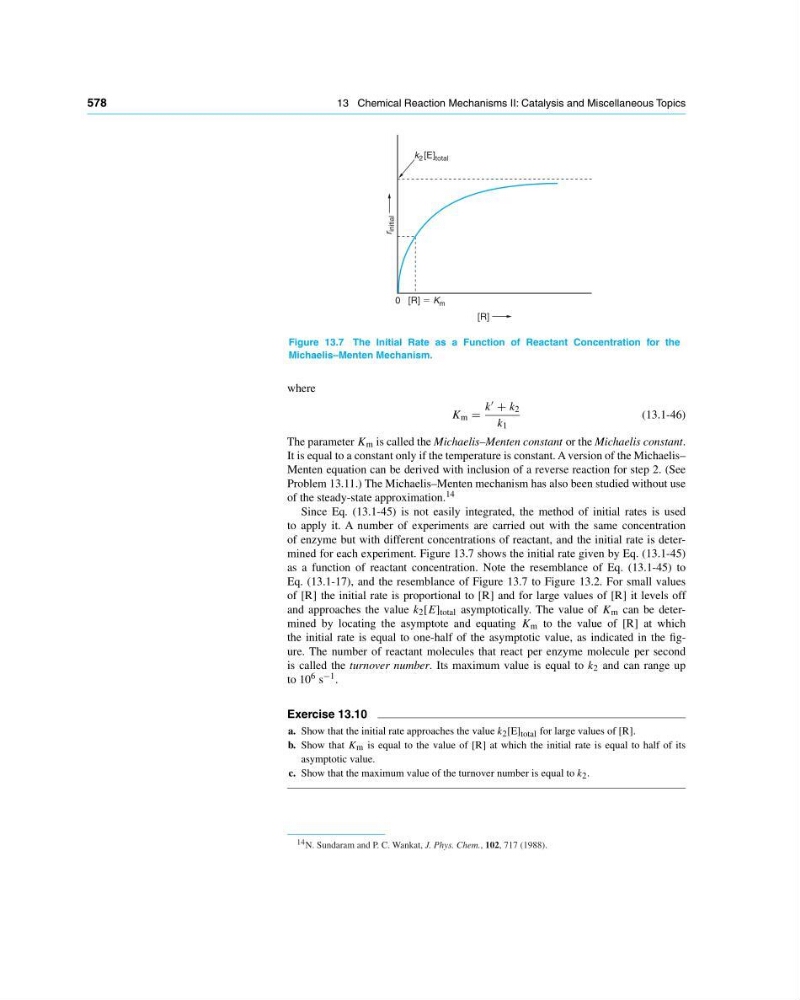
Figure 13.7 The Initial Rate as a Function of Reactant Concentration for the
Michaelis–Menten Mechanism.
where
K m
k + k 2
k 1
(13.1-46)
The parameter K m is called the Michaelis–Menten constant or the Michaelis constant.
It is equal to a constant only if the temperature is constant. A version of the Michaelis–
Menten equation can be derived with inclusion of a reverse reaction for step 2. (See
Problem 13.11.) The Michaelis–Menten mechanism has also been studied without use
of the steady-state approximation. 14
Since Eq. (13.1-45) is not easily integrated, the method of initial rates is used
to apply it. A number of experiments are carried out with the same concentration
of enzyme but with different concentrations of reactant, and the initial rate is determined for each experiment. Figure 13.7 shows the initial rate given by Eq. (13.1-45)
as a function of reactant concentration. Note the resemblance of Eq. (13.1-45) to
Eq. (13.1-17), and the resemblance of Figure 13.7 to Figure 13.2. For small values
of [R] the initial rate is proportional to [R] and for large values of [R] it levels off
and approaches the value k 2 [E] total asymptotically. The value of K m can be determined by locating the asymptote and equating K m to the value of [R] at which
the initial rate is equal to one-half of the asymptotic value, as indicated in the figure. The number of reactant molecules that react per enzyme molecule per second
is called the turnover number. Its maximum value is equal to k 2 and can range up
to 10 6 s −1 .
Exercise 13.10
a. Show that the initial rate approaches the value k 2 [E] total for large values of [R].
b. Show that K m is equal to the value of [R] at which the initial rate is equal to half of its
asymptotic value.
c. Show that the maximum value of the turnover number is equal to k 2 .
14 N. Sundaram and P. C. Wankat, J. Phys. Chem., 102, 717 (1988).