

568
13 Chemical Reaction Mechanisms II: Catalysis and Miscellaneous Topics
Since the total area of an adsorbing surface and the area occupied by one adsorbed
molecule are probably not known, the value of θ might not be known. However, the
mass adsorbed is proportional to θ, and a graph of the mass adsorbed will have the same
shape as the graph of Figure 13.2. The asymptote corresponds to θ 1, allowing one
to determine where θ 1/2 is located on the graph if the asymptote can be accurately
located. If the data suffer from experimental errors, locating the asymptote might be
difficult, so it is desirable to make a plot of a different type, as shown in Figure 13.3.
In this figure, 1/θ is plotted as a function of 1/[A], corresponding to the reciprocal of
Eq. (13.1-8):
1
θ
1 + k[A]
k[A]
1
k[A]
+ 1
(13.1-10)
If the Langmuir isotherm is obeyed, this should give a linear plot.
1/[A]
1/
Slope = 1/K
Figure 13.3 Linear Plot of the
Langmuir Isotherm.
0.3
0.2
0.1
0
500
1000
1
m / g
1
[A] / mol L –1
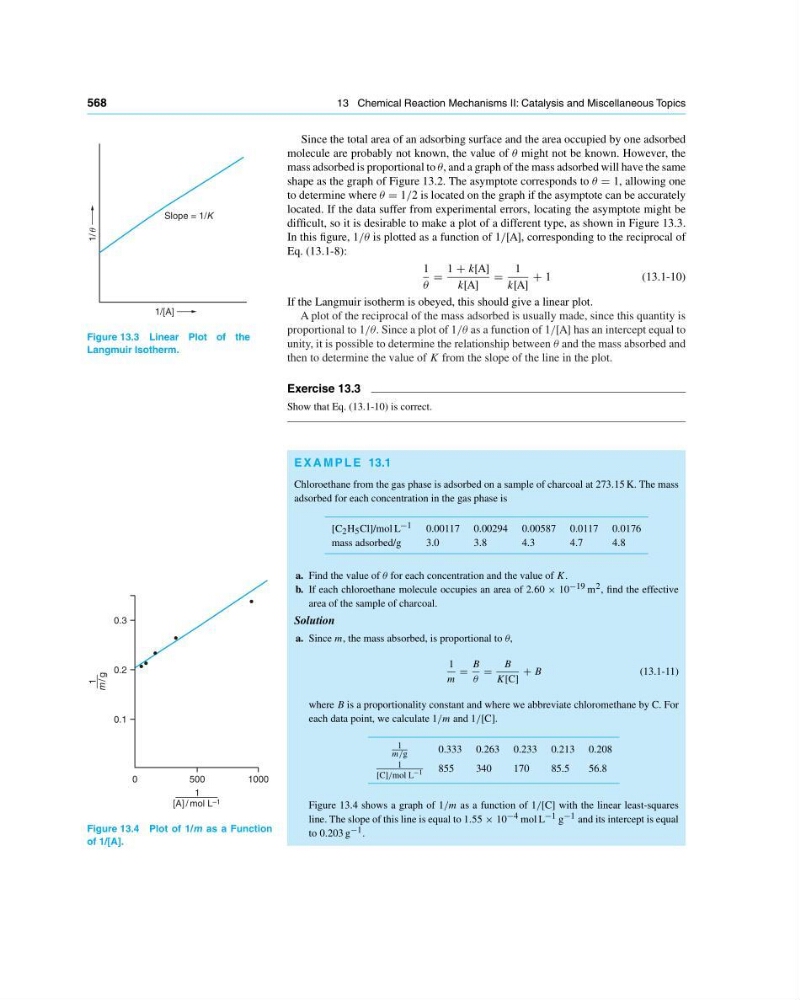
Figure 13.4 Plot of 1/m as a Function
of 1/[A].
A plot of the reciprocal of the mass adsorbed is usually made, since this quantity is
proportional to 1/θ. Since a plot of 1/θ as a function of 1/[A] has an intercept equal to
unity, it is possible to determine the relationship between θ and the mass absorbed and
then to determine the value of K from the slope of the line in the plot.
Exercise 13.3
Show that Eq. (13.1-10) is correct.
E X A M P L E 13.1
Chloroethane from the gas phase is adsorbed on a sample of charcoal at 273.15 K. The mass
adsorbed for each concentration in the gas phase is
[C 2 H 5 Cl]/mol L −1 0.00117 0.00294 0.00587 0.0117 0.0176
mass adsorbed/g
3.0
3.8
4.3
4.7
4.8
a. Find the value of θ for each concentration and the value of K.
b. If each chloroethane molecule occupies an area of 2.60 × 10 −19 m 2 , find the effective
area of the sample of charcoal.
Solution
a. Since m, the mass absorbed, is proportional to θ,
1
m
B
θ
B
K[C]
+ B
(13.1-11)
where B is a proportionality constant and where we abbreviate chloromethane by C. For
each data point, we calculate 1/m and 1/[C].
1
m/g
0.333 0.263 0.233 0.213 0.208
1
[C]/mol L −1
855
340
170
85.5
56.8
Figure 13.4 shows a graph of 1/m as a function of 1/[C] with the linear least-squares
line. The slope of this line is equal to 1.55 × 10 −4 mol L −1 g −1 and its intercept is equal
to 0.203 g −1 .