

13.1 Catalysis
567
This theory was devised by Irving
Langmuir, 1881–1957, an American
industrial chemist who won the 1932
Nobel Prize in chemistry for his work on
surface chemistry.
Let θ represent the fraction of the surface sites that are occupied by adsorbed
A molecules. The adsorption is assumed to be an elementary process so that the rate of
adsorption is proportional to the concentration of A in the fluid phase and to 1 − θ, the
fraction of surface sites available for adsorption:
rate of adsorption k 1 [A](1 − θ)
(13.1-5)
where [A] is the concentration of A in the gas or liquid phase and where k 1 is a rate
constant that can depend on temperature but not on [A] or θ. The desorption is also
assumed to be an elementary process so that
rate of desorption k
1 θ
(13.1-6)
where k
1 is another rate constant. At equilibrium, the rate of desorption equals the rate
of adsorption:
k
1 θ k 1 [A](1 − θ)
(13.1-7)
This equation can be solved for θ to give the Langmuir isotherm:
θ
k 1 [A]
k
1 + k 1 [A]
K[A]
1 + K[A]
(Langmuir isotherm)
(13.1-8)
where K is an equilibrium constant given by
K
k 1
k
1
(13.1-9)
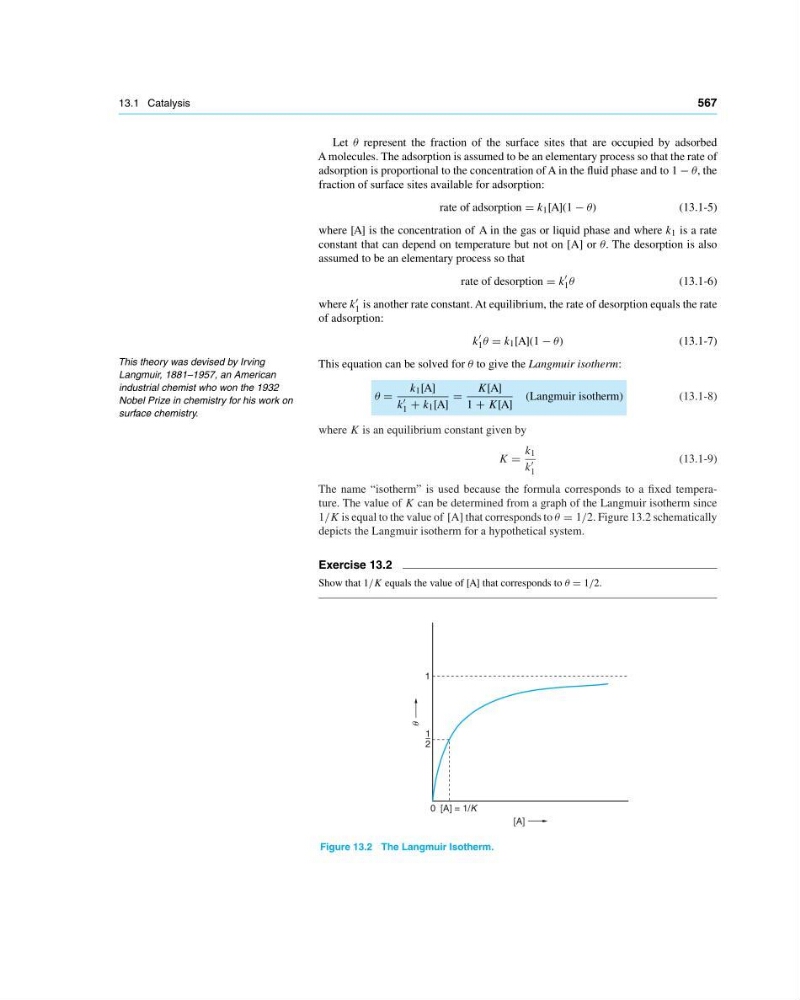
The name “isotherm” is used because the formula corresponds to a fixed temperature. The value of K can be determined from a graph of the Langmuir isotherm since
1/K is equal to the value of [A] that corresponds to θ 1/2. Figure 13.2 schematically
depicts the Langmuir isotherm for a hypothetical system.
Exercise 13.2
Show that 1/K equals the value of [A] that corresponds to θ 1/2.
1
1
2
0 [A] = 1/K
[A]
Figure 13.2 The Langmuir Isotherm.