

448
10 Transport Processes
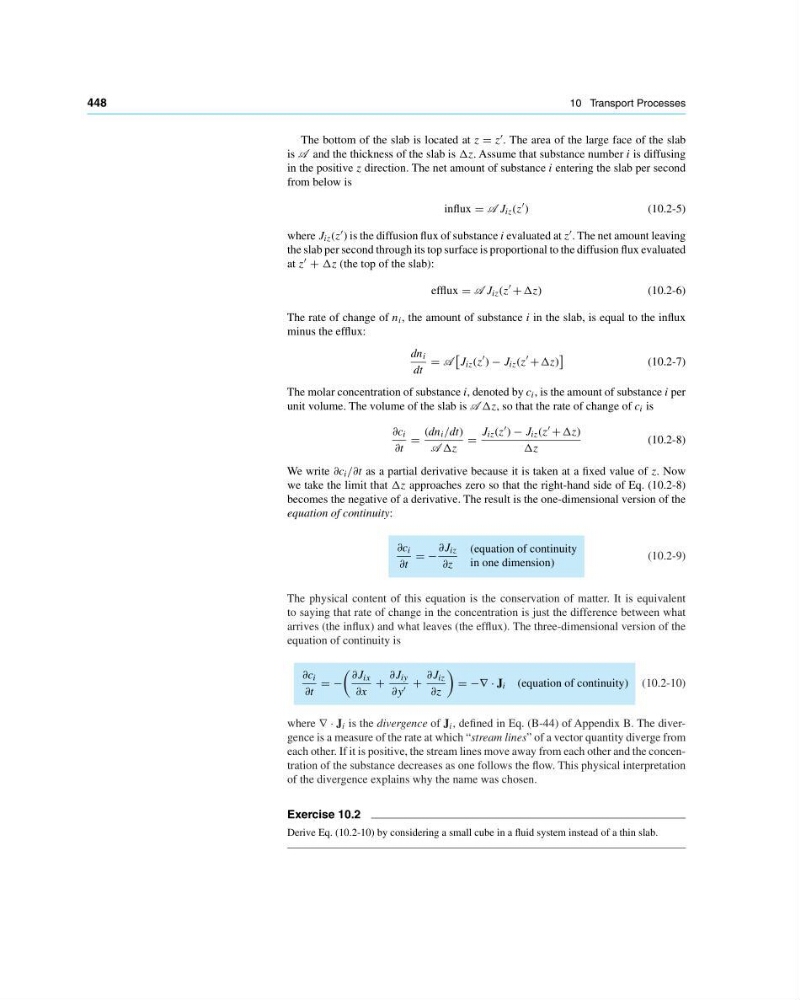
The bottom of the slab is located at z z . The area of the large face of the slab
is A and the thickness of the slab is ∆z. Assume that substance number i is diffusing
in the positive z direction. The net amount of substance i entering the slab per second
from below is
influx A J iz (z
)
(10.2-5)
where J iz (z ) is the diffusion flux of substance i evaluated at z . The net amount leaving
the slab per second through its top surface is proportional to the diffusion flux evaluated
at z + ∆z (the top of the slab):
efflux A J iz (z
+ ∆z)
(10.2-6)
The rate of change of n i , the amount of substance i in the slab, is equal to the influx
minus the efflux:
dn i
dt
A
J iz (z
) − J iz (z
+ ∆z)
(10.2-7)
The molar concentration of substance i, denoted by c i , is the amount of substance i per
unit volume. The volume of the slab is A ∆z, so that the rate of change of c i is
∂c i
∂t
(dn i /dt)
A ∆z
J iz (z ) − J iz (z + ∆z)
∆z
(10.2-8)
We write ∂c i /∂t as a partial derivative because it is taken at a fixed value of z. Now
we take the limit that ∆z approaches zero so that the right-hand side of Eq. (10.2-8)
becomes the negative of a derivative. The result is the one-dimensional version of the
equation of continuity:
∂c i
∂t
−
∂J iz
∂z
(equation of continuity
in one dimension)
(10.2-9)
The physical content of this equation is the conservation of matter. It is equivalent
to saying that rate of change in the concentration is just the difference between what
arrives (the influx) and what leaves (the efflux). The three-dimensional version of the
equation of continuity is
∂c i
∂t
−
∂J ix
∂x
+
∂J iy
∂y +
∂J iz
∂z
−∇ · J i (equation of continuity) (10.2-10)
where ∇ · J i is the divergence of J i , defined in Eq. (B-44) of Appendix B. The divergence is a measure of the rate at which “stream lines” of a vector quantity diverge from
each other. If it is positive, the stream lines move away from each other and the concentration of the substance decreases as one follows the flow. This physical interpretation
of the divergence explains why the name was chosen.
Exercise 10.2
Derive Eq. (10.2-10) by considering a small cube in a fluid system instead of a thin slab.
10 Transport Processes
The bottom of the slab is located at z z . The area of the large face of the slab
is A and the thickness of the slab is ∆z. Assume that substance number i is diffusing
in the positive z direction. The net amount of substance i entering the slab per second
from below is
influx A J iz (z
)
(10.2-5)
where J iz (z ) is the diffusion flux of substance i evaluated at z . The net amount leaving
the slab per second through its top surface is proportional to the diffusion flux evaluated
at z + ∆z (the top of the slab):
efflux A J iz (z
+ ∆z)
(10.2-6)
The rate of change of n i , the amount of substance i in the slab, is equal to the influx
minus the efflux:
dn i
dt
A
J iz (z
) − J iz (z
+ ∆z)
(10.2-7)
The molar concentration of substance i, denoted by c i , is the amount of substance i per
unit volume. The volume of the slab is A ∆z, so that the rate of change of c i is
∂c i
∂t
(dn i /dt)
A ∆z
J iz (z ) − J iz (z + ∆z)
∆z
(10.2-8)
We write ∂c i /∂t as a partial derivative because it is taken at a fixed value of z. Now
we take the limit that ∆z approaches zero so that the right-hand side of Eq. (10.2-8)
becomes the negative of a derivative. The result is the one-dimensional version of the
equation of continuity:
∂c i
∂t
−
∂J iz
∂z
(equation of continuity
in one dimension)
(10.2-9)
The physical content of this equation is the conservation of matter. It is equivalent
to saying that rate of change in the concentration is just the difference between what
arrives (the influx) and what leaves (the efflux). The three-dimensional version of the
equation of continuity is
∂c i
∂t
−
∂J ix
∂x
+
∂J iy
∂y +
∂J iz
∂z
−∇ · J i (equation of continuity) (10.2-10)
where ∇ · J i is the divergence of J i , defined in Eq. (B-44) of Appendix B. The divergence is a measure of the rate at which “stream lines” of a vector quantity diverge from
each other. If it is positive, the stream lines move away from each other and the concentration of the substance decreases as one follows the flow. This physical interpretation
of the divergence explains why the name was chosen.
Exercise 10.2
Derive Eq. (10.2-10) by considering a small cube in a fluid system instead of a thin slab.