

428
9 Gas Kinetic Theory: The Molecular Theory of Dilute Gases at Equilibrium
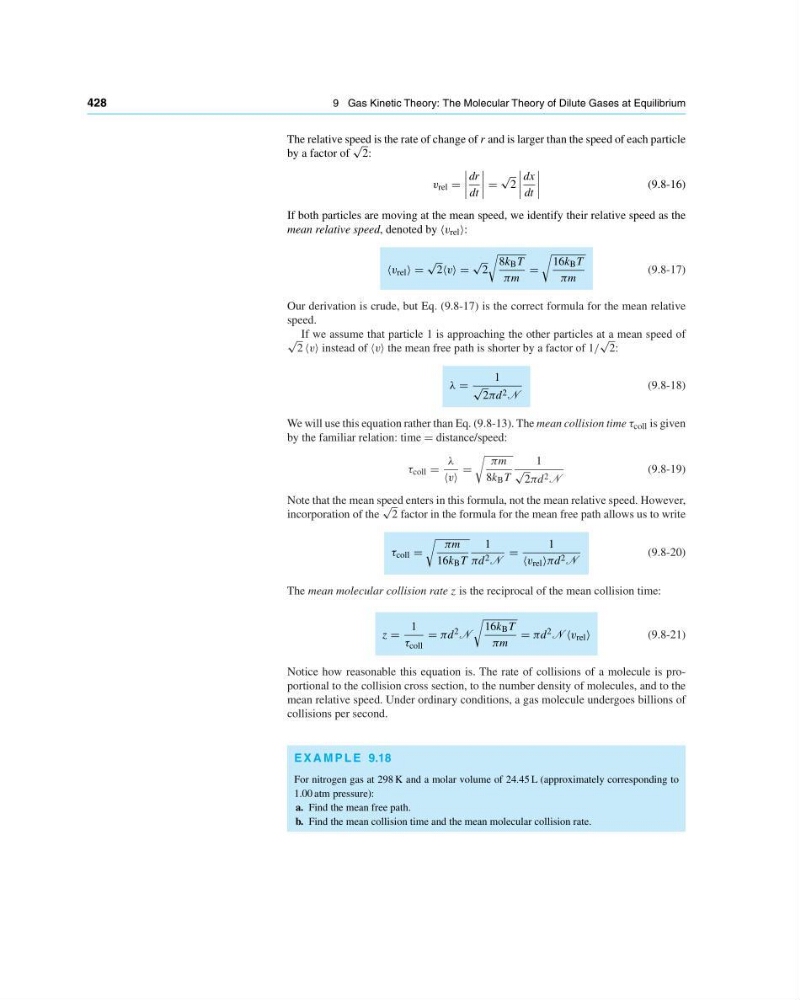
The relative speed is the rate of change of r and is larger than the speed of each particle
by a factor of
√
2:
v rel
dr
dt
√
2
dx
dt
(9.8-16)
If both particles are moving at the mean speed, we identify their relative speed as the
mean relative speed, denoted by v rel :
v rel
√
2v
√
2
8k B T
πm
16k B T
πm
(9.8-17)
Our derivation is crude, but Eq. (9.8-17) is the correct formula for the mean relative
speed.
If we assume that particle 1 is approaching the other particles at a mean speed of
√
2 v instead of v the mean free path is shorter by a factor of 1/
√
2:
λ
1
√
2πd 2 N
(9.8-18)
We will use this equation rather than Eq. (9.8-13). The mean collision time τ coll is given
by the familiar relation: time distance/speed:
τ coll
λ
v
πm
8k B T
1
√
2πd 2 N
(9.8-19)
Note that the mean speed enters in this formula, not the mean relative speed. However,
incorporation of the
√
2 factor in the formula for the mean free path allows us to write
τ coll
πm
16k B T
1
πd 2 N
1
v rel πd 2 N
(9.8-20)
The mean molecular collision rate z is the reciprocal of the mean collision time:
z
1
τ coll
πd 2 N
16k B T
πm
πd 2 N v rel
(9.8-21)
Notice how reasonable this equation is. The rate of collisions of a molecule is proportional to the collision cross section, to the number density of molecules, and to the
mean relative speed. Under ordinary conditions, a gas molecule undergoes billions of
collisions per second.
E X A M P L E 9.18
For nitrogen gas at 298 K and a molar volume of 24.45 L (approximately corresponding to
1.00 atm pressure):
a. Find the mean free path.
b. Find the mean collision time and the mean molecular collision rate.
9 Gas Kinetic Theory: The Molecular Theory of Dilute Gases at Equilibrium
The relative speed is the rate of change of r and is larger than the speed of each particle
by a factor of
√
2:
v rel
dr
dt
√
2
dx
dt
(9.8-16)
If both particles are moving at the mean speed, we identify their relative speed as the
mean relative speed, denoted by v rel :
v rel
√
2v
√
2
8k B T
πm
16k B T
πm
(9.8-17)
Our derivation is crude, but Eq. (9.8-17) is the correct formula for the mean relative
speed.
If we assume that particle 1 is approaching the other particles at a mean speed of
√
2 v instead of v the mean free path is shorter by a factor of 1/
√
2:
λ
1
√
2πd 2 N
(9.8-18)
We will use this equation rather than Eq. (9.8-13). The mean collision time τ coll is given
by the familiar relation: time distance/speed:
τ coll
λ
v
πm
8k B T
1
√
2πd 2 N
(9.8-19)
Note that the mean speed enters in this formula, not the mean relative speed. However,
incorporation of the
√
2 factor in the formula for the mean free path allows us to write
τ coll
πm
16k B T
1
πd 2 N
1
v rel πd 2 N
(9.8-20)
The mean molecular collision rate z is the reciprocal of the mean collision time:
z
1
τ coll
πd 2 N
16k B T
πm
πd 2 N v rel
(9.8-21)
Notice how reasonable this equation is. The rate of collisions of a molecule is proportional to the collision cross section, to the number density of molecules, and to the
mean relative speed. Under ordinary conditions, a gas molecule undergoes billions of
collisions per second.
E X A M P L E 9.18
For nitrogen gas at 298 K and a molar volume of 24.45 L (approximately corresponding to
1.00 atm pressure):
a. Find the mean free path.
b. Find the mean collision time and the mean molecular collision rate.