

9.8 The Hard-Sphere Gas
427
and denoted by λ. This volume is
(volume containing one particle) λπd
2
(9.8-11)
and must equal V /N, the average volume per molecule:
λπd
2
V
N
1
N
(9.8-12)
The mean free path is therefore given in this approximation by
λ
1
πd 2 N
(approximate equation)
(9.8-13)
Equation (9.8-13) is a crude approximation because all of the particles are actually
moving. When two particles collide they might initially be moving toward each other,
they might initially be moving roughly at right angles to each other, or they might be
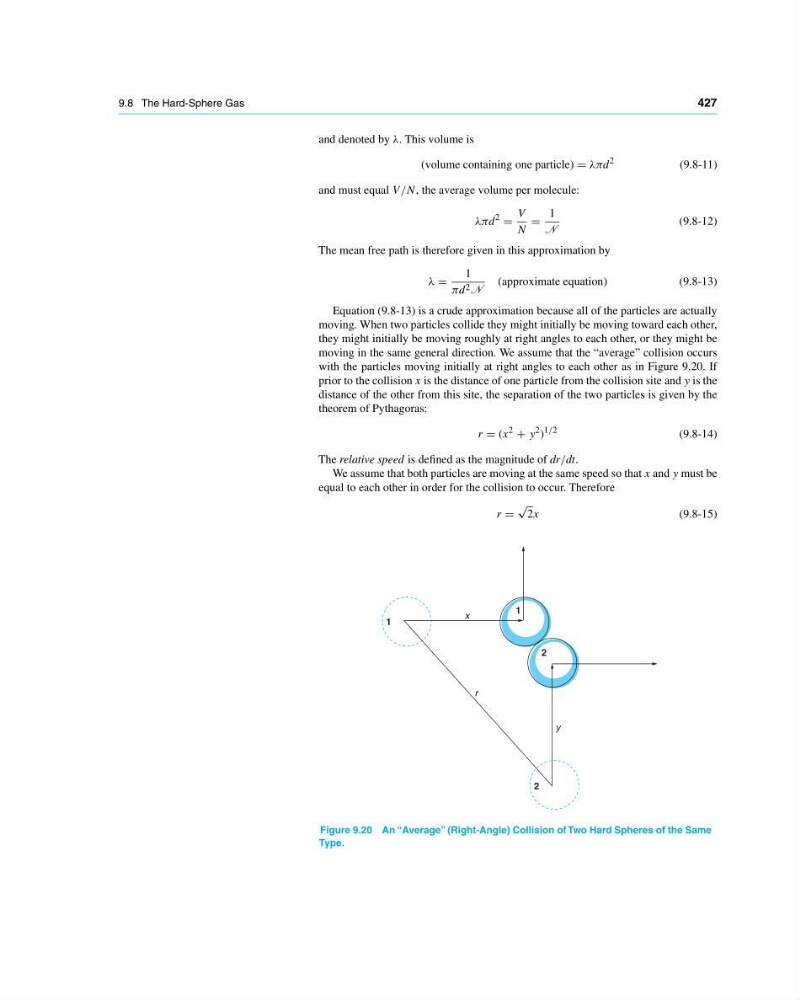
moving in the same general direction. We assume that the “average” collision occurs
with the particles moving initially at right angles to each other as in Figure 9.20. If
prior to the collision x is the distance of one particle from the collision site and y is the
distance of the other from this site, the separation of the two particles is given by the
theorem of Pythagoras:
r (x
2
+ y
2 )
1/2
(9.8-14)
The relative speed is defined as the magnitude of dr/dt.
We assume that both particles are moving at the same speed so that x and y must be
equal to each other in order for the collision to occur. Therefore
r
√
2x
(9.8-15)
1
1
x
r
y
2
2
Figure 9.20 An “Average” (Right-Angle) Collision of Two Hard Spheres of the Same
Type.
427
and denoted by λ. This volume is
(volume containing one particle) λπd
2
(9.8-11)
and must equal V /N, the average volume per molecule:
λπd
2
V
N
1
N
(9.8-12)
The mean free path is therefore given in this approximation by
λ
1
πd 2 N
(approximate equation)
(9.8-13)
Equation (9.8-13) is a crude approximation because all of the particles are actually
moving. When two particles collide they might initially be moving toward each other,
they might initially be moving roughly at right angles to each other, or they might be
moving in the same general direction. We assume that the “average” collision occurs
with the particles moving initially at right angles to each other as in Figure 9.20. If
prior to the collision x is the distance of one particle from the collision site and y is the
distance of the other from this site, the separation of the two particles is given by the
theorem of Pythagoras:
r (x
2
+ y
2 )
1/2
(9.8-14)
The relative speed is defined as the magnitude of dr/dt.
We assume that both particles are moving at the same speed so that x and y must be
equal to each other in order for the collision to occur. Therefore
r
√
2x
(9.8-15)
1
1
x
r
y
2
2
Figure 9.20 An “Average” (Right-Angle) Collision of Two Hard Spheres of the Same
Type.