

398
9 Gas Kinetic Theory: The Molecular Theory of Dilute Gases at Equilibrium
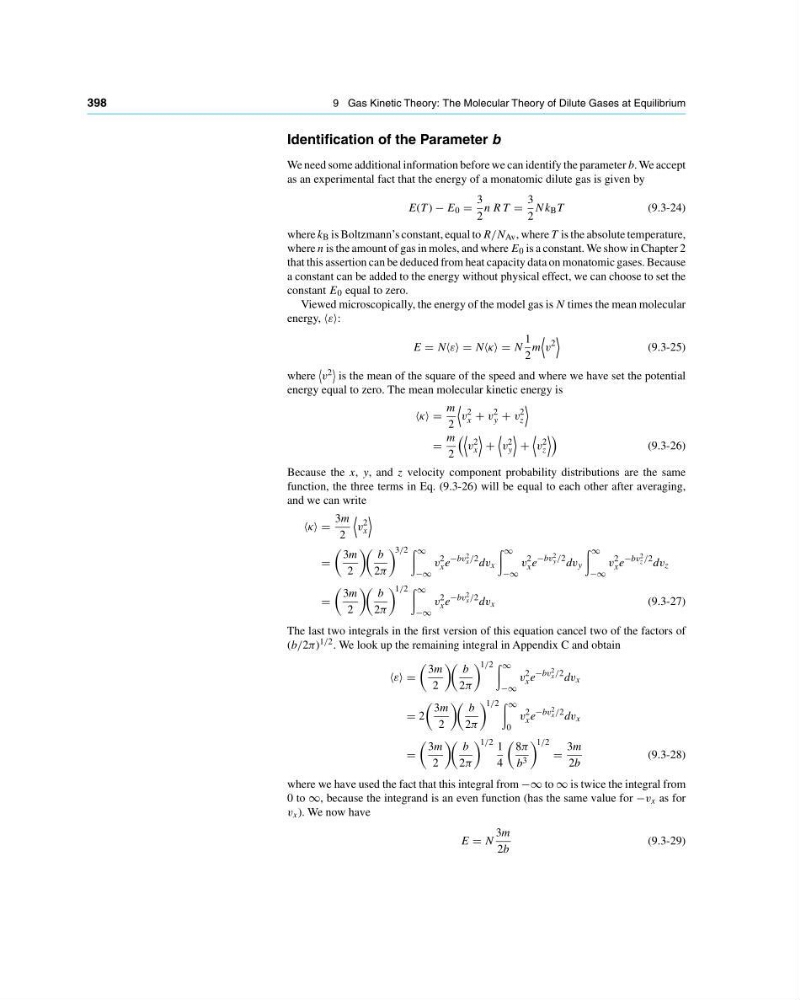
Identification of the Parameter b
We need some additional information before we can identify the parameter b. We accept
as an experimental fact that the energy of a monatomic dilute gas is given by
E(T ) − E 0
3
2
n R T
3
2
N k B T
(9.3-24)
where k B is Boltzmann’s constant, equal to R/N Av , where T is the absolute temperature,
where n is the amount of gas in moles, and where E 0 is a constant. We show in Chapter 2
that this assertion can be deduced from heat capacity data on monatomic gases. Because
a constant can be added to the energy without physical effect, we can choose to set the
constant E 0 equal to zero.
Viewed microscopically, the energy of the model gas is N times the mean molecular
energy, ε:
E Nε Nκ N
1
2
m
v
2
(9.3-25)
where
v 2
is the mean of the square of the speed and where we have set the potential
energy equal to zero. The mean molecular kinetic energy is
κ
m
2
v
2
x + v
2
y + v
2
z
m
2
v
2
x
+
v
2
y
+
v
2
z
(9.3-26)
Because the x, y, and z velocity component probability distributions are the same
function, the three terms in Eq. (9.3-26) will be equal to each other after averaging,
and we can write
κ
3m
2
v
2
x
3m
2
b
2π
3/2 ∞
−∞
v
2
x e
−bv 2
x /2 dv x
∞
−∞
v
2
x e
−bv 2
y /2 dv y
∞
−∞
v
2
x e
−bv 2
z /2 dv z
3m
2
b
2π
1/2 ∞
−∞
v
2
x e
−bv 2
x /2 dv x
(9.3-27)
The last two integrals in the first version of this equation cancel two of the factors of
(b/2π) 1/2 . We look up the remaining integral in Appendix C and obtain
ε
3m
2
b
2π
1/2 ∞
−∞
v
2
x e
−bv 2
x /2 dv x
2
3m
2
b
2π
1/2 ∞
0
v
2
x e
−bv 2
x /2 dv x
3m
2
b
2π
1/2 1
4
8π
b 3
1/2
3m
2b
(9.3-28)
where we have used the fact that this integral from −∞ to ∞ is twice the integral from
0 to ∞, because the integrand is an even function (has the same value for −v x as for
v x ). We now have
E N
3m
2b
(9.3-29)
9 Gas Kinetic Theory: The Molecular Theory of Dilute Gases at Equilibrium
Identification of the Parameter b
We need some additional information before we can identify the parameter b. We accept
as an experimental fact that the energy of a monatomic dilute gas is given by
E(T ) − E 0
3
2
n R T
3
2
N k B T
(9.3-24)
where k B is Boltzmann’s constant, equal to R/N Av , where T is the absolute temperature,
where n is the amount of gas in moles, and where E 0 is a constant. We show in Chapter 2
that this assertion can be deduced from heat capacity data on monatomic gases. Because
a constant can be added to the energy without physical effect, we can choose to set the
constant E 0 equal to zero.
Viewed microscopically, the energy of the model gas is N times the mean molecular
energy, ε:
E Nε Nκ N
1
2
m
v
2
(9.3-25)
where
v 2
is the mean of the square of the speed and where we have set the potential
energy equal to zero. The mean molecular kinetic energy is
κ
m
2
v
2
x + v
2
y + v
2
z
m
2
v
2
x
+
v
2
y
+
v
2
z
(9.3-26)
Because the x, y, and z velocity component probability distributions are the same
function, the three terms in Eq. (9.3-26) will be equal to each other after averaging,
and we can write
κ
3m
2
v
2
x
3m
2
b
2π
3/2 ∞
−∞
v
2
x e
−bv 2
x /2 dv x
∞
−∞
v
2
x e
−bv 2
y /2 dv y
∞
−∞
v
2
x e
−bv 2
z /2 dv z
3m
2
b
2π
1/2 ∞
−∞
v
2
x e
−bv 2
x /2 dv x
(9.3-27)
The last two integrals in the first version of this equation cancel two of the factors of
(b/2π) 1/2 . We look up the remaining integral in Appendix C and obtain
ε
3m
2
b
2π
1/2 ∞
−∞
v
2
x e
−bv 2
x /2 dv x
2
3m
2
b
2π
1/2 ∞
0
v
2
x e
−bv 2
x /2 dv x
3m
2
b
2π
1/2 1
4
8π
b 3
1/2
3m
2b
(9.3-28)
where we have used the fact that this integral from −∞ to ∞ is twice the integral from
0 to ∞, because the integrand is an even function (has the same value for −v x as for
v x ). We now have
E N
3m
2b
(9.3-29)