

22
1 The Behavior of Gases and Liquids
c. Find the pressure of 1.000 mol of nitrogen at a volume of 1.000 L and a temperature of
298.15 K using the van der Waals equation of state. Find the pressure of an ideal gas under
the same conditions.
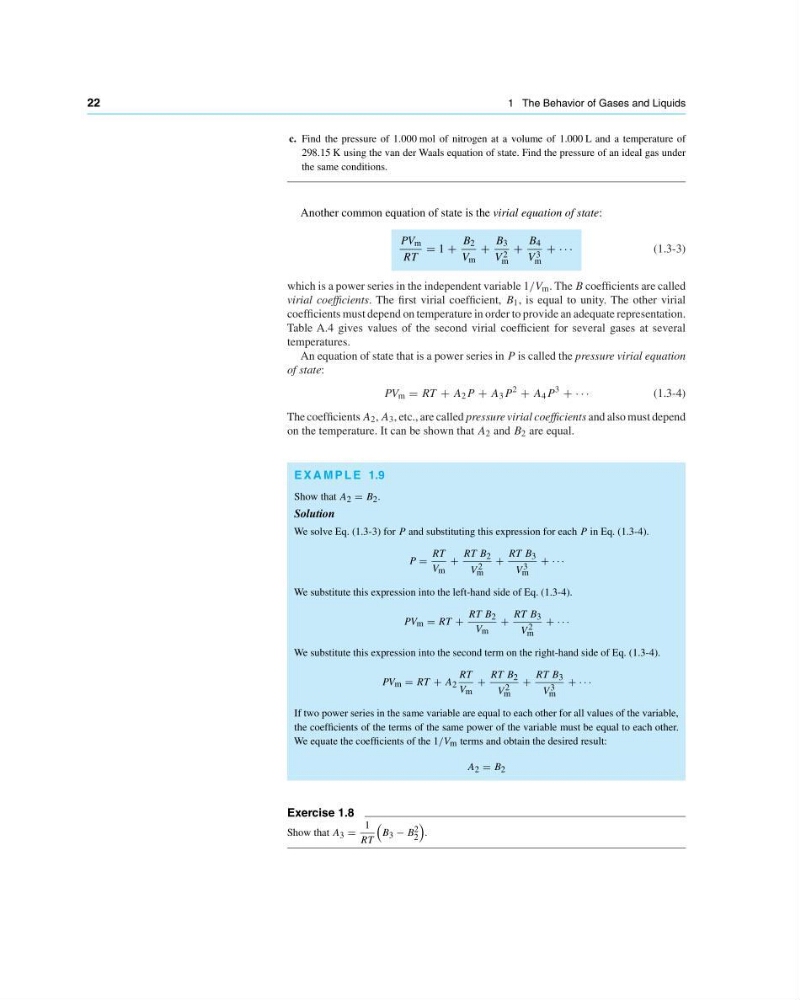
Another common equation of state is the virial equation of state:
PV m
RT
1 +
B 2
V m
+
B 3
V 2
m
+
B 4
V 3
m
+ · · ·
(1.3-3)
which is a power series in the independent variable 1/V m . The B coefficients are called
virial coefficients. The first virial coefficient, B 1 , is equal to unity. The other virial
coefficients must depend on temperature in order to provide an adequate representation.
Table A.4 gives values of the second virial coefficient for several gases at several
temperatures.
An equation of state that is a power series in P is called the pressure virial equation
of state:
PV m RT + A 2 P + A 3 P
2
+ A 4 P
3
+ · · ·
(1.3-4)
The coefficients A 2 , A 3 , etc., are called pressure virial coefficients and also must depend
on the temperature. It can be shown that A 2 and B 2 are equal.
E X A M P L E 1.9
Show that A 2 B 2 .
Solution
We solve Eq. (1.3-3) for P and substituting this expression for each P in Eq. (1.3-4).
P
RT
V m
+
RT B 2
V 2
m
+
RT B 3
V 3
m
+ · · ·
We substitute this expression into the left-hand side of Eq. (1.3-4).
PV m RT +
RT B 2
V m
+
RT B 3
V 2
m
+ · · ·
We substitute this expression into the second term on the right-hand side of Eq. (1.3-4).
PV m RT + A 2
RT
V m
+
RT B 2
V 2
m
+
RT B 3
V 3
m
+ · · ·
If two power series in the same variable are equal to each other for all values of the variable,
the coefficients of the terms of the same power of the variable must be equal to each other.
We equate the coefficients of the 1/V m terms and obtain the desired result:
A 2 B 2
Exercise 1.8
Show that A 3
1
RT
B 3 − B 2
2
.
1 The Behavior of Gases and Liquids
c. Find the pressure of 1.000 mol of nitrogen at a volume of 1.000 L and a temperature of
298.15 K using the van der Waals equation of state. Find the pressure of an ideal gas under
the same conditions.
Another common equation of state is the virial equation of state:
PV m
RT
1 +
B 2
V m
+
B 3
V 2
m
+
B 4
V 3
m
+ · · ·
(1.3-3)
which is a power series in the independent variable 1/V m . The B coefficients are called
virial coefficients. The first virial coefficient, B 1 , is equal to unity. The other virial
coefficients must depend on temperature in order to provide an adequate representation.
Table A.4 gives values of the second virial coefficient for several gases at several
temperatures.
An equation of state that is a power series in P is called the pressure virial equation
of state:
PV m RT + A 2 P + A 3 P
2
+ A 4 P
3
+ · · ·
(1.3-4)
The coefficients A 2 , A 3 , etc., are called pressure virial coefficients and also must depend
on the temperature. It can be shown that A 2 and B 2 are equal.
E X A M P L E 1.9
Show that A 2 B 2 .
Solution
We solve Eq. (1.3-3) for P and substituting this expression for each P in Eq. (1.3-4).
P
RT
V m
+
RT B 2
V 2
m
+
RT B 3
V 3
m
+ · · ·
We substitute this expression into the left-hand side of Eq. (1.3-4).
PV m RT +
RT B 2
V m
+
RT B 3
V 2
m
+ · · ·
We substitute this expression into the second term on the right-hand side of Eq. (1.3-4).
PV m RT + A 2
RT
V m
+
RT B 2
V 2
m
+
RT B 3
V 3
m
+ · · ·
If two power series in the same variable are equal to each other for all values of the variable,
the coefficients of the terms of the same power of the variable must be equal to each other.
We equate the coefficients of the 1/V m terms and obtain the desired result:
A 2 B 2
Exercise 1.8
Show that A 3
1
RT
B 3 − B 2
2
.