

1.3 Real Gases
21
1.3
Real Gases
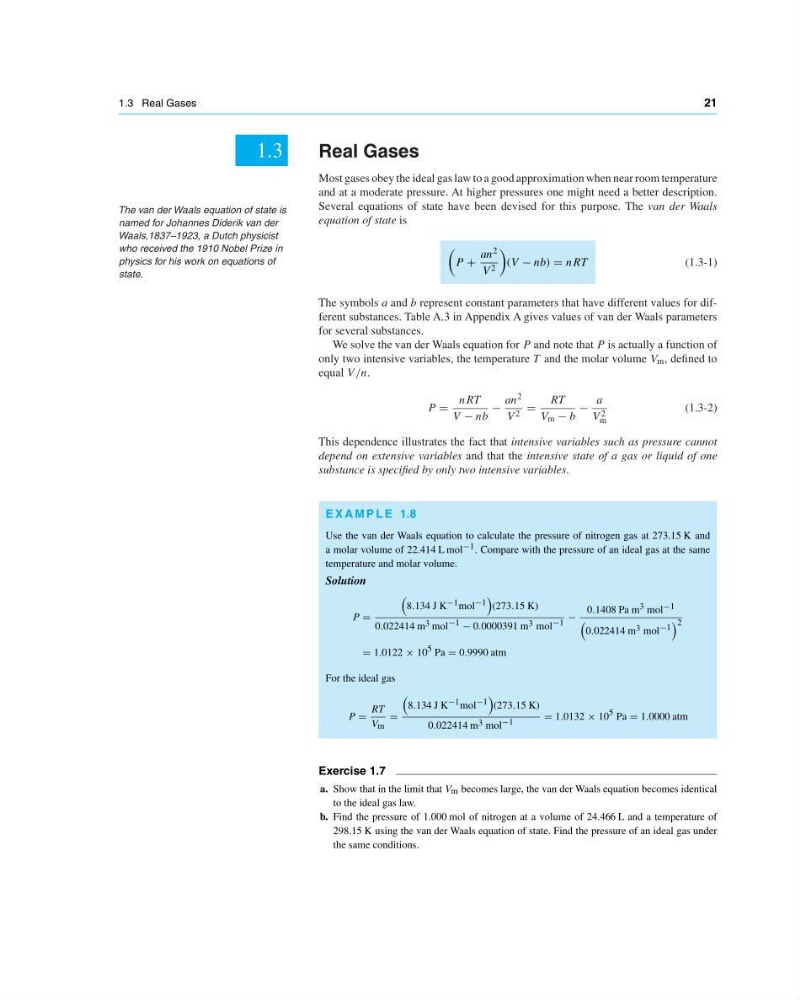
Most gases obey the ideal gas law to a good approximation when near room temperature
and at a moderate pressure. At higher pressures one might need a better description.
Several equations of state have been devised for this purpose. The van der Waals
equation of state is
P +
an 2
V 2
(V − nb) nRT
(1.3-1)
The symbols a and b represent constant parameters that have different values for different substances. Table A.3 in Appendix A gives values of van der Waals parameters
for several substances.
The van der Waals equation of state is
named for Johannes Diderik van der
Waals,1837–1923, a Dutch physicist
who received the 1910 Nobel Prize in
physics for his work on equations of
state.
We solve the van der Waals equation for P and note that P is actually a function of
only two intensive variables, the temperature T and the molar volume V m , defined to
equal V /n.
P
nRT
V − nb
−
an 2
V 2
RT
V m − b
−
a
V 2
m
(1.3-2)
This dependence illustrates the fact that intensive variables such as pressure cannot
depend on extensive variables and that the intensive state of a gas or liquid of one
substance is specified by only two intensive variables.
E X A M P L E 1.8
Use the van der Waals equation to calculate the pressure of nitrogen gas at 273.15 K and
a molar volume of 22.414 L mol −1 . Compare with the pressure of an ideal gas at the same
temperature and molar volume.
Solution
P
8.134 J K −1 mol −1
(273.15 K)
0.022414 m 3 mol −1 − 0.0000391 m 3 mol −1 −
0.1408 Pa m 3 mol −1
0.022414 m 3 mol −1
2
1.0122 × 10 5 Pa 0.9990 atm
For the ideal gas
P
RT
V m
8.134 J K −1 mol −1
(273.15 K)
0.022414 m 3 mol −1
1.0132 × 10 5 Pa 1.0000 atm
Exercise 1.7
a. Show that in the limit that V m becomes large, the van der Waals equation becomes identical
to the ideal gas law.
b. Find the pressure of 1.000 mol of nitrogen at a volume of 24.466 L and a temperature of
298.15 K using the van der Waals equation of state. Find the pressure of an ideal gas under
the same conditions.
21
1.3
Real Gases
Most gases obey the ideal gas law to a good approximation when near room temperature
and at a moderate pressure. At higher pressures one might need a better description.
Several equations of state have been devised for this purpose. The van der Waals
equation of state is
P +
an 2
V 2
(V − nb) nRT
(1.3-1)
The symbols a and b represent constant parameters that have different values for different substances. Table A.3 in Appendix A gives values of van der Waals parameters
for several substances.
The van der Waals equation of state is
named for Johannes Diderik van der
Waals,1837–1923, a Dutch physicist
who received the 1910 Nobel Prize in
physics for his work on equations of
state.
We solve the van der Waals equation for P and note that P is actually a function of
only two intensive variables, the temperature T and the molar volume V m , defined to
equal V /n.
P
nRT
V − nb
−
an 2
V 2
RT
V m − b
−
a
V 2
m
(1.3-2)
This dependence illustrates the fact that intensive variables such as pressure cannot
depend on extensive variables and that the intensive state of a gas or liquid of one
substance is specified by only two intensive variables.
E X A M P L E 1.8
Use the van der Waals equation to calculate the pressure of nitrogen gas at 273.15 K and
a molar volume of 22.414 L mol −1 . Compare with the pressure of an ideal gas at the same
temperature and molar volume.
Solution
P
8.134 J K −1 mol −1
(273.15 K)
0.022414 m 3 mol −1 − 0.0000391 m 3 mol −1 −
0.1408 Pa m 3 mol −1
0.022414 m 3 mol −1
2
1.0122 × 10 5 Pa 0.9990 atm
For the ideal gas
P
RT
V m
8.134 J K −1 mol −1
(273.15 K)
0.022414 m 3 mol −1
1.0132 × 10 5 Pa 1.0000 atm
Exercise 1.7
a. Show that in the limit that V m becomes large, the van der Waals equation becomes identical
to the ideal gas law.
b. Find the pressure of 1.000 mol of nitrogen at a volume of 24.466 L and a temperature of
298.15 K using the van der Waals equation of state. Find the pressure of an ideal gas under
the same conditions.