

386
9 Gas Kinetic Theory: The Molecular Theory of Dilute Gases at Equilibrium
Exercise 9.2
For the quiz scores in Exercise 9.1, find the mean of the squares of the scores
w 2
M
i1
p i w 2
i
and the square root of the mean of the squares, called the root-mean-square (rms) value, denoted
by w rms .
P R O B L E M S
Section 9.1: Macroscopic and Microscopic States of
Macroscopic Systems
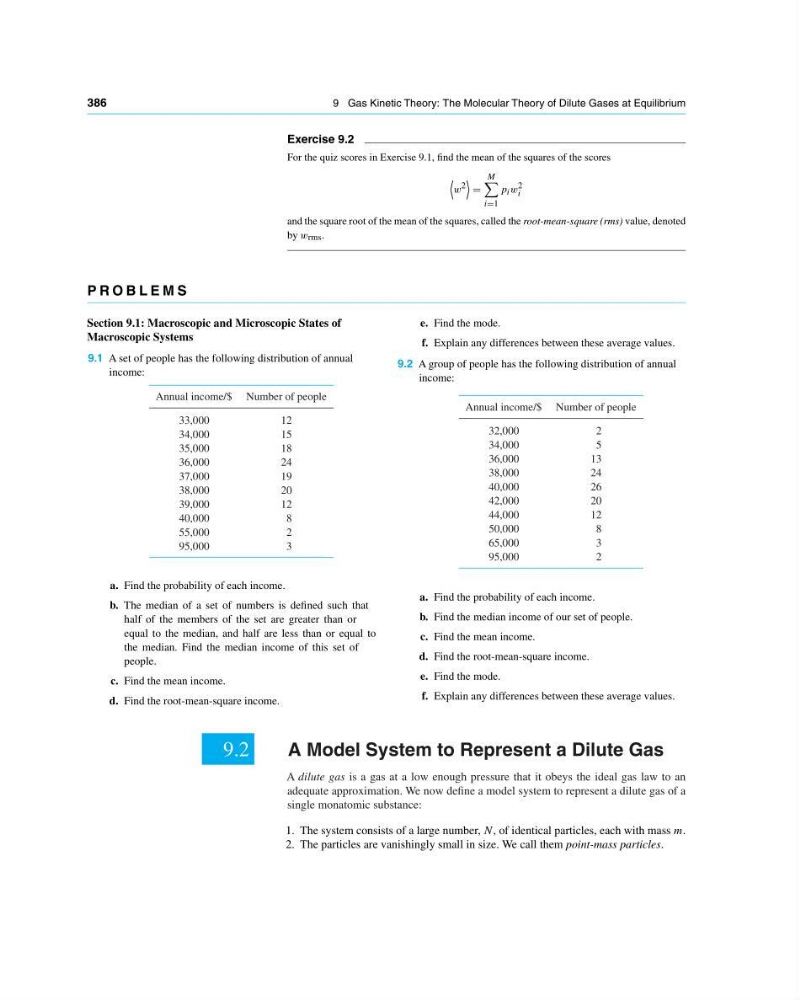
9.1 A set of people has the following distribution of annual
income:
Annual income/$ Number of people
33,000
12
34,000
15
35,000
18
36,000
24
37,000
19
38,000
20
39,000
12
40,000
8
55,000
2
95,000
3
a. Find the probability of each income.
b. The median of a set of numbers is defined such that
half of the members of the set are greater than or
equal to the median, and half are less than or equal to
the median. Find the median income of this set of
people.
c. Find the mean income.
d. Find the root-mean-square income.
e. Find the mode.
f. Explain any differences between these average values.
9.2 A group of people has the following distribution of annual
income:
Annual income/$ Number of people
32,000
2
34,000
5
36,000
13
38,000
24
40,000
26
42,000
20
44,000
12
50,000
8
65,000
3
95,000
2
a. Find the probability of each income.
b. Find the median income of our set of people.
c. Find the mean income.
d. Find the root-mean-square income.
e. Find the mode.
f. Explain any differences between these average values.
9.2
A Model System to Represent a Dilute Gas
A dilute gas is a gas at a low enough pressure that it obeys the ideal gas law to an
adequate approximation. We now define a model system to represent a dilute gas of a
single monatomic substance:
1. The system consists of a large number, N, of identical particles, each with mass m.
2. The particles are vanishingly small in size. We call them point-mass particles.
9 Gas Kinetic Theory: The Molecular Theory of Dilute Gases at Equilibrium
Exercise 9.2
For the quiz scores in Exercise 9.1, find the mean of the squares of the scores
w 2
M
i1
p i w 2
i
and the square root of the mean of the squares, called the root-mean-square (rms) value, denoted
by w rms .
P R O B L E M S
Section 9.1: Macroscopic and Microscopic States of
Macroscopic Systems
9.1 A set of people has the following distribution of annual
income:
Annual income/$ Number of people
33,000
12
34,000
15
35,000
18
36,000
24
37,000
19
38,000
20
39,000
12
40,000
8
55,000
2
95,000
3
a. Find the probability of each income.
b. The median of a set of numbers is defined such that
half of the members of the set are greater than or
equal to the median, and half are less than or equal to
the median. Find the median income of this set of
people.
c. Find the mean income.
d. Find the root-mean-square income.
e. Find the mode.
f. Explain any differences between these average values.
9.2 A group of people has the following distribution of annual
income:
Annual income/$ Number of people
32,000
2
34,000
5
36,000
13
38,000
24
40,000
26
42,000
20
44,000
12
50,000
8
65,000
3
95,000
2
a. Find the probability of each income.
b. Find the median income of our set of people.
c. Find the mean income.
d. Find the root-mean-square income.
e. Find the mode.
f. Explain any differences between these average values.
9.2
A Model System to Represent a Dilute Gas
A dilute gas is a gas at a low enough pressure that it obeys the ideal gas law to an
adequate approximation. We now define a model system to represent a dilute gas of a
single monatomic substance:
1. The system consists of a large number, N, of identical particles, each with mass m.
2. The particles are vanishingly small in size. We call them point-mass particles.