

9.1 Macroscopic and Microscopic States of Macroscopic Systems
385
the total number of members of the set equal to w i . The mean can now be written as a
sum over the distinct members of the set
w
1
N
M
i1
N i w i
(9.1-2)
There are fewer terms in this sum than in the sum of Eq. (9.1-1) unless every N i equals
unity, but the mean value is the same. We define
p i
N i
N
(9.1-3)
The quantity p i is the fraction of the members of the set that are equal to w i . It is also
equal to the probability that a randomly chosen member of the set will be equal to w i .
The set of p i values is called a probability distribution. We can now write
w
M
i1
p i w i
(9.1-4)
From the definition of p i in Eq. (9.1-3) these probabilities are normalized, which
means that they sum to unity.
M
i1
p i
1
N
M
i1
N i
N
N
1 (normalization)
(9.1-5)
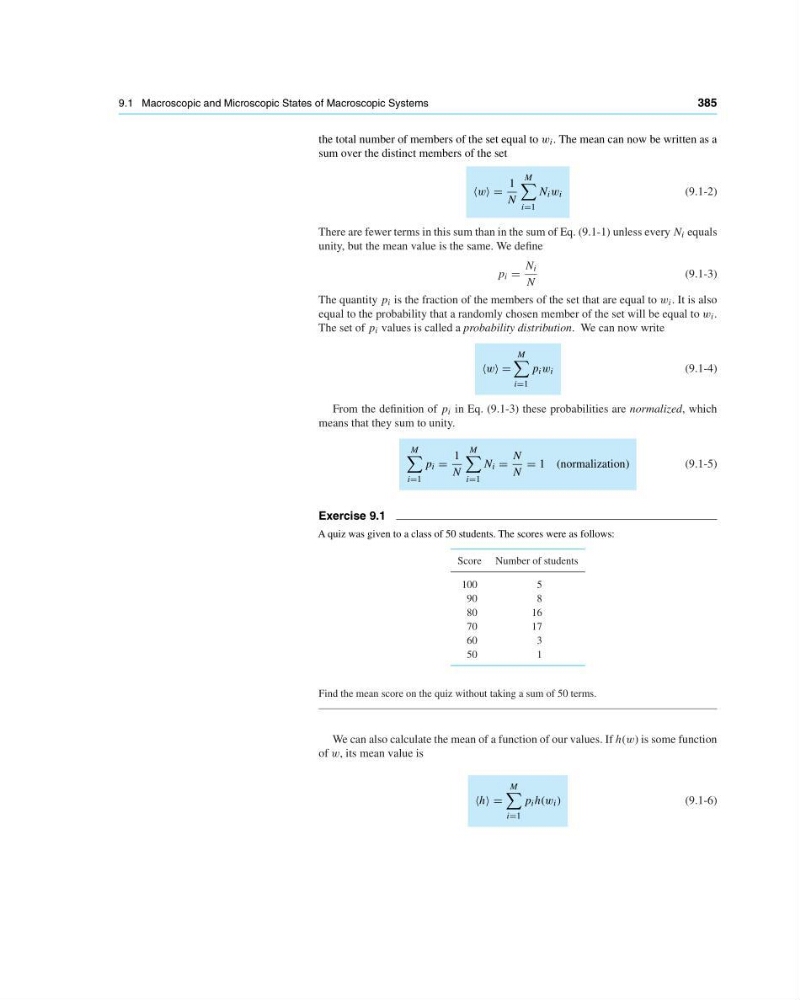
Exercise 9.1
A quiz was given to a class of 50 students. The scores were as follows:
Score Number of students
100
5
90
8
80
16
70
17
60
3
50
1
Find the mean score on the quiz without taking a sum of 50 terms.
We can also calculate the mean of a function of our values. If h(w) is some function
of w, its mean value is
h
M
i1
p i h(w i )
(9.1-6)
385
the total number of members of the set equal to w i . The mean can now be written as a
sum over the distinct members of the set
w
1
N
M
i1
N i w i
(9.1-2)
There are fewer terms in this sum than in the sum of Eq. (9.1-1) unless every N i equals
unity, but the mean value is the same. We define
p i
N i
N
(9.1-3)
The quantity p i is the fraction of the members of the set that are equal to w i . It is also
equal to the probability that a randomly chosen member of the set will be equal to w i .
The set of p i values is called a probability distribution. We can now write
w
M
i1
p i w i
(9.1-4)
From the definition of p i in Eq. (9.1-3) these probabilities are normalized, which
means that they sum to unity.
M
i1
p i
1
N
M
i1
N i
N
N
1 (normalization)
(9.1-5)
Exercise 9.1
A quiz was given to a class of 50 students. The scores were as follows:
Score Number of students
100
5
90
8
80
16
70
17
60
3
50
1
Find the mean score on the quiz without taking a sum of 50 terms.
We can also calculate the mean of a function of our values. If h(w) is some function
of w, its mean value is
h
M
i1
p i h(w i )
(9.1-6)