

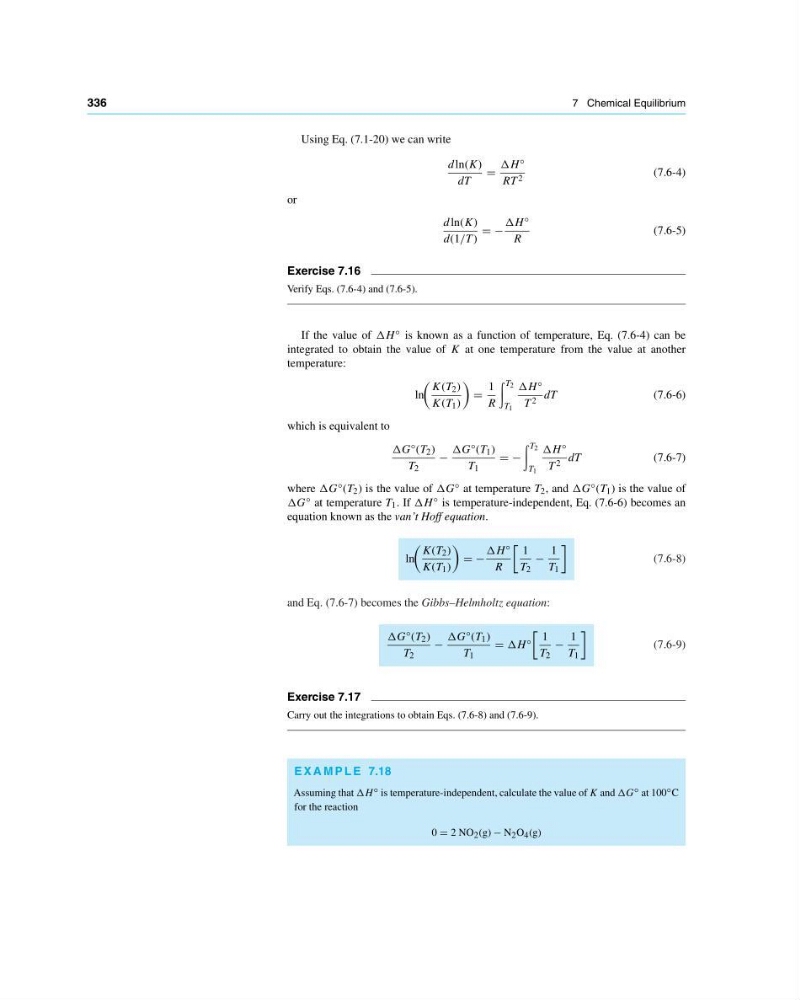
336
7 Chemical Equilibrium
Using Eq. (7.1-20) we can write
d ln(K)
dT
∆H ◦
RT 2
(7.6-4)
or
d ln(K)
d(1/T )
−
∆H ◦
R
(7.6-5)
Exercise 7.16
Verify Eqs. (7.6-4) and (7.6-5).
If the value of ∆H ◦ is known as a function of temperature, Eq. (7.6-4) can be
integrated to obtain the value of K at one temperature from the value at another
temperature:
ln
K(T 2 )
K(T 1 )
1
R
T 2
T 1
∆H ◦
T 2 dT
(7.6-6)
which is equivalent to
∆G ◦ (T 2 )
T 2
−
∆G ◦ (T 1 )
T 1
−
T 2
T 1
∆H ◦
T 2 dT
(7.6-7)
where ∆G ◦ (T 2 ) is the value of ∆G ◦ at temperature T 2 , and ∆G ◦ (T 1 ) is the value of
∆G ◦ at temperature T 1 . If ∆H ◦ is temperature-independent, Eq. (7.6-6) becomes an
equation known as the van’t Hoff equation.
ln
K(T 2 )
K(T 1 )
−
∆H ◦
R
1
T 2
−
1
T 1
(7.6-8)
and Eq. (7.6-7) becomes the Gibbs–Helmholtz equation:
∆G ◦ (T 2 )
T 2
−
∆G ◦ (T 1 )
T 1
∆H ◦
1
T 2
−
1
T 1
(7.6-9)
Exercise 7.17
Carry out the integrations to obtain Eqs. (7.6-8) and (7.6-9).
E X A M P L E 7.18
Assuming that ∆H ◦ is temperature-independent, calculate the value of K and ∆G ◦ at 100 ◦ C
for the reaction
0 2 NO 2 (g) − N 2 O 4 (g)
7 Chemical Equilibrium
Using Eq. (7.1-20) we can write
d ln(K)
dT
∆H ◦
RT 2
(7.6-4)
or
d ln(K)
d(1/T )
−
∆H ◦
R
(7.6-5)
Exercise 7.16
Verify Eqs. (7.6-4) and (7.6-5).
If the value of ∆H ◦ is known as a function of temperature, Eq. (7.6-4) can be
integrated to obtain the value of K at one temperature from the value at another
temperature:
ln
K(T 2 )
K(T 1 )
1
R
T 2
T 1
∆H ◦
T 2 dT
(7.6-6)
which is equivalent to
∆G ◦ (T 2 )
T 2
−
∆G ◦ (T 1 )
T 1
−
T 2
T 1
∆H ◦
T 2 dT
(7.6-7)
where ∆G ◦ (T 2 ) is the value of ∆G ◦ at temperature T 2 , and ∆G ◦ (T 1 ) is the value of
∆G ◦ at temperature T 1 . If ∆H ◦ is temperature-independent, Eq. (7.6-6) becomes an
equation known as the van’t Hoff equation.
ln
K(T 2 )
K(T 1 )
−
∆H ◦
R
1
T 2
−
1
T 1
(7.6-8)
and Eq. (7.6-7) becomes the Gibbs–Helmholtz equation:
∆G ◦ (T 2 )
T 2
−
∆G ◦ (T 1 )
T 1
∆H ◦
1
T 2
−
1
T 1
(7.6-9)
Exercise 7.17
Carry out the integrations to obtain Eqs. (7.6-8) and (7.6-9).
E X A M P L E 7.18
Assuming that ∆H ◦ is temperature-independent, calculate the value of K and ∆G ◦ at 100 ◦ C
for the reaction
0 2 NO 2 (g) − N 2 O 4 (g)