

6.4 The Activities of Nonvolatile Solutes
269
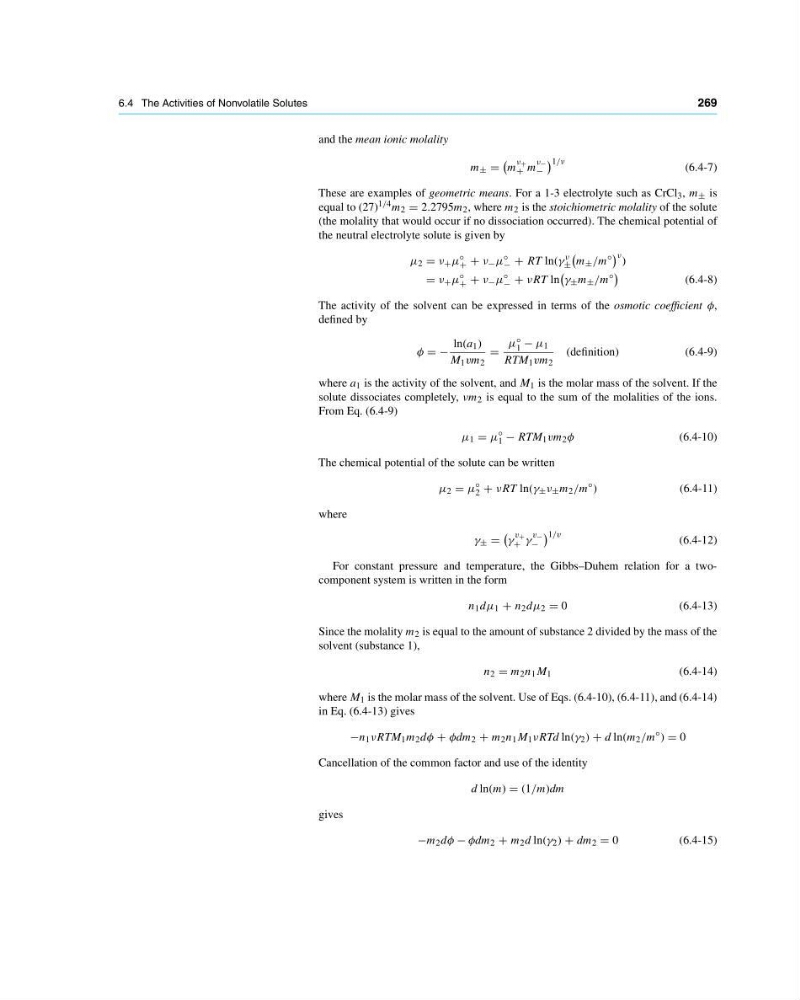
and the mean ionic molality
m ±
m
ν +
+ m
ν −
−
1/ν
(6.4-7)
These are examples of geometric means. For a 1-3 electrolyte such as CrCl 3 , m ± is
equal to (27) 1/4 m 2 2.2795m 2 , where m 2 is the stoichiometric molality of the solute
(the molality that would occur if no dissociation occurred). The chemical potential of
the neutral electrolyte solute is given by
µ 2 ν + µ
◦
+ + ν − µ
◦
− + RT ln(γ
ν
±
m ± /m
◦
ν )
ν + µ
◦
+ + ν − µ
◦
− + νRT ln
γ ± m ± /m
◦
(6.4-8)
The activity of the solvent can be expressed in terms of the osmotic coefficient φ,
defined by
φ −
ln(a 1 )
M 1 vm 2
µ ◦
1 − µ 1
RTM 1 vm 2
(definition)
(6.4-9)
where a 1 is the activity of the solvent, and M 1 is the molar mass of the solvent. If the
solute dissociates completely, νm 2 is equal to the sum of the molalities of the ions.
From Eq. (6.4-9)
µ 1 µ
◦
1 − RTM 1 vm 2 φ
(6.4-10)
The chemical potential of the solute can be written
µ 2 µ
◦
2 + νRT ln(γ ± ν ± m 2 /m
◦ )
(6.4-11)
where
γ ±
γ
v +
+ γ
v −
−
1/v
(6.4-12)
For constant pressure and temperature, the Gibbs–Duhem relation for a twocomponent system is written in the form
n 1 dµ 1 + n 2 dµ 2 0
(6.4-13)
Since the molality m 2 is equal to the amount of substance 2 divided by the mass of the
solvent (substance 1),
n 2 m 2 n 1 M 1
(6.4-14)
where M 1 is the molar mass of the solvent. Use of Eqs. (6.4-10), (6.4-11), and (6.4-14)
in Eq. (6.4-13) gives
−n 1 νRTM 1 m 2 dφ + φdm 2 + m 2 n 1 M 1 νRTd ln(γ 2 ) + d ln(m 2 /m
◦ ) 0
Cancellation of the common factor and use of the identity
d ln(m) (1/m)dm
gives
−m 2 dφ − φdm 2 + m 2 d ln(γ 2 ) + dm 2 0
(6.4-15)
269
and the mean ionic molality
m ±
m
ν +
+ m
ν −
−
1/ν
(6.4-7)
These are examples of geometric means. For a 1-3 electrolyte such as CrCl 3 , m ± is
equal to (27) 1/4 m 2 2.2795m 2 , where m 2 is the stoichiometric molality of the solute
(the molality that would occur if no dissociation occurred). The chemical potential of
the neutral electrolyte solute is given by
µ 2 ν + µ
◦
+ + ν − µ
◦
− + RT ln(γ
ν
±
m ± /m
◦
ν )
ν + µ
◦
+ + ν − µ
◦
− + νRT ln
γ ± m ± /m
◦
(6.4-8)
The activity of the solvent can be expressed in terms of the osmotic coefficient φ,
defined by
φ −
ln(a 1 )
M 1 vm 2
µ ◦
1 − µ 1
RTM 1 vm 2
(definition)
(6.4-9)
where a 1 is the activity of the solvent, and M 1 is the molar mass of the solvent. If the
solute dissociates completely, νm 2 is equal to the sum of the molalities of the ions.
From Eq. (6.4-9)
µ 1 µ
◦
1 − RTM 1 vm 2 φ
(6.4-10)
The chemical potential of the solute can be written
µ 2 µ
◦
2 + νRT ln(γ ± ν ± m 2 /m
◦ )
(6.4-11)
where
γ ±
γ
v +
+ γ
v −
−
1/v
(6.4-12)
For constant pressure and temperature, the Gibbs–Duhem relation for a twocomponent system is written in the form
n 1 dµ 1 + n 2 dµ 2 0
(6.4-13)
Since the molality m 2 is equal to the amount of substance 2 divided by the mass of the
solvent (substance 1),
n 2 m 2 n 1 M 1
(6.4-14)
where M 1 is the molar mass of the solvent. Use of Eqs. (6.4-10), (6.4-11), and (6.4-14)
in Eq. (6.4-13) gives
−n 1 νRTM 1 m 2 dφ + φdm 2 + m 2 n 1 M 1 νRTd ln(γ 2 ) + d ln(m 2 /m
◦ ) 0
Cancellation of the common factor and use of the identity
d ln(m) (1/m)dm
gives
−m 2 dφ − φdm 2 + m 2 d ln(γ 2 ) + dm 2 0
(6.4-15)