

268
6 The Thermodynamics of Solutions
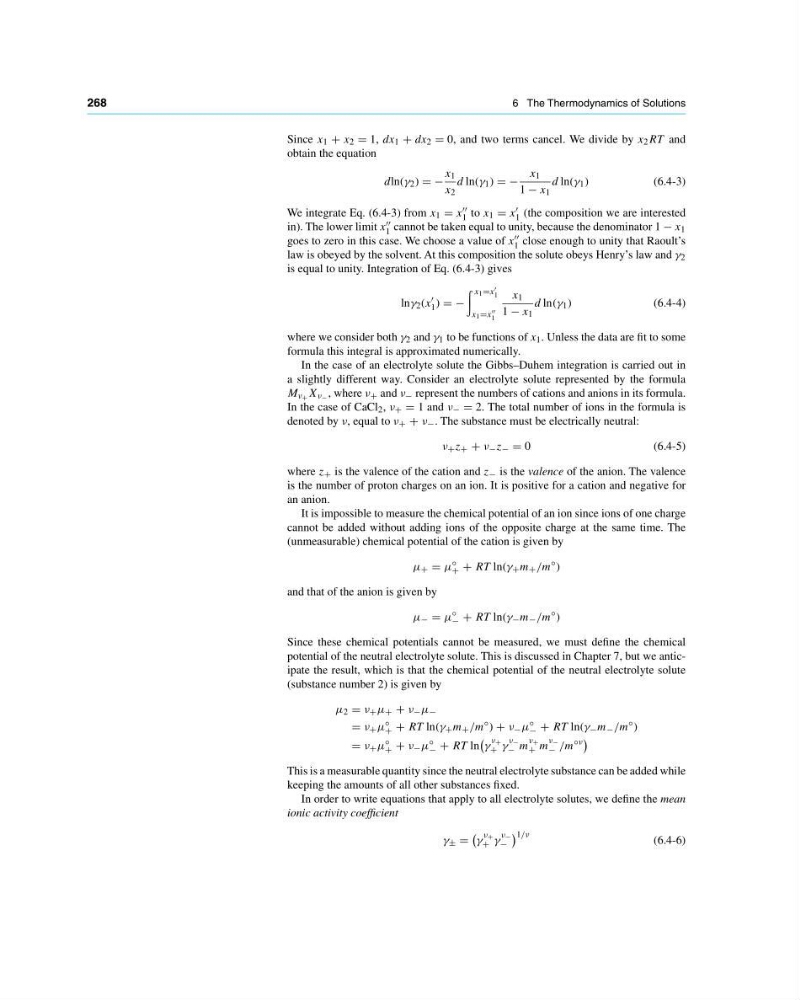
Since x 1 + x 2 1, dx 1 + dx 2 0, and two terms cancel. We divide by x 2 RT and
obtain the equation
dln(γ 2 ) −
x 1
x 2
d ln(γ 1 ) −
x 1
1 − x 1
d ln(γ 1 )
(6.4-3)
We integrate Eq. (6.4-3) from x 1 x
1 to x 1 x
1 (the composition we are interested
in). The lower limit x
1 cannot be taken equal to unity, because the denominator 1 − x 1
goes to zero in this case. We choose a value of x
1 close enough to unity that Raoult’s
law is obeyed by the solvent. At this composition the solute obeys Henry’s law and γ 2
is equal to unity. Integration of Eq. (6.4-3) gives
lnγ 2 (x
1 ) −
x 1 x
1
x 1 x
1
x 1
1 − x 1
d ln(γ 1 )
(6.4-4)
where we consider both γ 2 and γ 1 to be functions of x 1 . Unless the data are fit to some
formula this integral is approximated numerically.
In the case of an electrolyte solute the Gibbs–Duhem integration is carried out in
a slightly different way. Consider an electrolyte solute represented by the formula
M ν + X ν − , where ν + and ν − represent the numbers of cations and anions in its formula.
In the case of CaCl 2 , ν + 1 and ν − 2. The total number of ions in the formula is
denoted by ν, equal to ν + + ν − . The substance must be electrically neutral:
ν + z + + ν − z − 0
(6.4-5)
where z + is the valence of the cation and z − is the valence of the anion. The valence
is the number of proton charges on an ion. It is positive for a cation and negative for
an anion.
It is impossible to measure the chemical potential of an ion since ions of one charge
cannot be added without adding ions of the opposite charge at the same time. The
(unmeasurable) chemical potential of the cation is given by
µ + µ
◦
+ + RT ln(γ + m + /m
◦ )
and that of the anion is given by
µ − µ
◦
− + RT ln(γ − m − /m
◦ )
Since these chemical potentials cannot be measured, we must define the chemical
potential of the neutral electrolyte solute. This is discussed in Chapter 7, but we anticipate the result, which is that the chemical potential of the neutral electrolyte solute
(substance number 2) is given by
µ 2 ν + µ + + ν − µ −
ν + µ
◦
+ + RT ln(γ + m + /m
◦ ) + ν − µ
◦
− + RT ln(γ − m − /m
◦ )
ν + µ
◦
+ + ν − µ
◦
− + RT ln
γ
ν +
+ γ
ν −
− m
ν +
+ m
ν −
− /m
◦ν
This is a measurable quantity since the neutral electrolyte substance can be added while
keeping the amounts of all other substances fixed.
In order to write equations that apply to all electrolyte solutes, we define the mean
ionic activity coefficient
γ ±
γ
ν +
+ γ
ν −
−
1/ν
(6.4-6)
6 The Thermodynamics of Solutions
Since x 1 + x 2 1, dx 1 + dx 2 0, and two terms cancel. We divide by x 2 RT and
obtain the equation
dln(γ 2 ) −
x 1
x 2
d ln(γ 1 ) −
x 1
1 − x 1
d ln(γ 1 )
(6.4-3)
We integrate Eq. (6.4-3) from x 1 x
1 to x 1 x
1 (the composition we are interested
in). The lower limit x
1 cannot be taken equal to unity, because the denominator 1 − x 1
goes to zero in this case. We choose a value of x
1 close enough to unity that Raoult’s
law is obeyed by the solvent. At this composition the solute obeys Henry’s law and γ 2
is equal to unity. Integration of Eq. (6.4-3) gives
lnγ 2 (x
1 ) −
x 1 x
1
x 1 x
1
x 1
1 − x 1
d ln(γ 1 )
(6.4-4)
where we consider both γ 2 and γ 1 to be functions of x 1 . Unless the data are fit to some
formula this integral is approximated numerically.
In the case of an electrolyte solute the Gibbs–Duhem integration is carried out in
a slightly different way. Consider an electrolyte solute represented by the formula
M ν + X ν − , where ν + and ν − represent the numbers of cations and anions in its formula.
In the case of CaCl 2 , ν + 1 and ν − 2. The total number of ions in the formula is
denoted by ν, equal to ν + + ν − . The substance must be electrically neutral:
ν + z + + ν − z − 0
(6.4-5)
where z + is the valence of the cation and z − is the valence of the anion. The valence
is the number of proton charges on an ion. It is positive for a cation and negative for
an anion.
It is impossible to measure the chemical potential of an ion since ions of one charge
cannot be added without adding ions of the opposite charge at the same time. The
(unmeasurable) chemical potential of the cation is given by
µ + µ
◦
+ + RT ln(γ + m + /m
◦ )
and that of the anion is given by
µ − µ
◦
− + RT ln(γ − m − /m
◦ )
Since these chemical potentials cannot be measured, we must define the chemical
potential of the neutral electrolyte solute. This is discussed in Chapter 7, but we anticipate the result, which is that the chemical potential of the neutral electrolyte solute
(substance number 2) is given by
µ 2 ν + µ + + ν − µ −
ν + µ
◦
+ + RT ln(γ + m + /m
◦ ) + ν − µ
◦
− + RT ln(γ − m − /m
◦ )
ν + µ
◦
+ + ν − µ
◦
− + RT ln
γ
ν +
+ γ
ν −
− m
ν +
+ m
ν −
− /m
◦ν
This is a measurable quantity since the neutral electrolyte substance can be added while
keeping the amounts of all other substances fixed.
In order to write equations that apply to all electrolyte solutes, we define the mean
ionic activity coefficient
γ ±
γ
ν +
+ γ
ν −
−
1/ν
(6.4-6)