

6.3 Activity and Activity Coefficients
259
The activity is a dimensionless quantity that is equal to unity if the substance is in its
standard state. Each measure of the activity corresponds to a different standard state.
For example, the standard state for a component in an ideal solution or a solvent in
an arbitrary solution is the pure substance. The standard state for a solute that obeys
Henry’s law is the hypothetical pure substance that has a vapor pressure equal to k i , the
Henry’s law constant. The standard state of a dilute solute in the molality description is
a hypothetical solute with a molality of 1 mol kg −1 such that Henry’s law is obeyed at
this composition. The standard state of a dilute solute in the concentration description
is a hypothetical solute with a molar concentration of 1 mol m −3 or 1 mol L −1 such
that Henry’s law is obeyed at this composition.
The Activity of a Pure Solid or Liquid
The standard state of a pure solid or liquid is the pure substance at pressure P ◦ . If the
substance is at a pressure P not equal to P ◦ ,
µ i (P
) G
∗
m,i (P
) G
◦
m,i +
P
P ◦
V
∗
m,i dP ≈ µ
◦
i + V
∗
m,i
P
− P
◦
(6.3-12)
where we assume that the solid or liquid has a nearly constant volume. By comparison
with Eq. (6.3-6),
RT ln(a i ) V
∗
m,i
P − P
◦
(6.3-13)
where we drop the prime label ( ) on the P. The activity of a pure liquid or solid at
pressure P is given by
a i exp
V ∗
m,i (P − P ◦ )
RT
(pure solid or liquid)
(6.3-14)
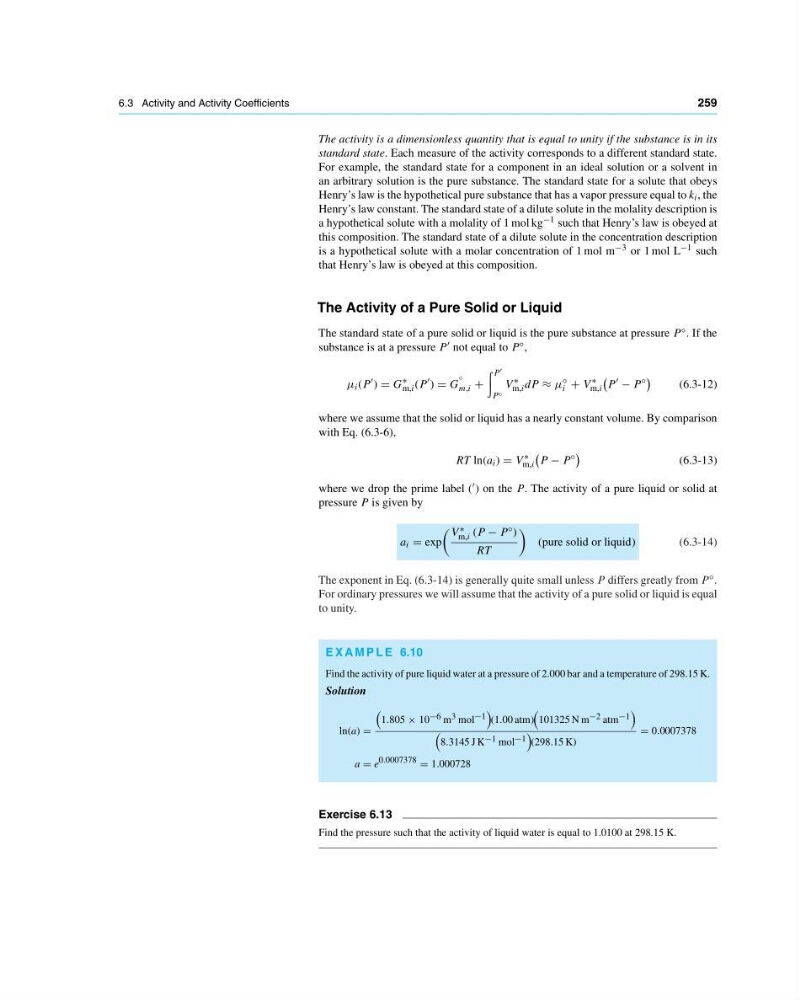
The exponent in Eq. (6.3-14) is generally quite small unless P differs greatly from P ◦ .
For ordinary pressures we will assume that the activity of a pure solid or liquid is equal
to unity.
E X A M P L E 6.10
Find the activity of pure liquid water at a pressure of 2.000 bar and a temperature of 298.15 K.
Solution
ln(a)
1.805 × 10 −6 m 3 mol −1
(1.00 atm)
101325 N m −2 atm −1
8.3145 J K −1 mol −1
(298.15 K)
0.0007378
a e 0.0007378 1.000728
Exercise 6.13
Find the pressure such that the activity of liquid water is equal to 1.0100 at 298.15 K.
259
The activity is a dimensionless quantity that is equal to unity if the substance is in its
standard state. Each measure of the activity corresponds to a different standard state.
For example, the standard state for a component in an ideal solution or a solvent in
an arbitrary solution is the pure substance. The standard state for a solute that obeys
Henry’s law is the hypothetical pure substance that has a vapor pressure equal to k i , the
Henry’s law constant. The standard state of a dilute solute in the molality description is
a hypothetical solute with a molality of 1 mol kg −1 such that Henry’s law is obeyed at
this composition. The standard state of a dilute solute in the concentration description
is a hypothetical solute with a molar concentration of 1 mol m −3 or 1 mol L −1 such
that Henry’s law is obeyed at this composition.
The Activity of a Pure Solid or Liquid
The standard state of a pure solid or liquid is the pure substance at pressure P ◦ . If the
substance is at a pressure P not equal to P ◦ ,
µ i (P
) G
∗
m,i (P
) G
◦
m,i +
P
P ◦
V
∗
m,i dP ≈ µ
◦
i + V
∗
m,i
P
− P
◦
(6.3-12)
where we assume that the solid or liquid has a nearly constant volume. By comparison
with Eq. (6.3-6),
RT ln(a i ) V
∗
m,i
P − P
◦
(6.3-13)
where we drop the prime label ( ) on the P. The activity of a pure liquid or solid at
pressure P is given by
a i exp
V ∗
m,i (P − P ◦ )
RT
(pure solid or liquid)
(6.3-14)
The exponent in Eq. (6.3-14) is generally quite small unless P differs greatly from P ◦ .
For ordinary pressures we will assume that the activity of a pure solid or liquid is equal
to unity.
E X A M P L E 6.10
Find the activity of pure liquid water at a pressure of 2.000 bar and a temperature of 298.15 K.
Solution
ln(a)
1.805 × 10 −6 m 3 mol −1
(1.00 atm)
101325 N m −2 atm −1
8.3145 J K −1 mol −1
(298.15 K)
0.0007378
a e 0.0007378 1.000728
Exercise 6.13
Find the pressure such that the activity of liquid water is equal to 1.0100 at 298.15 K.