

258
6 The Thermodynamics of Solutions
6.3
Activity and Activity Coefficients
We have obtained several relations for the chemical potential that look quite similar.
For an ideal gas, either pure or in a mixture,
µ i µ
◦
i + RT ln
P i
P ◦
(ideal gas)
(6.3-1)
For a component of an ideal solution or for the solvent in a dilute solution,
µ i µ
∗
i + RT ln(x i )
(component of an ideal solution
or solvent in a dilute solution)
(6.3-2)
For a solute in a dilute solution we had a choice of three relations:
µ i µ
◦(H)
i
+ RT ln(x i ) (solute in a dilute solution)
(6.3-3)
µ i µ
◦(m)
i
+ RT ln(m i /m
◦ ) (solute in a dilute solution)
(6.3-4)
µ i µ
◦(c)
i
+ RT ln(c i /c
◦ ) (solute in a dilute solution)
(6.3-5)
The Definition of the Activity
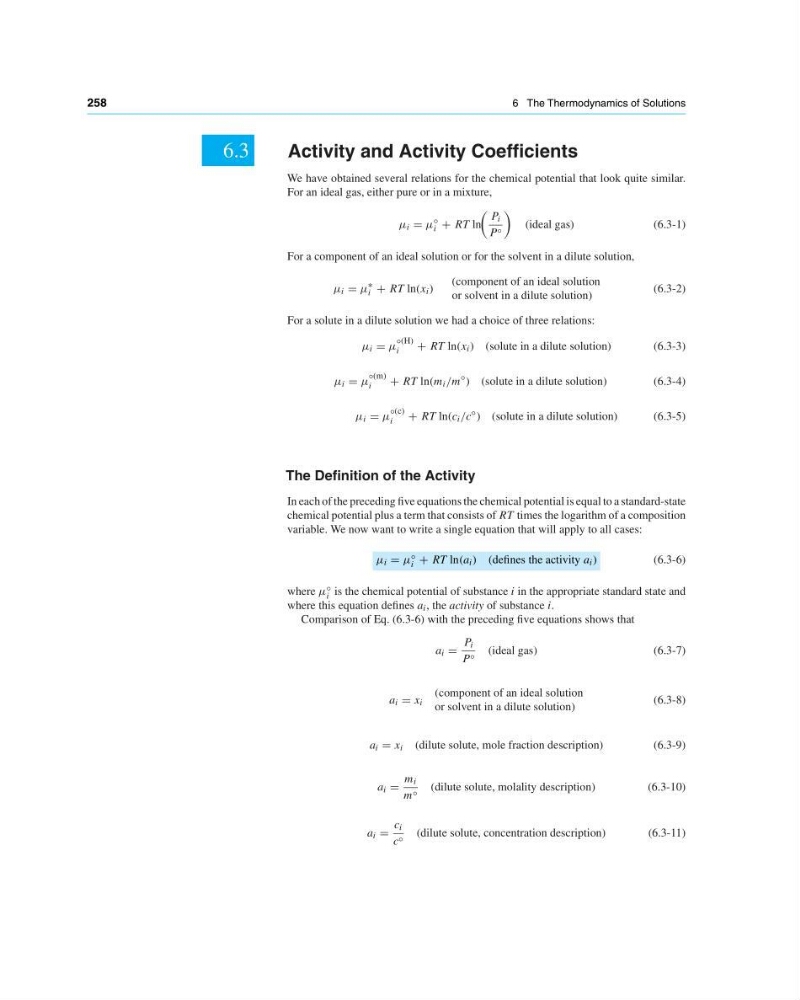
In each of the preceding five equations the chemical potential is equal to a standard-state
chemical potential plus a term that consists of RT times the logarithm of a composition
variable. We now want to write a single equation that will apply to all cases:
µ i µ ◦
i + RT ln(a i ) (defines the activity a i )
(6.3-6)
where µ ◦
i is the chemical potential of substance i in the appropriate standard state and
where this equation defines a i , the activity of substance i.
Comparison of Eq. (6.3-6) with the preceding five equations shows that
a i
P i
P ◦ (ideal gas)
(6.3-7)
a i x i
(component of an ideal solution
or solvent in a dilute solution)
(6.3-8)
a i x i (dilute solute, mole fraction description)
(6.3-9)
a i
m i
m ◦ (dilute solute, molality description)
(6.3-10)
a i
c i
c ◦ (dilute solute, concentration description)
(6.3-11)
6 The Thermodynamics of Solutions
6.3
Activity and Activity Coefficients
We have obtained several relations for the chemical potential that look quite similar.
For an ideal gas, either pure or in a mixture,
µ i µ
◦
i + RT ln
P i
P ◦
(ideal gas)
(6.3-1)
For a component of an ideal solution or for the solvent in a dilute solution,
µ i µ
∗
i + RT ln(x i )
(component of an ideal solution
or solvent in a dilute solution)
(6.3-2)
For a solute in a dilute solution we had a choice of three relations:
µ i µ
◦(H)
i
+ RT ln(x i ) (solute in a dilute solution)
(6.3-3)
µ i µ
◦(m)
i
+ RT ln(m i /m
◦ ) (solute in a dilute solution)
(6.3-4)
µ i µ
◦(c)
i
+ RT ln(c i /c
◦ ) (solute in a dilute solution)
(6.3-5)
The Definition of the Activity
In each of the preceding five equations the chemical potential is equal to a standard-state
chemical potential plus a term that consists of RT times the logarithm of a composition
variable. We now want to write a single equation that will apply to all cases:
µ i µ ◦
i + RT ln(a i ) (defines the activity a i )
(6.3-6)
where µ ◦
i is the chemical potential of substance i in the appropriate standard state and
where this equation defines a i , the activity of substance i.
Comparison of Eq. (6.3-6) with the preceding five equations shows that
a i
P i
P ◦ (ideal gas)
(6.3-7)
a i x i
(component of an ideal solution
or solvent in a dilute solution)
(6.3-8)
a i x i (dilute solute, mole fraction description)
(6.3-9)
a i
m i
m ◦ (dilute solute, molality description)
(6.3-10)
a i
c i
c ◦ (dilute solute, concentration description)
(6.3-11)