

5.6 Surfaces in Multicomponent Systems
233
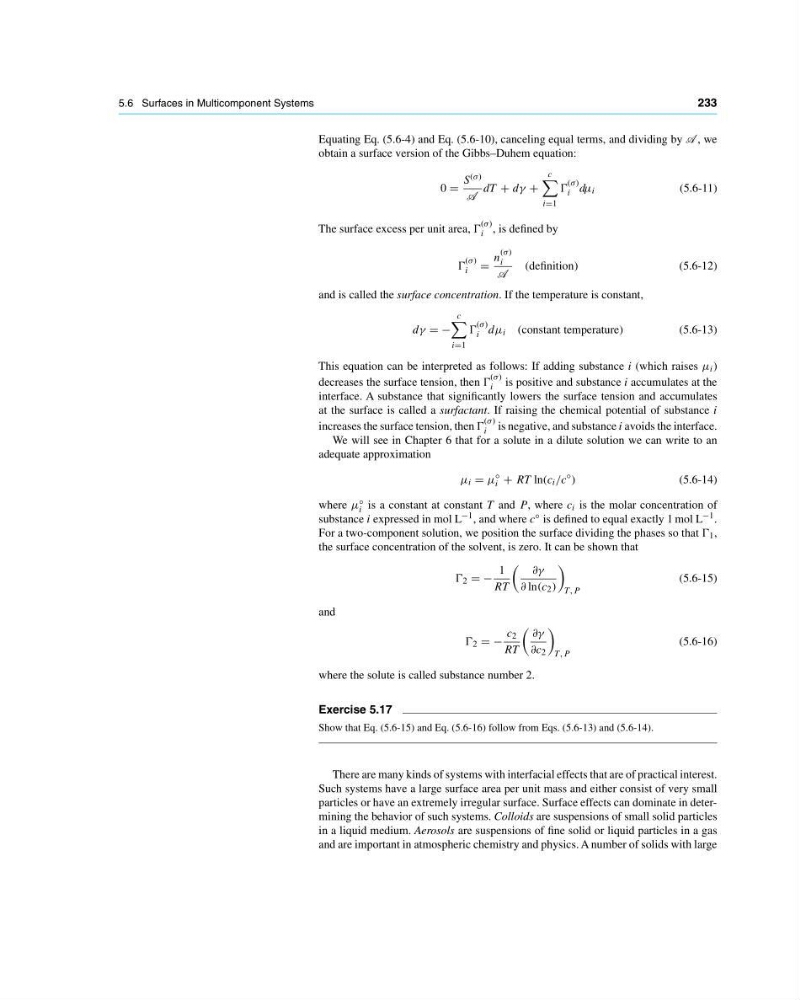
Equating Eq. (5.6-4) and Eq. (5.6-10), canceling equal terms, and dividing by A , we
obtain a surface version of the Gibbs–Duhem equation:
0
S (σ)
A
dT + dγ +
c
i1
Γ
(σ)
i dµ i
(5.6-11)
The surface excess per unit area, Γ
(σ)
i , is defined by
Γ
(σ)
i
n
(σ)
i
A
(definition)
(5.6-12)
and is called the surface concentration. If the temperature is constant,
dγ −
c
i1
Γ
(σ)
i dµ i (constant temperature)
(5.6-13)
This equation can be interpreted as follows: If adding substance i (which raises µ i )
decreases the surface tension, then Γ
(σ)
i is positive and substance i accumulates at the
interface. A substance that significantly lowers the surface tension and accumulates
at the surface is called a surfactant. If raising the chemical potential of substance i
increases the surface tension, then Γ
(σ)
i is negative, and substance i avoids the interface.
We will see in Chapter 6 that for a solute in a dilute solution we can write to an
adequate approximation
µ i µ
◦
i + RT ln(c i /c
◦ )
(5.6-14)
where µ ◦
i is a constant at constant T and P, where c i is the molar concentration of
substance i expressed in mol L −1 , and where c ◦ is defined to equal exactly 1 mol L −1 .
For a two-component solution, we position the surface dividing the phases so that Γ 1 ,
the surface concentration of the solvent, is zero. It can be shown that
Γ 2 −
1
RT
∂γ
∂ ln(c 2 )
T , P
(5.6-15)
and
Γ 2 −
c 2
RT
∂γ
∂c 2
T , P
(5.6-16)
where the solute is called substance number 2.
Exercise 5.17
Show that Eq. (5.6-15) and Eq. (5.6-16) follow from Eqs. (5.6-13) and (5.6-14).
There are many kinds of systems with interfacial effects that are of practical interest.
Such systems have a large surface area per unit mass and either consist of very small
particles or have an extremely irregular surface. Surface effects can dominate in determining the behavior of such systems. Colloids are suspensions of small solid particles
in a liquid medium. Aerosols are suspensions of fine solid or liquid particles in a gas
and are important in atmospheric chemistry and physics. A number of solids with large
233
Equating Eq. (5.6-4) and Eq. (5.6-10), canceling equal terms, and dividing by A , we
obtain a surface version of the Gibbs–Duhem equation:
0
S (σ)
A
dT + dγ +
c
i1
Γ
(σ)
i dµ i
(5.6-11)
The surface excess per unit area, Γ
(σ)
i , is defined by
Γ
(σ)
i
n
(σ)
i
A
(definition)
(5.6-12)
and is called the surface concentration. If the temperature is constant,
dγ −
c
i1
Γ
(σ)
i dµ i (constant temperature)
(5.6-13)
This equation can be interpreted as follows: If adding substance i (which raises µ i )
decreases the surface tension, then Γ
(σ)
i is positive and substance i accumulates at the
interface. A substance that significantly lowers the surface tension and accumulates
at the surface is called a surfactant. If raising the chemical potential of substance i
increases the surface tension, then Γ
(σ)
i is negative, and substance i avoids the interface.
We will see in Chapter 6 that for a solute in a dilute solution we can write to an
adequate approximation
µ i µ
◦
i + RT ln(c i /c
◦ )
(5.6-14)
where µ ◦
i is a constant at constant T and P, where c i is the molar concentration of
substance i expressed in mol L −1 , and where c ◦ is defined to equal exactly 1 mol L −1 .
For a two-component solution, we position the surface dividing the phases so that Γ 1 ,
the surface concentration of the solvent, is zero. It can be shown that
Γ 2 −
1
RT
∂γ
∂ ln(c 2 )
T , P
(5.6-15)
and
Γ 2 −
c 2
RT
∂γ
∂c 2
T , P
(5.6-16)
where the solute is called substance number 2.
Exercise 5.17
Show that Eq. (5.6-15) and Eq. (5.6-16) follow from Eqs. (5.6-13) and (5.6-14).
There are many kinds of systems with interfacial effects that are of practical interest.
Such systems have a large surface area per unit mass and either consist of very small
particles or have an extremely irregular surface. Surface effects can dominate in determining the behavior of such systems. Colloids are suspensions of small solid particles
in a liquid medium. Aerosols are suspensions of fine solid or liquid particles in a gas
and are important in atmospheric chemistry and physics. A number of solids with large