

210
5 Phase Equilibrium
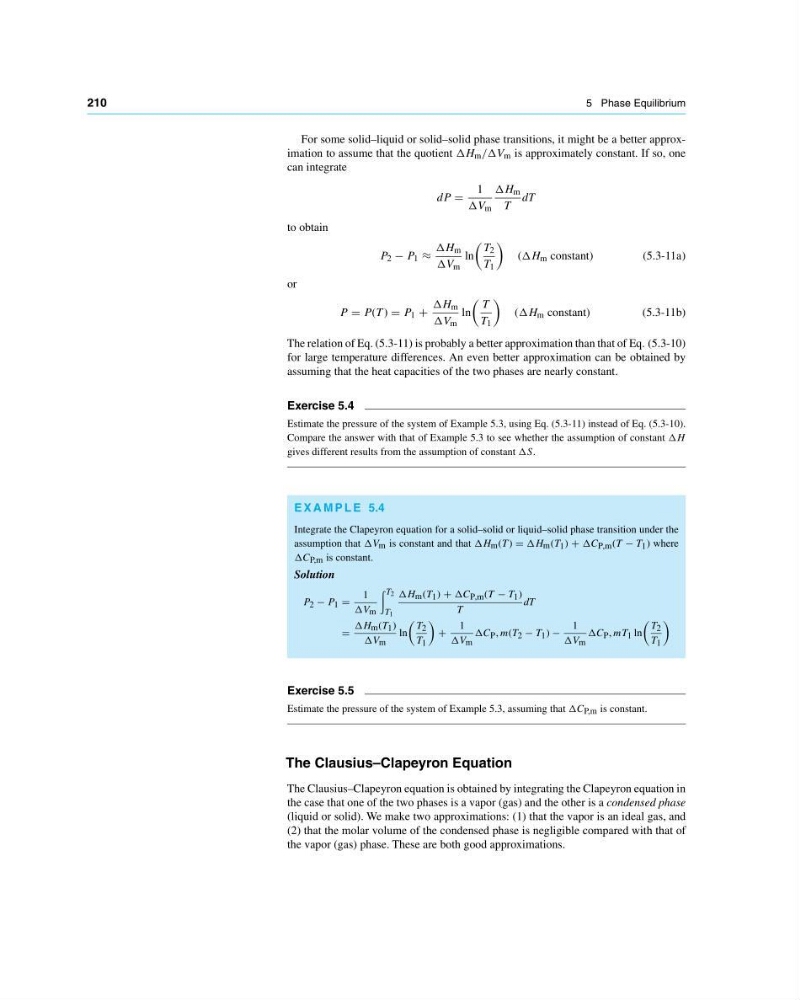
For some solid–liquid or solid–solid phase transitions, it might be a better approximation to assume that the quotient ∆H m /∆V m is approximately constant. If so, one
can integrate
dP
1
∆V m
∆H m
T
dT
to obtain
P 2 − P 1 ≈
∆H m
∆V m
ln
T 2
T 1
(∆H m constant)
(5.3-11a)
or
P P(T ) P 1 +
∆H m
∆V m
ln
T
T 1
(∆H m constant)
(5.3-11b)
The relation of Eq. (5.3-11) is probably a better approximation than that of Eq. (5.3-10)
for large temperature differences. An even better approximation can be obtained by
assuming that the heat capacities of the two phases are nearly constant.
Exercise 5.4
Estimate the pressure of the system of Example 5.3, using Eq. (5.3-11) instead of Eq. (5.3-10).
Compare the answer with that of Example 5.3 to see whether the assumption of constant ∆H
gives different results from the assumption of constant ∆S.
E X A M P L E 5.4
Integrate the Clapeyron equation for a solid–solid or liquid–solid phase transition under the
assumption that ∆V m is constant and that ∆H m (T ) ∆H m (T 1 ) + ∆C P,m (T − T 1 ) where
∆C P,m is constant.
Solution
P 2 − P 1
1
∆V m
T 2
T 1
∆H m (T 1 ) + ∆C P,m (T − T 1 )
T
dT
∆H m (T 1 )
∆V m
ln
T 2
T 1
+
1
∆V m
∆C P , m(T 2 − T 1 ) −
1
∆V m
∆C P , mT 1 ln
T 2
T 1
Exercise 5.5
Estimate the pressure of the system of Example 5.3, assuming that ∆C P,m is constant.
The Clausius–Clapeyron Equation
The Clausius–Clapeyron equation is obtained by integrating the Clapeyron equation in
the case that one of the two phases is a vapor (gas) and the other is a condensed phase
(liquid or solid). We make two approximations: (1) that the vapor is an ideal gas, and
(2) that the molar volume of the condensed phase is negligible compared with that of
the vapor (gas) phase. These are both good approximations.
5 Phase Equilibrium
For some solid–liquid or solid–solid phase transitions, it might be a better approximation to assume that the quotient ∆H m /∆V m is approximately constant. If so, one
can integrate
dP
1
∆V m
∆H m
T
dT
to obtain
P 2 − P 1 ≈
∆H m
∆V m
ln
T 2
T 1
(∆H m constant)
(5.3-11a)
or
P P(T ) P 1 +
∆H m
∆V m
ln
T
T 1
(∆H m constant)
(5.3-11b)
The relation of Eq. (5.3-11) is probably a better approximation than that of Eq. (5.3-10)
for large temperature differences. An even better approximation can be obtained by
assuming that the heat capacities of the two phases are nearly constant.
Exercise 5.4
Estimate the pressure of the system of Example 5.3, using Eq. (5.3-11) instead of Eq. (5.3-10).
Compare the answer with that of Example 5.3 to see whether the assumption of constant ∆H
gives different results from the assumption of constant ∆S.
E X A M P L E 5.4
Integrate the Clapeyron equation for a solid–solid or liquid–solid phase transition under the
assumption that ∆V m is constant and that ∆H m (T ) ∆H m (T 1 ) + ∆C P,m (T − T 1 ) where
∆C P,m is constant.
Solution
P 2 − P 1
1
∆V m
T 2
T 1
∆H m (T 1 ) + ∆C P,m (T − T 1 )
T
dT
∆H m (T 1 )
∆V m
ln
T 2
T 1
+
1
∆V m
∆C P , m(T 2 − T 1 ) −
1
∆V m
∆C P , mT 1 ln
T 2
T 1
Exercise 5.5
Estimate the pressure of the system of Example 5.3, assuming that ∆C P,m is constant.
The Clausius–Clapeyron Equation
The Clausius–Clapeyron equation is obtained by integrating the Clapeyron equation in
the case that one of the two phases is a vapor (gas) and the other is a condensed phase
(liquid or solid). We make two approximations: (1) that the vapor is an ideal gas, and
(2) that the molar volume of the condensed phase is negligible compared with that of
the vapor (gas) phase. These are both good approximations.