

130
3 The Second and Third Laws of Thermodynamics: Entropy
Removable partitions
V 1
V 3
V c
V 2
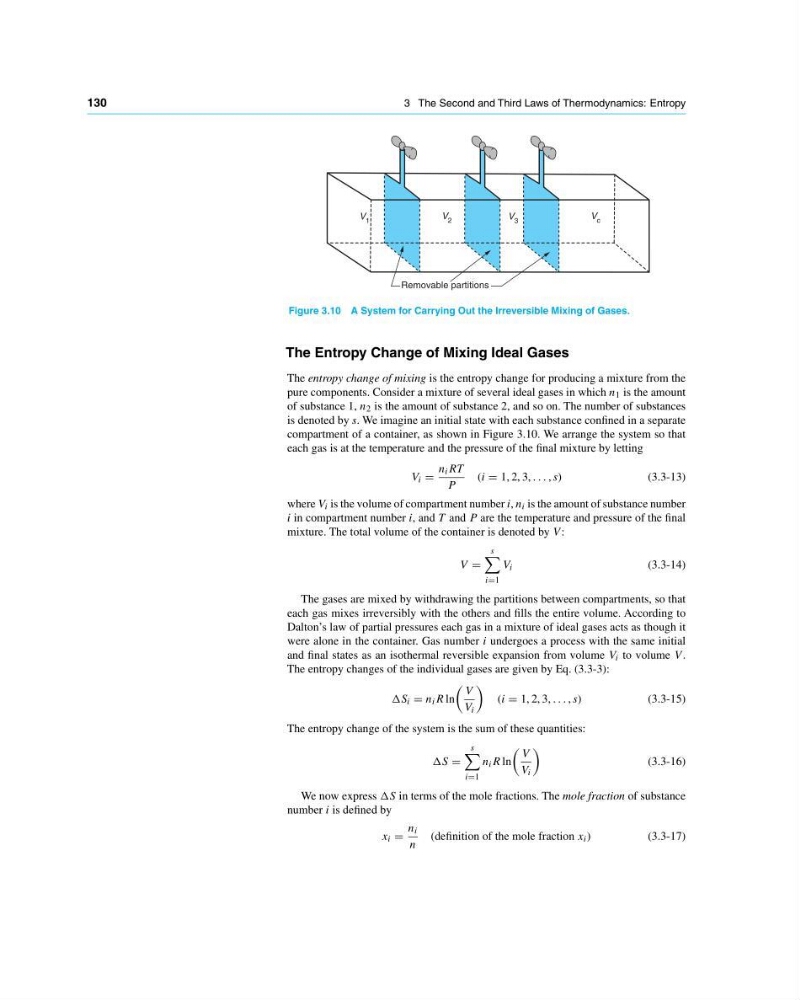
Figure 3.10 A System for Carrying Out the Irreversible Mixing of Gases.
The Entropy Change of Mixing Ideal Gases
The entropy change of mixing is the entropy change for producing a mixture from the
pure components. Consider a mixture of several ideal gases in which n 1 is the amount
of substance 1, n 2 is the amount of substance 2, and so on. The number of substances
is denoted by s. We imagine an initial state with each substance confined in a separate
compartment of a container, as shown in Figure 3.10. We arrange the system so that
each gas is at the temperature and the pressure of the final mixture by letting
V i
n i RT
P
(i 1, 2, 3, . . . , s)
(3.3-13)
where V i is the volume of compartment number i, n i is the amount of substance number
i in compartment number i, and T and P are the temperature and pressure of the final
mixture. The total volume of the container is denoted by V :
V
s
i1
V i
(3.3-14)
The gases are mixed by withdrawing the partitions between compartments, so that
each gas mixes irreversibly with the others and fills the entire volume. According to
Dalton’s law of partial pressures each gas in a mixture of ideal gases acts as though it
were alone in the container. Gas number i undergoes a process with the same initial
and final states as an isothermal reversible expansion from volume V i to volume V .
The entropy changes of the individual gases are given by Eq. (3.3-3):
∆S i n i R ln
V
V i
(i 1, 2, 3, . . . , s)
(3.3-15)
The entropy change of the system is the sum of these quantities:
∆S
s
i1
n i R ln
V
V i
(3.3-16)
We now express ∆S in terms of the mole fractions. The mole fraction of substance
number i is defined by
x i
n i
n
(definition of the mole fraction x i )
(3.3-17)
3 The Second and Third Laws of Thermodynamics: Entropy
Removable partitions
V 1
V 3
V c
V 2
Figure 3.10 A System for Carrying Out the Irreversible Mixing of Gases.
The Entropy Change of Mixing Ideal Gases
The entropy change of mixing is the entropy change for producing a mixture from the
pure components. Consider a mixture of several ideal gases in which n 1 is the amount
of substance 1, n 2 is the amount of substance 2, and so on. The number of substances
is denoted by s. We imagine an initial state with each substance confined in a separate
compartment of a container, as shown in Figure 3.10. We arrange the system so that
each gas is at the temperature and the pressure of the final mixture by letting
V i
n i RT
P
(i 1, 2, 3, . . . , s)
(3.3-13)
where V i is the volume of compartment number i, n i is the amount of substance number
i in compartment number i, and T and P are the temperature and pressure of the final
mixture. The total volume of the container is denoted by V :
V
s
i1
V i
(3.3-14)
The gases are mixed by withdrawing the partitions between compartments, so that
each gas mixes irreversibly with the others and fills the entire volume. According to
Dalton’s law of partial pressures each gas in a mixture of ideal gases acts as though it
were alone in the container. Gas number i undergoes a process with the same initial
and final states as an isothermal reversible expansion from volume V i to volume V .
The entropy changes of the individual gases are given by Eq. (3.3-3):
∆S i n i R ln
V
V i
(i 1, 2, 3, . . . , s)
(3.3-15)
The entropy change of the system is the sum of these quantities:
∆S
s
i1
n i R ln
V
V i
(3.3-16)
We now express ∆S in terms of the mole fractions. The mole fraction of substance
number i is defined by
x i
n i
n
(definition of the mole fraction x i )
(3.3-17)