

3.3 The Calculation of Entropy Changes
129
Massive
object at
temperature
T 1
Massive
object at
temperature
T 2
Thin
connecting
bar
Adiabatic
insulation
(b)
(a)
X
T
T 2
T 1
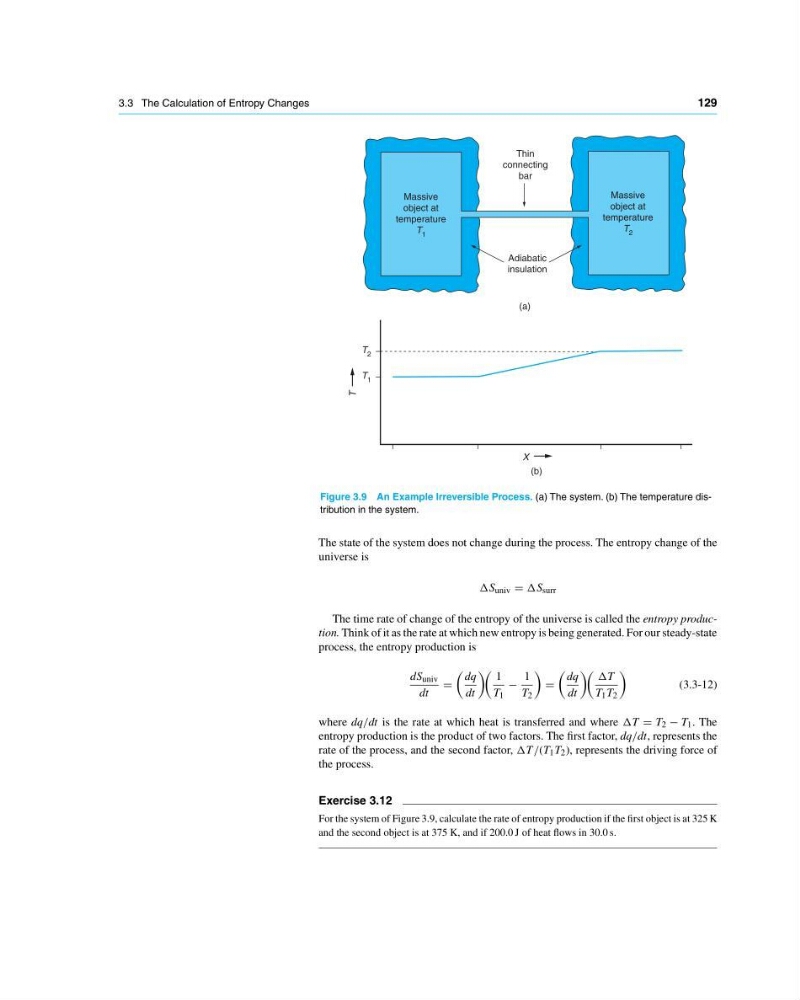
Figure 3.9 An Example Irreversible Process. (a) The system. (b) The temperature distribution in the system.
The state of the system does not change during the process. The entropy change of the
universe is
∆S univ ∆S surr
The time rate of change of the entropy of the universe is called the entropy production. Think of it as the rate at which new entropy is being generated. For our steady-state
process, the entropy production is
dS univ
dt
dq
dt
1
T 1
−
1
T 2
dq
dt
∆T
T 1 T 2
(3.3-12)
where dq/dt is the rate at which heat is transferred and where ∆T T 2 − T 1 . The
entropy production is the product of two factors. The first factor, dq/dt, represents the
rate of the process, and the second factor, ∆T /(T 1 T 2 ), represents the driving force of
the process.
Exercise 3.12
For the system of Figure 3.9, calculate the rate of entropy production if the first object is at 325 K
and the second object is at 375 K, and if 200.0 J of heat flows in 30.0 s.
129
Massive
object at
temperature
T 1
Massive
object at
temperature
T 2
Thin
connecting
bar
Adiabatic
insulation
(b)
(a)
X
T
T 2
T 1
Figure 3.9 An Example Irreversible Process. (a) The system. (b) The temperature distribution in the system.
The state of the system does not change during the process. The entropy change of the
universe is
∆S univ ∆S surr
The time rate of change of the entropy of the universe is called the entropy production. Think of it as the rate at which new entropy is being generated. For our steady-state
process, the entropy production is
dS univ
dt
dq
dt
1
T 1
−
1
T 2
dq
dt
∆T
T 1 T 2
(3.3-12)
where dq/dt is the rate at which heat is transferred and where ∆T T 2 − T 1 . The
entropy production is the product of two factors. The first factor, dq/dt, represents the
rate of the process, and the second factor, ∆T /(T 1 T 2 ), represents the driving force of
the process.
Exercise 3.12
For the system of Figure 3.9, calculate the rate of entropy production if the first object is at 325 K
and the second object is at 375 K, and if 200.0 J of heat flows in 30.0 s.