

of producer strain libraries. High-throughput
screening, with the help of appropriate cultivation facilities, fluorescence-activated cell sorting (FACS), or microfluidics, permits the rapid
screen of hundreds and thousands of strains to
identify best performing cells (Becker et al.
2004; Dietrich et al. 2010; Wang et al. 2014a).
High-throughput screening technologies have
the potential to substantially speed up metabolic engineering efforts and strain selection
in the next years (Schallmey et al. 2014).
V. S. cerevisiae as a Production
Platform for Fatty Acid Derivatives
Several biosynthetic pathways have recently
been engineered to produce a broad spectrum
of FA derivatives in various microbes. In this
part, we will give a brief overview of some
recently reported biosynthetic pathways in S.
cerevisiae to produce FA esters, fatty alcohols,
fatty aldehydes, and alkanes/alkenes as well as
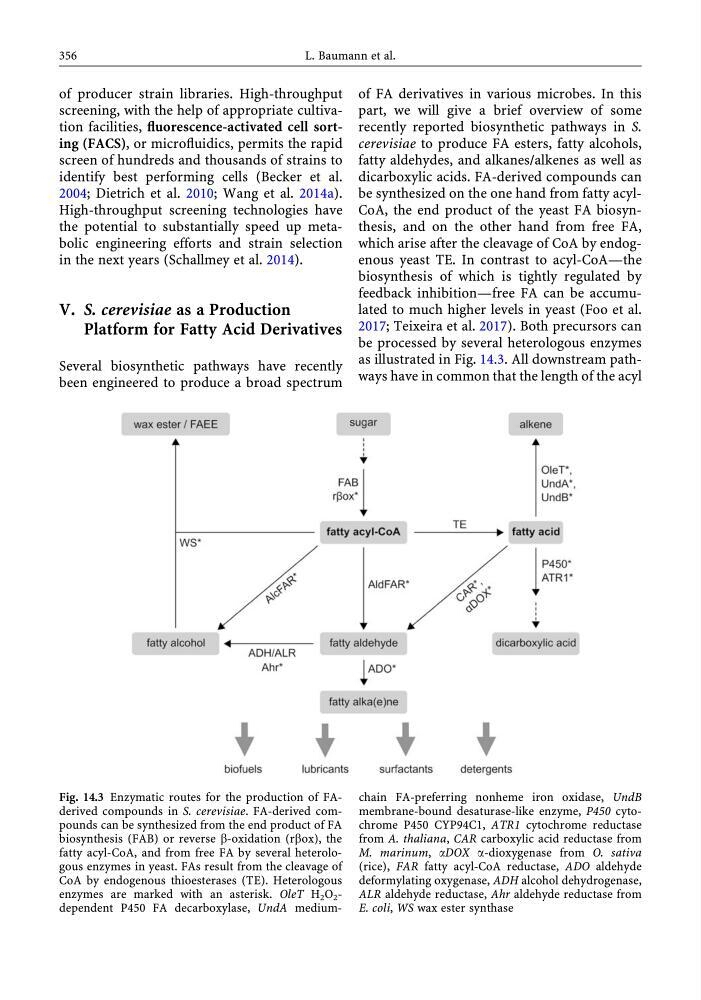
dicarboxylic acids. FA-derived compounds can
be synthesized on the one hand from fatty acylCoA, the end product of the yeast FA biosynthesis, and on the other hand from free FA,
which arise after the cleavage of CoA by endogenous yeast TE. In contrast to acyl-CoA—the
biosynthesis of which is tightly regulated by
feedback inhibition—free FA can be accumulated to much higher levels in yeast (Foo et al.
2017; Teixeira et al. 2017). Both precursors can
be processed by several heterologous enzymes
as illustrated in Fig. 14.3. All downstream pathways have in common that the length of the acyl
Fig. 14.3 Enzymatic routes for the production of FAderived compounds in S. cerevisiae. FA-derived compounds can be synthesized from the end product of FA
biosynthesis (FAB) or reverse b-oxidation (rbox), the
fatty acyl-CoA, and from free FA by several heterologous enzymes in yeast. FAs result from the cleavage of
CoA by endogenous thioesterases (TE). Heterologous
enzymes are marked with an asterisk. OleT H 2 O 2 -
dependent P450 FA decarboxylase, UndA mediumchain FA-preferring nonheme iron oxidase, UndB
membrane-bound desaturase-like enzyme, P450 cytochrome P450 CYP94C1, ATR1 cytochrome reductase
from A. thaliana, CAR carboxylic acid reductase from
M. marinum, aDOX a-dioxygenase from O. sativa
(rice), FAR fatty acyl-CoA reductase, ADO aldehyde
deformylating oxygenase, ADH alcohol dehydrogenase,
ALR aldehyde reductase, Ahr aldehyde reductase from
E. coli, WS wax ester synthase
356
L. Baumann et al.
screening, with the help of appropriate cultivation facilities, fluorescence-activated cell sorting (FACS), or microfluidics, permits the rapid
screen of hundreds and thousands of strains to
identify best performing cells (Becker et al.
2004; Dietrich et al. 2010; Wang et al. 2014a).
High-throughput screening technologies have
the potential to substantially speed up metabolic engineering efforts and strain selection
in the next years (Schallmey et al. 2014).
V. S. cerevisiae as a Production
Platform for Fatty Acid Derivatives
Several biosynthetic pathways have recently
been engineered to produce a broad spectrum
of FA derivatives in various microbes. In this
part, we will give a brief overview of some
recently reported biosynthetic pathways in S.
cerevisiae to produce FA esters, fatty alcohols,
fatty aldehydes, and alkanes/alkenes as well as
dicarboxylic acids. FA-derived compounds can
be synthesized on the one hand from fatty acylCoA, the end product of the yeast FA biosynthesis, and on the other hand from free FA,
which arise after the cleavage of CoA by endogenous yeast TE. In contrast to acyl-CoA—the
biosynthesis of which is tightly regulated by
feedback inhibition—free FA can be accumulated to much higher levels in yeast (Foo et al.
2017; Teixeira et al. 2017). Both precursors can
be processed by several heterologous enzymes
as illustrated in Fig. 14.3. All downstream pathways have in common that the length of the acyl
Fig. 14.3 Enzymatic routes for the production of FAderived compounds in S. cerevisiae. FA-derived compounds can be synthesized from the end product of FA
biosynthesis (FAB) or reverse b-oxidation (rbox), the
fatty acyl-CoA, and from free FA by several heterologous enzymes in yeast. FAs result from the cleavage of
CoA by endogenous thioesterases (TE). Heterologous
enzymes are marked with an asterisk. OleT H 2 O 2 -
dependent P450 FA decarboxylase, UndA mediumchain FA-preferring nonheme iron oxidase, UndB
membrane-bound desaturase-like enzyme, P450 cytochrome P450 CYP94C1, ATR1 cytochrome reductase
from A. thaliana, CAR carboxylic acid reductase from
M. marinum, aDOX a-dioxygenase from O. sativa
(rice), FAR fatty acyl-CoA reductase, ADO aldehyde
deformylating oxygenase, ADH alcohol dehydrogenase,
ALR aldehyde reductase, Ahr aldehyde reductase from
E. coli, WS wax ester synthase
356
L. Baumann et al.