

developments of yeast biotechnology, using
Saccharomyces cerevisiae and its sibling species, laid the basis for a broad development of
bioproductions based on a range of species,
mostly of ascomycete yeasts.
Besides its value for food industry, S. cerevisiae is still the dominant yeast for biotechnology applications. This is partly due to its
outstanding ability to produce ethanol, applied
to manufacture biofuel from corn and sugar
cane, and partly based on its traditional use as
a platform for metabolic and cell engineering,
e.g., as a host for production of recombinant
proteins or secondary metabolites. However, an
increasing variety of ascomycete and basidiomycete yeasts are nowadays also employed for
biotechnological production, such as Yarrowia
lipolytica, Kluyveromyces lactis, Pichia pastoris
(syn Komagataella spp.), and Xanthophyllomyces dendrorhous, to name a few prominent
examples. Although yeasts are defined as unicellular fungi, they vary significantly in their
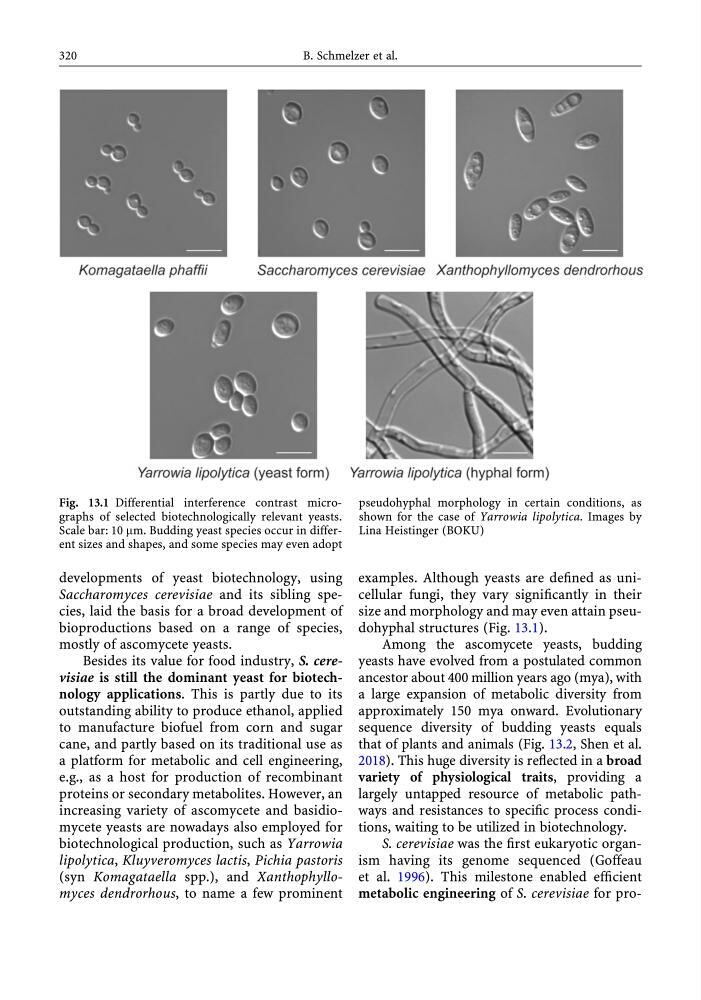
size and morphology and may even attain pseudohyphal structures (Fig. 13.1).
Among the ascomycete yeasts, budding
yeasts have evolved from a postulated common
ancestor about 400 million years ago (mya), with
a large expansion of metabolic diversity from
approximately 150 mya onward. Evolutionary
sequence diversity of budding yeasts equals
that of plants and animals (Fig. 13.2, Shen et al.
2018). This huge diversity is reflected in a broad
variety of physiological traits, providing a
largely untapped resource of metabolic pathways and resistances to specific process conditions, waiting to be utilized in biotechnology.
S. cerevisiae was the first eukaryotic organism having its genome sequenced (Goffeau
et al. 1996). This milestone enabled efficient
metabolic engineering of S. cerevisiae for proFig. 13.1 Differential interference contrast micrographs of selected biotechnologically relevant yeasts.
Scale bar: 10 mm. Budding yeast species occur in different sizes and shapes, and some species may even adopt
pseudohyphal morphology in certain conditions, as
shown for the case of Yarrowia lipolytica. Images by
Lina Heistinger (BOKU)
320
B. Schmelzer et al.
Saccharomyces cerevisiae and its sibling species, laid the basis for a broad development of
bioproductions based on a range of species,
mostly of ascomycete yeasts.
Besides its value for food industry, S. cerevisiae is still the dominant yeast for biotechnology applications. This is partly due to its
outstanding ability to produce ethanol, applied
to manufacture biofuel from corn and sugar
cane, and partly based on its traditional use as
a platform for metabolic and cell engineering,
e.g., as a host for production of recombinant
proteins or secondary metabolites. However, an
increasing variety of ascomycete and basidiomycete yeasts are nowadays also employed for
biotechnological production, such as Yarrowia
lipolytica, Kluyveromyces lactis, Pichia pastoris
(syn Komagataella spp.), and Xanthophyllomyces dendrorhous, to name a few prominent
examples. Although yeasts are defined as unicellular fungi, they vary significantly in their
size and morphology and may even attain pseudohyphal structures (Fig. 13.1).
Among the ascomycete yeasts, budding
yeasts have evolved from a postulated common
ancestor about 400 million years ago (mya), with
a large expansion of metabolic diversity from
approximately 150 mya onward. Evolutionary
sequence diversity of budding yeasts equals
that of plants and animals (Fig. 13.2, Shen et al.
2018). This huge diversity is reflected in a broad
variety of physiological traits, providing a
largely untapped resource of metabolic pathways and resistances to specific process conditions, waiting to be utilized in biotechnology.
S. cerevisiae was the first eukaryotic organism having its genome sequenced (Goffeau
et al. 1996). This milestone enabled efficient
metabolic engineering of S. cerevisiae for proFig. 13.1 Differential interference contrast micrographs of selected biotechnologically relevant yeasts.
Scale bar: 10 mm. Budding yeast species occur in different sizes and shapes, and some species may even adopt
pseudohyphal morphology in certain conditions, as
shown for the case of Yarrowia lipolytica. Images by
Lina Heistinger (BOKU)
320
B. Schmelzer et al.