

Below, we review strategies for assembling
gene-expression cassettes for heterologous
enzyme or pathway expression, along with
methods for introducing these into the fungal
host and the benefits of these methods. The
functional bio-blocks for fungal heterologous
gene expression are presented in Sect. III.
A. Construction of Simple Gene-Expression
Cassettes
In the simplest setups, heterologous production
depends on the expression of a single gene of
interest (GOI). In these cases, gene-expression
cassettes (GEC) can be constructed by fusing
the GOI bio-block to relevant components of a
basic set of bio-blocks that includes promoters,
terminators, and selectable markers (Fig. 10.1).
If necessary, this set can be expanded with
additional bio-blocks for specialized purposes
such as sequences encoding secretion signals,
epitope- and purification tags, fluorescent proteins etc., or bio-blocks that are designed to
target the expression cassette for integration
at a specific site in the genome by homologous
recombination. Since many individual bioblocks need to be combined in a single cloning
step, it is important that they can be joined with
high efficiency. Several reliable systems are
available for this task, e.g., In-Fusion assembly
(Zhu et al. 2007), Gibson assembly (Gibson
et al. 2009), USER fusion (Bitinaite et al.
2007), and Golden Gate cloning (Engler and
Marillonnet 2014). Often these systems are
directly compatible with accompanying vectors
dedicated to gene transfer into a desirable host
and the construction work commonly facilitated by ligation and propagation in Escherichia
coli. Alternatively, bio-blocks can be assembled
by in vivo homologous recombination using,
e.g., the yeast Saccharomyces cerevisiae as a
host (Finnigan and Thorner 2015).
B. Introducing Gene-Expression Cassettes into
Fungal Hosts
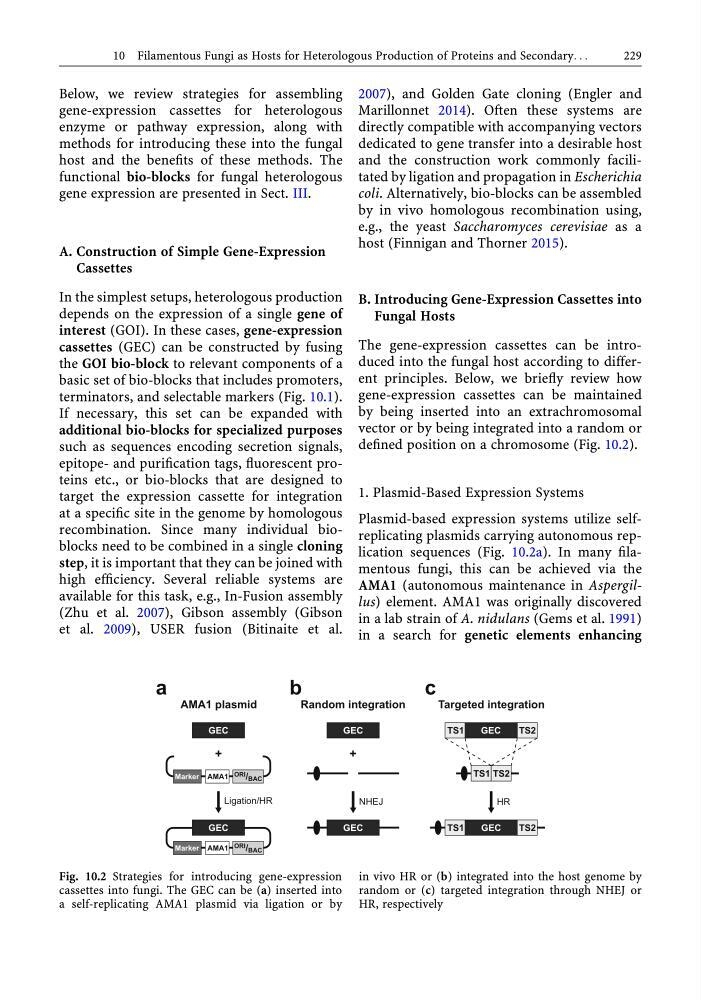
The gene-expression cassettes can be introduced into the fungal host according to different principles. Below, we briefly review how
gene-expression cassettes can be maintained
by being inserted into an extrachromosomal
vector or by being integrated into a random or
defined position on a chromosome (Fig. 10.2).
1. Plasmid-Based Expression Systems
Plasmid-based expression systems utilize selfreplicating plasmids carrying autonomous replication sequences (Fig. 10.2a). In many filamentous fungi, this can be achieved via the
AMA1 (autonomous maintenance in Aspergillus) element. AMA1 was originally discovered
in a lab strain of A. nidulans (Gems et al. 1991)
in a search for genetic elements enhancing
b
NHEJ
Random integration
GEC
+
c
Targeted integration
HR
a
Ligation/HR
AMA1 plasmid
AMA1
Marker
ORI / BAC
GEC
GEC
+
AMA1
Marker
ORI / BAC
GEC
GEC
1
S
T
2
S
T
GEC
TS2
TS1
1
S
T
2
S
T
Fig. 10.2 Strategies for introducing gene-expression
cassettes into fungi. The GEC can be (a) inserted into
a self-replicating AMA1 plasmid via ligation or by
in vivo HR or (b) integrated into the host genome by
random or (c) targeted integration through NHEJ or
HR, respectively
10 Filamentous Fungi as Hosts for Heterologous Production of Proteins and Secondary. . .
229
gene-expression cassettes for heterologous
enzyme or pathway expression, along with
methods for introducing these into the fungal
host and the benefits of these methods. The
functional bio-blocks for fungal heterologous
gene expression are presented in Sect. III.
A. Construction of Simple Gene-Expression
Cassettes
In the simplest setups, heterologous production
depends on the expression of a single gene of
interest (GOI). In these cases, gene-expression
cassettes (GEC) can be constructed by fusing
the GOI bio-block to relevant components of a
basic set of bio-blocks that includes promoters,
terminators, and selectable markers (Fig. 10.1).
If necessary, this set can be expanded with
additional bio-blocks for specialized purposes
such as sequences encoding secretion signals,
epitope- and purification tags, fluorescent proteins etc., or bio-blocks that are designed to
target the expression cassette for integration
at a specific site in the genome by homologous
recombination. Since many individual bioblocks need to be combined in a single cloning
step, it is important that they can be joined with
high efficiency. Several reliable systems are
available for this task, e.g., In-Fusion assembly
(Zhu et al. 2007), Gibson assembly (Gibson
et al. 2009), USER fusion (Bitinaite et al.
2007), and Golden Gate cloning (Engler and
Marillonnet 2014). Often these systems are
directly compatible with accompanying vectors
dedicated to gene transfer into a desirable host
and the construction work commonly facilitated by ligation and propagation in Escherichia
coli. Alternatively, bio-blocks can be assembled
by in vivo homologous recombination using,
e.g., the yeast Saccharomyces cerevisiae as a
host (Finnigan and Thorner 2015).
B. Introducing Gene-Expression Cassettes into
Fungal Hosts
The gene-expression cassettes can be introduced into the fungal host according to different principles. Below, we briefly review how
gene-expression cassettes can be maintained
by being inserted into an extrachromosomal
vector or by being integrated into a random or
defined position on a chromosome (Fig. 10.2).
1. Plasmid-Based Expression Systems
Plasmid-based expression systems utilize selfreplicating plasmids carrying autonomous replication sequences (Fig. 10.2a). In many filamentous fungi, this can be achieved via the
AMA1 (autonomous maintenance in Aspergillus) element. AMA1 was originally discovered
in a lab strain of A. nidulans (Gems et al. 1991)
in a search for genetic elements enhancing
b
NHEJ
Random integration
GEC
+
c
Targeted integration
HR
a
Ligation/HR
AMA1 plasmid
AMA1
Marker
ORI / BAC
GEC
GEC
+
AMA1
Marker
ORI / BAC
GEC
GEC
1
S
T
2
S
T
GEC
TS2
TS1
1
S
T
2
S
T
Fig. 10.2 Strategies for introducing gene-expression
cassettes into fungi. The GEC can be (a) inserted into
a self-replicating AMA1 plasmid via ligation or by
in vivo HR or (b) integrated into the host genome by
random or (c) targeted integration through NHEJ or
HR, respectively
10 Filamentous Fungi as Hosts for Heterologous Production of Proteins and Secondary. . .
229